“Jack Shindo has made it back alive from Mars. but his reappearance will raise more questions than it answers. He has a secret that cannot be shared. He can tell no one that he is Ultraman, a savior from the stars.”
Ultraman is a huge part of Japanese culture and pretty much has been since the original live-action show in 1966. Perhaps Godzilla started the ball rolling, but Ultraman brought us these monsters on a regular basis. In Japan, Ultraman is like our Superman. He’s an iconic hero and a huge part of the pop culture. Since the 60’s he has appeared in many forms, most of them animated. But it is this 1966 series that made a ton of us kids fall in love with him and an entire genre. Yes, there were many from the era: Space Giants featured a giant fighting robot who fought monsters and sometimes converted into a spaceship (yes, before transformers were ever thought of); Johnny Socko had his giant robot; and the list goes on. But it was Ultraman who started it. Eiji Tsuburaya, who created the original Godzilla, formed a new company outside of Toho Pictures. Ultraman was pretty much the first thing out of the new shop.
It started with a series called Ultra Q. It was a popular series in Japan. There was no Ultraman here, but some of the elements of what would be the Science Patrol started there. When it was finished, the staff was approached to create a new show, and fast. But this one needed more action and also something that could be sold to the American markets. That was Ultraman. In some form or another, the character has been around for over 60 years and is still plugging.
Ultraman was a space being who was chasing an escaped monster. When his spacecraft collided with that of Science Patrol Officer Hayata, he inadvertently killed the young man. To make up for his mistake and also offer Earth a way to fight the endless row of monsters unleashed, he merged his life with Hayata. Now, whenever a monster threatens, Hayata uses his “beta capsule” and morphs into Ultraman. Complete with martial arts moves and an array of ray weapons, Ultraman fights these creatures in hand-to-hand combat. The downside is that Ultraman’s solar energy diminishes rapidly in Earth’s atmosphere. As he weakens, a light on his chest flashes. A narrator reminds us each time that if it stops, Ultraman will die.
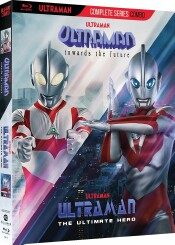
For the last couple of years we have been covering the many recent and more modern versions of Ultraman as Mill Creek and Alliance have partnered to get these shows out on Blu-ray for the fans young and old. This time they’ve reached back in the archives about halfway between then and now for two shows featuring the popular hero. Ultraman: Towards The Future and Ultraman: Ultimate Hero. Both of these shows go back to the 1990’s and the production values are going to drop a bit from the recent releases but that’s no problem because if you’re a fan you want this in your collection. These are also the first attempts to produce the show outside of Japan and market them more solidly toward a Western audience. They are natively in English with many non-Japanese actors. Both shows clock in at just 13 episodes.
Ultraman: Toward The Future (1990-1992)
This was the first time Ultraman was produced outside of Japan. The show was filmed in Australia and featured many Aussie cast and crew which included a young David Prowse as director. Prowse would go on to become a part of a huge sci-fi series produced Downunder. Of course, I’m talking about Farscape and you can already see the seeds of such a thing developing here.
The first men to land on Mars encounter a giant monster. Soon they encounter a giant silver and red man fighting the creature trying to give the humans a chance to escape and go home. Ultraman is too late to save one of the men who dies when his ship is destroyed. Jack Shindo (Kraus) will be stranded. Ultraman communes with Shindo and helps him return to Earth by combining forms with him. They get back to Earth just as a sentient virus also travels to Earth causing creatures to mutate into monsters. Instead of the earlier Science Patrol we now have UMA lead by Arthur Grant (Cotterill) who appears to have financed the advanced weapons and technology. There’s Jean Echo, played by Gia Carides who is the actor to be the best known later for movies like My Big Fat Greek Wedding and shows like Big Little Lies and Without A Trace. She was Shindo’s love interest and she’s shaken at his apparent loss but becomes close to him once he’s returned. She’ll eventually figure out he’s Ultraman. Charles Morgan is a civilian and the requisite wise guy. He’s played by Lloyd Morris. Lloyd Wilder (Adams) is the muscle man on the show. The score sounds a lot like John Williams memorable score on the 1978 Superman.
Unfortunately, the show was shot on video and the production values here are pretty bad. It’s a shame because having the show in the Outback gives it its own unique spin and a rather fresh look at the character. The show also gets quite heavy-handed with environmental messages. Almost every creature is really just upset that the environment is getting messed up and while a fine message the show leans to the point of being a bit of a bully.
Ultraman: Ultimate Hero (1993)
This series was produced in The United States and has quite a good production design particularly for its day. The image is clear and the f/x work appears decades ahead of the previous show instead of just a year. Unfortunately, the series relied on remaking episodes from the 1966 show and while it’s endearing to revisit the early monsters and villains it would have been nice to have a more original arc.
This time it’s Kane Kosugi as Kenishi Kai who becomes Superman and the beta capsule is back. This time it’s an American organization called WINR, pronounced Winner that fights the monsters along with Ultraman. The Baltans, complete with that echo laugh are back and leading the monster parade against Earth. They even have the old Science Patrol pin from the 1966 series. The best part of this show is that it had production design ahead of its time. The suits were a bit inferior to other shows. This was also true on the previous series. There isn’t as much grappling with the monsters because the suits were coming apart and could not hold up to a lot of contact between Ultraman and the creatures.
While the series was made in the United States it could not find a distribution partner and would never be seen on American television. It ended up being a home video launch and the quality of those tapes were pretty bad. Now you get the series in HD where you will be able to appreciate the image presentation like you’ve never had the chance before.
You get both shows on two Blu-ray discs each. Again there just aren’t any features but this is intended for the collector, really. Ultraman would return many times and with modern technology but he would always remain the man in the suit. So far they have resisted the urge to use CGI to create monsters and hero. I hope that stays that way for a long time. “The future of humanity might just depend on it”.