


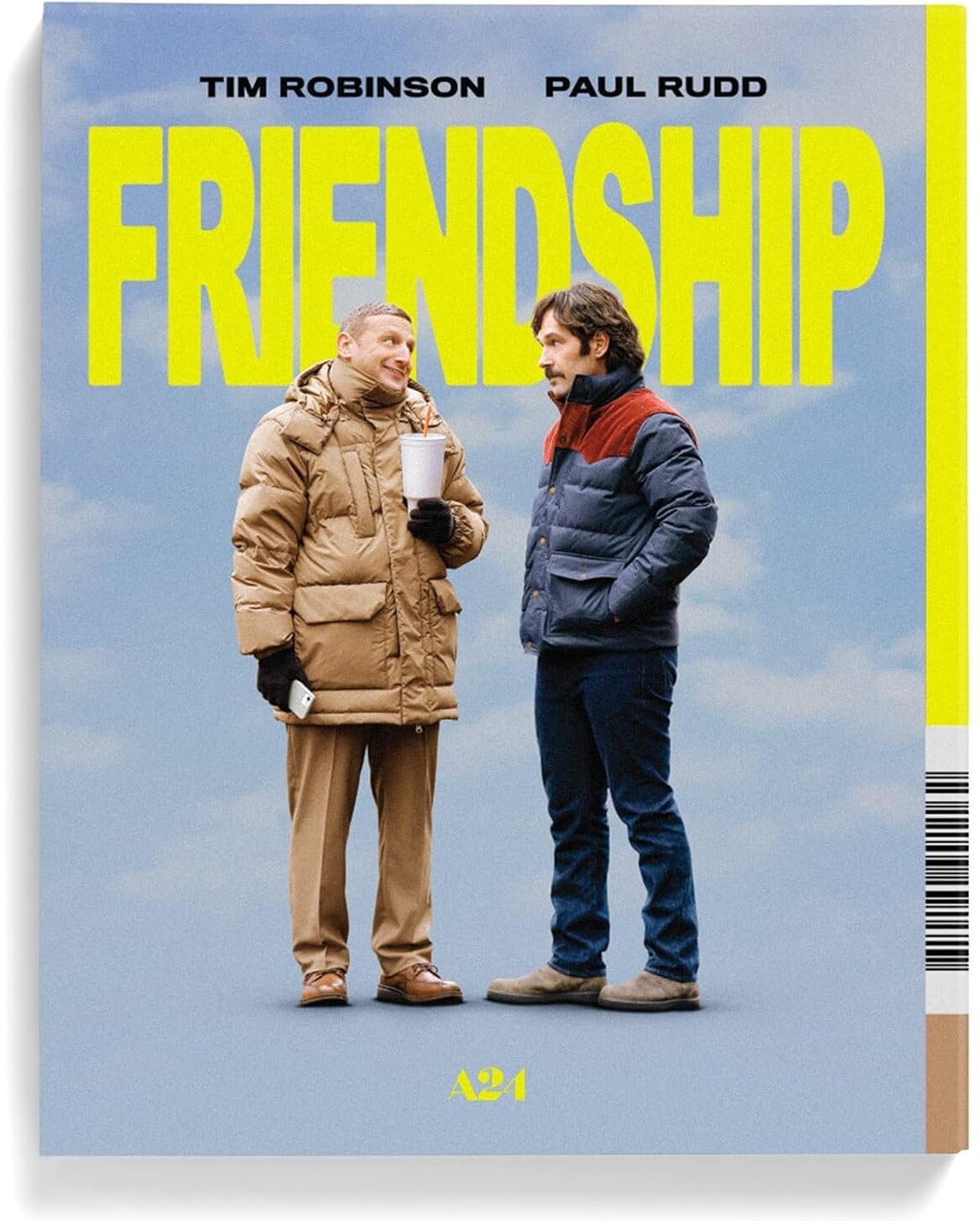

“I can see the future. It’s full of pals helping pals, and being a boss. I’m on the edge of life, and the view is gorgeous.”
Andrew DeYoung has actually been around for quite a little while. He’s been directing television episodes a short features since around 2008. And so into every working director a feature film must eventually fall. For Andrew DeYoung it turns out to be the self-written feature film for A24, Friendship. He took a pretty safe route, choosing to work with an actor who has shown a pretty similar shade of dark comedy as Tim Robinson, who plays the lead and very tragic figure. If you’ve seen episodes of The Office, there’s a lot of that kind of humor here. Of course it goes off the rails quite beyond anything you might have seen from the show or Tim Robinson. It’s a bit of an experimental film, and while it’s listed as a comedy, I’m not sure it really fits into that domain. I think the film’s uniqueness works both for and against the film. It’s not the kind of thing that is going to bring in tons at the box office, streaming platform, or home video market, but on the other hand it’s one of the most truly original films I’ve seen in ages, and I have a little bit of a soft spot when someone can show me something new and experimental without being so “out there” that it leaves you scratching your head. You won’t have any trouble understanding what’s going on here, and while it might get a laugh or two out of you, it will certainly give you something to think about. It’s a dark film at its core, and you have to be willing to take that kind of a ride to enjoy Friendship. If you’re coming into this to laugh yourself silly, this one might disappoint.
Craig Waterman, played by Tim Robinson, is an obvious outsider in his own life. His wife Tami, played by Kate Mara, is a recent cancer survivor running a florist business from their home, but she feels completely ignored by Craig. It’s bad enough that she openly ponders whether she should go out on a date with her ex-boyfriend. Craig’s rather bland reaction sums up the whole relationship. They have a son who isn’t a fan of dad’s, either. He works as a marketing developer hired basically to get people “addicted to a product”. No one at work pays much attention, and he is pretty much outside looking in on his own life.
All of that changes with a postal carrier’s mistake. It’s apparent that that happens all the time in this neighborhood. I get that; we once had one of those carriers as well. Austin Carmichael, played by Paul Rudd, has just moved into the neighborhood when he receives a package meant for Craig. He’s the overnight weather man on a local television station hoping to get on the morning shift. He decides to take the package to his neighbor, and that might have been a big mistake. Craig finds him interesting and is overjoyed to be invited to hang with him. Suddenly Craig feels alive and has Walter-Mitty-like fantasies of the two of them as best buds. But he goes too far during a hangout with Austin’s friends, and a play-boxing game turns badly. Craig gets shut out, and things take a turn for the worse. Think of Fatal Attraction without the sex and the bunny stew.
At first Craig tries to compensate by trying to finally show an interest in his wife and son. It’s a bit too late for that. He takes up smoking to hang with a group from work, but that also doesn’t really work out, so he becomes a kind of stalker, stepping more and more over some serious lines. They have a lot of fun with Paul Rudd’s Antman character. While the character is never mentioned, Craig is obsessed with what he calls the Marvel film. So remember that the next time you catch a Marvel film. The guy sitting right next to you just might be another Craig.
The entire film really hangs on Tim Robinson’s performance. Paul Rudd has to carry some weight as well, but Robinson has a tough task here. We watch him do some really disturbing things, but somehow Robinson forces us to have some kind of sympathy for the guy. The worse it gets, the deeper he draws us into caring for a guy who in real life would make us run for the hills. The supporting cast play a huge part in this as well. There’s really no one in this film who is a good guy. Austin is an obviously self-centered jerk, and his wife? You saw where I told you she openly ponders sleeping with an ex-boyfriend, right? Everyone in this film is disturbed, but the one we feel the most empathy for is the most disturbed in the bunch. How the heck does that happen?
It happens because DeYoung, while filming only his first feature film, knows how to write the circumstances, pick the right actors, and basically stay out of their way. Usually we’re won over by characters we’d like to hang out with in our real lives, but you wouldn’t want to hang out with any of these guys. But you’ll find yourself compelled to watch this train wreck get worse and worse. It also helps that Robinson and Rudd share a kind of quirky chemistry that just works on so many levels.
You get a couple of deleted/extended scenes and a Q&A here with DeYoung and the stars. They’re in a dark room shot with infrared. There is a collection of cards with film stills much like the old lobby cards of box offices gone by.
There’s a lot of nuance here, and I suspect this is one of those films where you won’t get it all the first time around. I’ll watch it again down the road and feel certain I’ll catch stuff I didn’t the first time. That makes a film rewatchable, and that’s the kind of movie you want on your video shelf. I’ve got tons of discs that I keep but suspect I’ll never watch again. This one I’ll watch again. “It isn’t about how you play. It’s about how persistent you are.”
