



“My dad used to say, wherever you go, there you are. I guess he was right. No matter how hard you try, or in my case, how far you go, you can’t leave it all behind. There is no such thing as a clean slate. They’re always there. They’re always with you, the stories you’ve told. Hell, even worse, the ones you never could. This is a story I never tell.”
Mark Harmon as Gibbs was the soul of the NCIS franchise. When he finally called it quits after nearly 20 years, I have to admit I wasn’t sure how much longer the show could go on. I mean, there has to be a reason for this kind of longevity. All of the spin-offs have now come and gone. NCIS: Hawaii has now ended. NCIS: New Orleans shuttered its doors years ago after a mere seven years. The longest-running of the spin-offs was L.A., but even they have gone now after only 10 years. I say only 10 years. For most shows a 10-year run is rarefied air. So how about 21 years? Only Dick Wolf’s Law & Order franchise has accomplished more. Yes, Harmon might have been the franchise’s soul, but the show managed to find its footing without him. Of course, Mark Harmon has remained involved in the franchise as a producer, but it looked like we would be going on without Gibbs. At least that’s what everyone thought.
There’s been a little bit of a trend these days, and it started with a show called Young Sheldon. Writers took a popular and quirky sitcom character and decided to tell the story of his youth. It was a big risk. Everyone knew the version of Sheldon played by Jim Parsons, and now we’re going to recast a much younger actor and tell you how Sheldon got to be Sheldon. It worked well, partly because they got Parsons to narrate the story, and the kid did a spot-on version of the character. More recently the Dexter franchise was brought back with Dexter: Original Sin. Once again we’re going to take a well-known character and tell you how he got to be who and what he was. Again, Michael C. Hall had created something special. Patrick Gibson wasn’t near as spot-on as Dexter, but in a short while we bought it and went along for the ride. Now NCIS is trying to pull off the same stunt with NCIS: Origins. Here we’re going to see the story of a young Gibbs and his start as an agent. The problem here is that has hard as he might try and as compelling a character as he created, Austin Stowell doesn’t even slightly remind me of Mark Harmon’s Agent Gibbs, and that’s a problem … but only a small one.
“When you come back from killing the man who killed your family, the uniform doesn’t fit the same. You wish it did. But it doesn’t.”
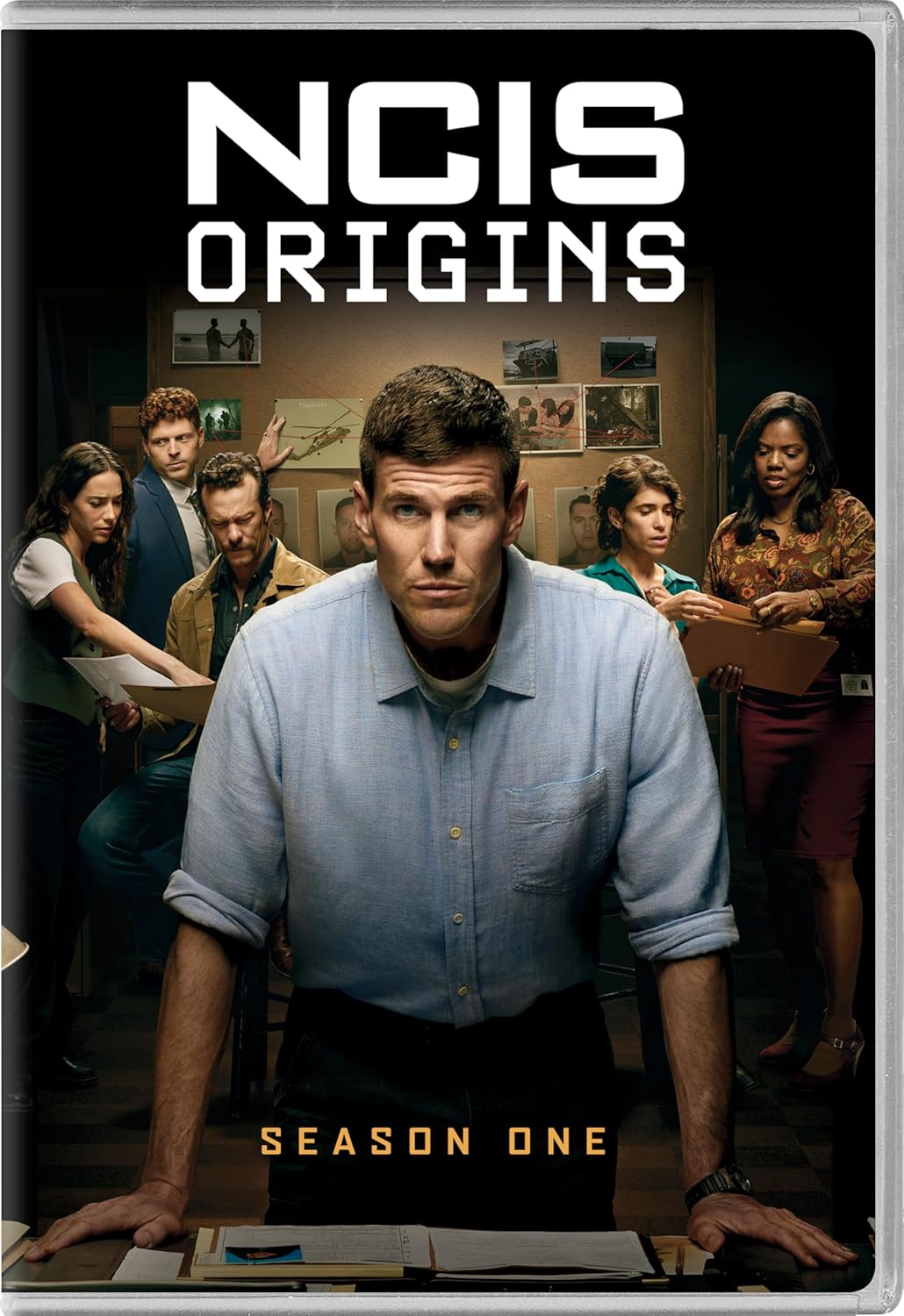
The series begins just as Gibbs is returning from combat where he was seriously injured. That injury might have been part of a death wish, because this is Leroy Gibbs just after his wife and daughter were murdered. It’s a good place to start. Fans of the franchise know this was a life-changing moment for Gibbs, and it has been referenced throughout his nearly 20-year run on NCIS. So this is where it all starts. Gibbs takes a flophouse room because he can’t stand to pack up or live in the house where he lived with his wife and daughter. He’s at a low point when a friend Mike Franks, played by Kyle Schmid, offers him a lifeline. Even though Gibbs failed his psych evaluation, he recruits him to become a federal agent in the NIS, which was the precursor to NCIS. He knows he’s not only getting Gibbs, but all of the baggage he’s still carrying around. It’s not necessarily a smart move, but it happens, and we now see Gibbs as the “probie” of the team. Just as in the other three examples, Harmon narrates these voyages into his past life. It’s good to hear him again, but here’s what you have to do from episode one. As hard as it might be, you have to forget that this is Gibbs. If you don’t, the show just isn’t going to work for you, because this just ain’t Gibbs no matter how hard everyone tries. If you can do that, it’s actually a pretty good show. I just like to think of it as a new spin-off, but instead of a different place it’s a different time. So let’s pretend we’re watching NCIS: 1991. Everyone OK with my change of title? OK. Here we go into the past with a character who is coincidentally also named Gibbs. Yeah, that happens, right?
We’re in 1991, so there’s more different than just the name. The team works out of the San Diego Naval Yard in what passes for a bunker. I’m told that Mark Harmon actually has one of these things in his back yard. So Gibbs is the new guy. He’s driven to find the man who killed his family, and when he does, there will be consequences, and those consequences drive the story arc for this first season. If you have watched the original show, you know how all of that happens. I won’t spoil it for you here.
So meet the new team. Mike Franks is a fireball. You met him as his older self in the original show. He might be Gibbs’ best friend outside of Farnell (Spano). I’m disappointed we have not yet met the young Farnell. Anyway. Franks is the kind of guy who doesn’t go around, over, or under whatever is in his way. He just plows straight through. Officer Mary Jo Sullivan, played by Tyla Abercrumbie, is the team’s mother hen. She’s out there running interference and trying to protect the flock. It doesn’t always work, but she’s the maternal presence next to Frank’s paternal position. Special Agent Lala, played by Mariel Molino, is the emotional center of the group. She’s the passionate one who cares, sometimes too much, about everyone else. Special Agent Bernard Randolph, Randy, is played by Caleb Foote, and he’s the young guy with a wife and son who carries those worries with him. Cliff Wheeler, played by Patrick Fischler, is in charge of the group. Yeah, he’s the desk jockey. Kowalsky, is played by Michael Harney, who you might remember as Mike Roberts from NYPD Blue. He runs the evidence room and is a former priest. We learn the evidence room has become his new sacristy when it’s violated after someone breaks in and tears it apart. It almost breaks the man, so this is more than his job. He takes a guy who did not do well in the field, played by Daniel Bellomy. Finally we have Special Agent Vera Strickland, played by Diany Rodriguez. She’s conflicted about her place in the team and is working to bring a profiler program into the unit. She fights red tape and money, and her work with a serial killer named The Sandman is one of the season’s larger threads.
You can expect the same kind of cases and storytelling you always get from the franchise. The era gives us a fresh perspective. The unit gets their first computer, and it’s a huge old CRT unit, and there’s only enough cash for one. They use a Polaroid for a camera. There isn’t any digital stuff here, and they still use VHS camcorders. When you change the era, you get to play in a field much more alien than just another office somewhere else in the world, so as much as I’m not buying the Gibbs connection, I did enjoy the freshness of it all. This really isn’t Gibbs’ story, anyway, because we see things he was not present to see. So he’s just a part of the story, and it stays in the background enough for me to enjoy this as really another NCIS series set in a different time and place, and that works OK enough for me.
You get all 19 episodes on four discs, and the last disc gives us the standard 20 minute season wrap-up, another feature on the unique production design, and a gag reel. There may be some other things you might want in the release, but honestly, “I can’t think of anything.”
