



“It takes a heavy sack to sign up for this contest. I’m not gonna go through the whole rule book, but it boils down to this. If you fall below the speed of three miles per hour, you get your ticket. Walk until there’s only one of you left.”
Stephen King has been America’s most renowned writer for about 50 years. That’s a long time to stay on top. He does it by giving audiences something they want but are not always willing to admit that they want. Of course, he’s the master of horror, but he doesn’t always write specifically about horror. The reason King is able to scare us so well is because he understands the human condition. He has an innate ability to touch our emotions. The truth is that the best of his film adaptations have tended to be the films less related to horror. The Shawshank Redemption remains the best Stephen King film ever made. He returns to the subject of prisons and punishment in The Green Mile. Stand By Me, based on his story The Body, isn’t really a horror story at all. It’s a coming-of-age story. Still, when we thing of King, we think of horror, and that is part of the reason that several decades ago he decided to write a few stories under the pen name Richard Bachman. I’m not sure we were fooled for very long, and when I got the four-story Richard Bachman collection, I already knew who had written them. I’m not sure if it made a difference, but The Long Walk remains to this day my favorite King tale, and I’ve read it many times more than any of the other stories he’s written.
“You walk as long as you can. But sometimes the body won’t listen. For some, your heart will stop. For others, your brain. And the blood will flow … suddenly. There’s one winner and no finish line.”
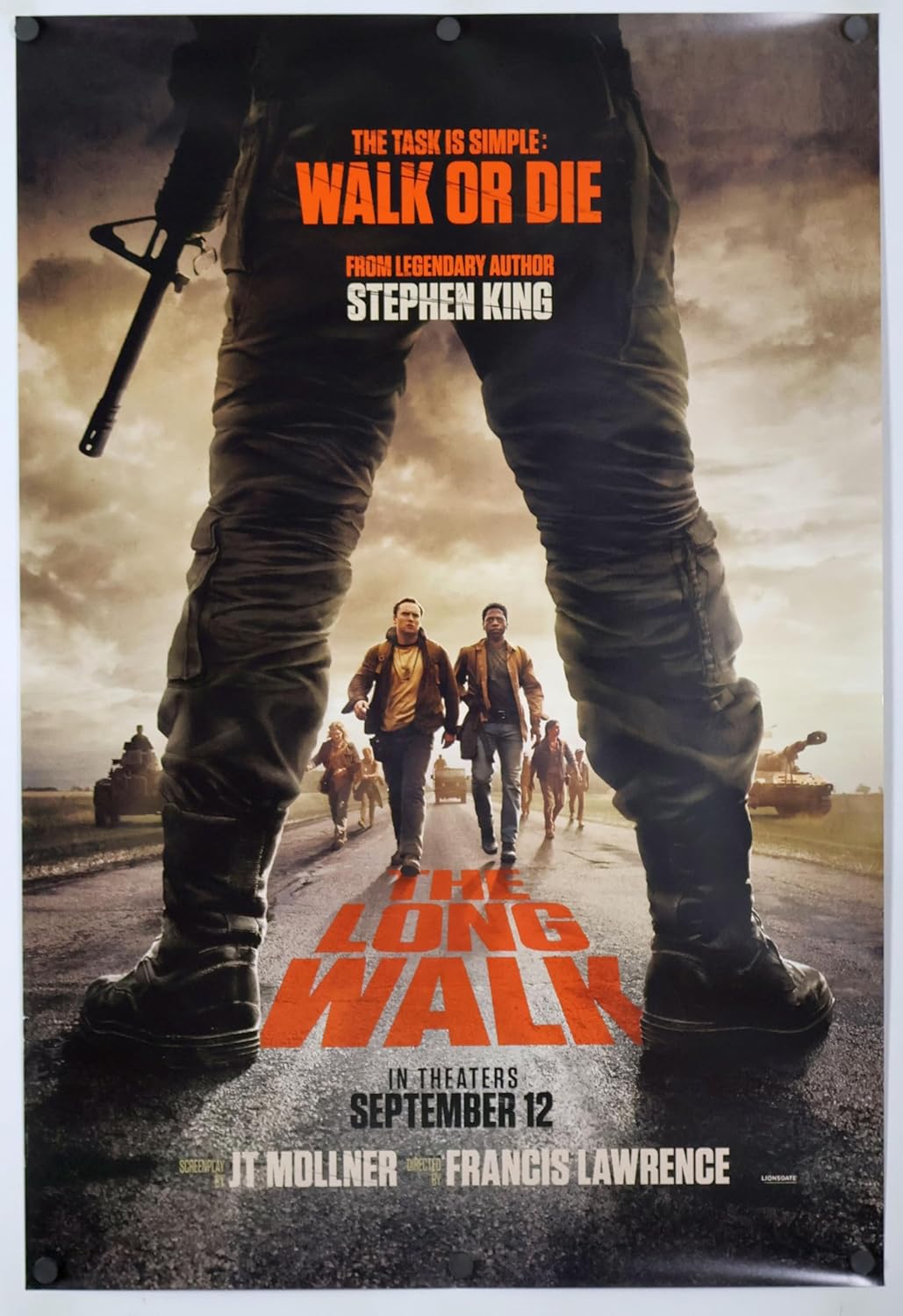
The story is so simple it’s insane. America has reached that dystopian future we’ve seen so many times before. As in The Hunger Games, the powers that be have found a way to distract the populus from their dreary lives and authoritarian oppression. Each year one teen boy from each state is selected by lottery from a pool of volunteers to participate in the Long Walk. The rules are simple. All 50 walk for as far as they can, keeping a pace of at least 3mph (4mph in the book). You get three warnings, and then you get your ticket, which is a nice way of saying a bullet in the brain. As in the book, the raw feelings of the walk are what makes this work. We’ve all walked, and we’ve all likely had a time in our lives where we pushed ourselves to the limit. It’s an experience all of us have had, and King understands that like no one else. Throw in the mortal danger and the fact that the last boy standing gets a “super” wish and all the riches he can imagine, and you have an intense situation that doesn’t rely on jump scares or a monster in the shadows.
The “Monster” is Mark Hamill as the Major. He delivers all the flowery speeches of glory and guts. Even when the boys rebel a bit, he turns it back on them by telling them, “That’s the spirit!” He’s the authoritarian behind the authoritarian, and Hamill plays it quite well. We never see his face. He wears huge sunglasses and a cap that casts a shadow over what you might see. It’s his voice that does the job. Remember this is the guy who has voiced the Joker more than any other actor has. But he can’t carry the movie. He’s the antagonist for sure, but he isn’t what makes the film compelling.
The actors are all of them great here. Cooper Hoffman plays Raymond. He’s the typical small-town kid and the local entry in the walk. The film starts with his mother driving him to the start of the race. Next we have David Jonsson as Peter. The two form an unlikely friendship, and that’s one of the huge emotional beats of the film. They talk about how a friendship can be real even if it only lasts a couple of days, and it’s a theme that resonates throughout the film. The rest of the kids play both good and bad guys. In the book much more is made of some of the nasty banter. Here we get a hint of it, but the focus stays on the friendship. We know it can’t end well. We know one of them’s going to get his ticket. Director Francis Lawrence understands that all he really has to do is set the pieces in motion and pretty much just stay out of the way. He doesn’t attempt to overcook it with distractions meant for cheap points. It would only have destroyed any hope the film had of being so compelling, and it is.
For too many years this was an impossible story to bring to the screen. It didn’t have to do with f/x catching up or 1500 words having to be crammed into a two-hour movie. It has to do with the content. For a long time I don’t think you could make a mainstream film that depicts young boys getting shot graphically in the back of the head because they fell below a certain speed for more than 30 seconds. Many people credit The Hunger Games for smoothing the way, but I don’t think it did at all. Firstly, The Hunger Games had children fighting children, and the actual battle wasn’t the entire run of the film. In The Long Walk these are military people popping the heads off young boys, and it’s not just a part of the movie. It’s the entire movie. The only way this was ever going to work was to do it right. Use those harsh realities and moments and build on them. You have to make these characters real, and some likable, as King did in print. Otherwise it’s just blatant violence for no other reason but violence. That’s not what this is. Still, it’s not at all for the squeamish. And it’s no surprise that The Hunger Games‘ director helmed this film. It really was right in his wheelhouse.
There are many changes from the book. One change was obviously made to limit the voices we hear, and for a film that’s OK with me. The ending ruins it for me and keeps this film from being the flawless classic it comes so close to becoming. Lawrence got in the way. The writer got in the way, and the film loses so much with just one small flaw. King wrote this earlier in his career. Some say it was his first story, but it wasn’t. At 11 years old he sent an 11-page story to Forry Ackerman, the monster fan and editor of Famous Monsters Of Filmland magazine. I got the chance to befriend Forry in the last decade of his life, and he showed me the handwritten story the young King had sent. Forry knew there was something special about this kid, and he kept the story all that time. A Halloween doesn’t go by that I don’t miss Forry, but he was King’s first audience. I think Forry also would have loved this film if not for the ending. It’s still worth your time and should make some noise at awards season. I think Lawrence understood he needed to stay out of the way, and for 98% of the movie, he does. “But sometimes the body just won’t listen.”
