



“The following is based on true events. The events depicted were transcribed by Father Joseph Steiger. The story represents the most thoroughly documented case of demonic possession in American history.”
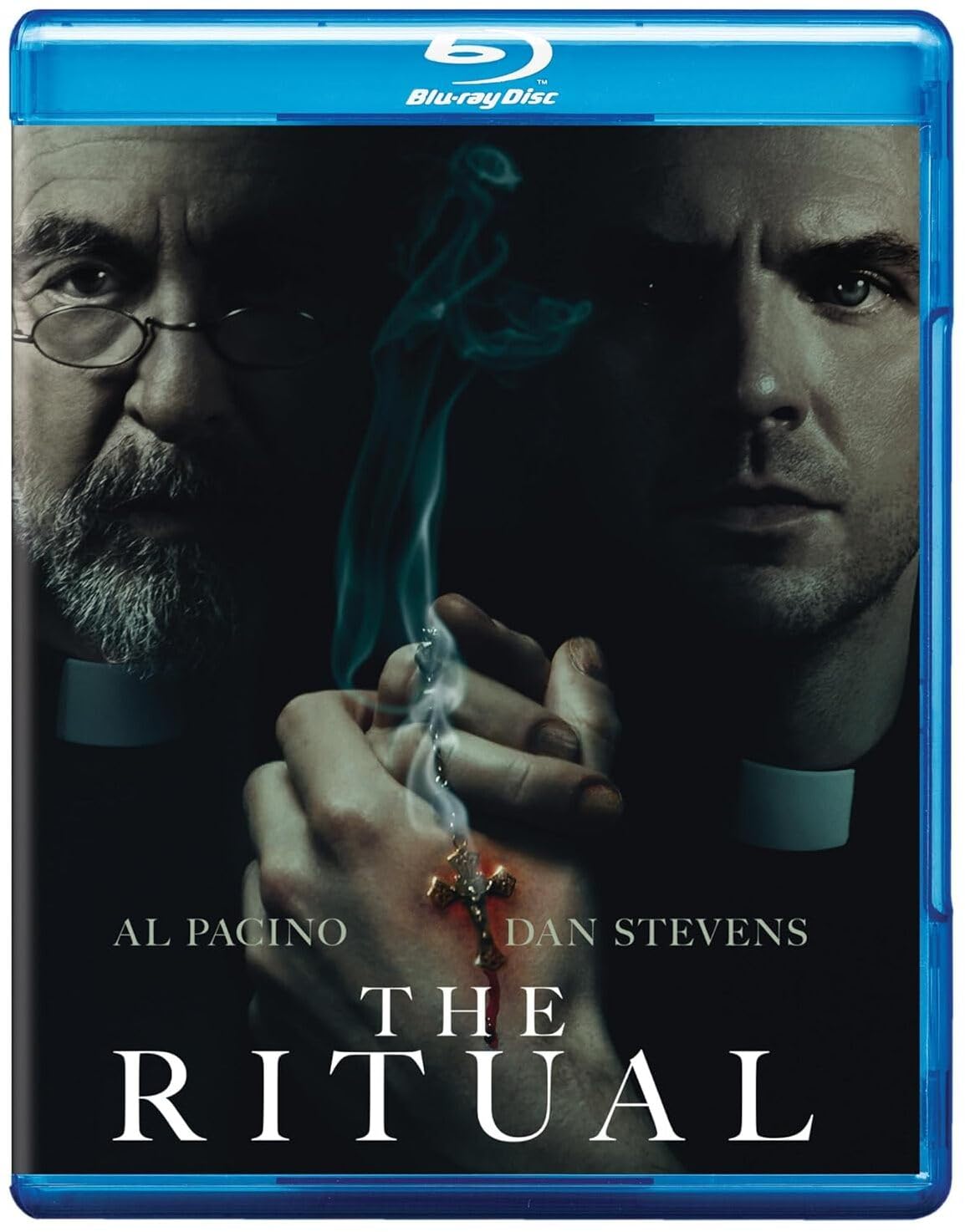
Of course, the exorcism that we’re all talking about is the same event that The Exorcist was based upon. I don’t know what possesses filmmakers to keep chasing that lightning in a bottle, but I doubt it will ever be done. And I think that is something I like about The Ritual, directed by David Midell and starring Al Pacino and Dan Stevens. It’s not trying to be The Exorcist. Instead they are trying to do something more faithful to the original story, and I think that is one of several elements which led me to appreciate this film more than I have much of any horror out in the last handful of years. The devil’s back in town, and Michael Corleone is going to make him an offer he can’t refuse. I’m going to do the same to you out there. Check out The Ritual now out on Blu-ray… and I’m going to give you my reasons.
“The problem is not psychological. 99 out of 100 times someone contacts the Church, they are assessed, referred to medical doctors, and an exorcism would do nothing for them. This is not that.”
Father Joseph Steiger (Stevens) is the pastor of a small rural parish in Iowa in 1928. He has suffered a recent loss, much as Father Damian did on The Exorcist. This time it’s a brother, and like Father Damian, he is facing somewhat of a crisis of faith. He lives a very simple life among the order of nuns that serve the parish led by Mother Superior, played by Patricia Heaton. That simple life is about to be invaded. The Bishop (Fabian) arrives with a very unusual request. There has been a woman believed to be possessed by a demon or demons. The Bishop has chosen this out-of-the-way church as the venue for the exorcism. Steiger is none too happy about the whole thing, but it’s the bishop. Remember those offers you can’t refuse? This is the first of many in this film. Steiger will only be a helper and chronicler of the event. The hands-on work will be handled by a priest with experience in the practice. That’s Father Theophilus Riesinger (Pacino). Of course everyone from Steiger himself to Mother Superior doubts this is an authentic possession, but they all have their orders.
“Emma is not well. I’m sure that’s quite apparent. She’s dehydrated, malnourished, tormented. She suffers on levels that we ourselves cannot possibly fathom. I know this is all unusual, this aspect of our calling. It will be like entering a foreign land to you. So please, I ask you. Follow my instructions to the word, and expect the unexpected spiritually, emotionally, physically, though you may be new to the ways of the enemy. The enemy’s ways are not new. They are ancient.”
Enter Father Riesinger. He’s an old, frail priest who gives brisk instructions about what to do with Emma (Cowen). Riesinger wants her restrained, but no one is willing to do that. It takes some injuries to the staff before everyone starts to get on the boss’s program. The film plays out over a series of nightly rituals that are a kind of 10-step program for demon possession. Each night it gets worse and more dangerous for those involved. Riesinger starts to get pushback from Mother Superior and Fr. Steiger.
“It is important that we work in unison. The enemy will lie. He will draw us into sin. He will do everything he can to sow discord among us. We are the Lord’s army in this battle. We are together by His design to save one of our children, and to do that we must not see each other as strangers. For us to be divided is for us to fall.”
This is a much more intimate film than most in the genre, and I believe that gives it an advantage. Midell doesn’t try to outdo the others; he goes for the atmosphere and isolates his cast and the task before them. He also knows that he’s got a good cast here, and he gets out of the way, something more filmmakers need to know how to do. Pacino has been on the other side of this bargain when he played Satan himself in The Devil’s Advocate. He delivers one of his best signature speeches in that one. Now he’s working for the other side, and while the action might get intense and hostile, Pacino actually gives us a very toned-down performance. He’s used the “quiet” shout over the course of his career to overcome a speech issue he’s had all of his life, but Pacino is calm in the face of chaos here. He even shows up for the extras, which he almost never does. I’m not sure if this started as just another paycheck, but he didn’t phone this one in. It’s likely the most subtle performance the iconic actor has given.
Dan Stevens provides the opposite side of the spectrum here. Stevens’ character is a guy who has already questioned his beliefs, and now he’s faced with something he can’t process. He feels the pressure to protect his parish nuns, and it’s his job to write all of this down for posterity. Stevens isn’t new to the horror genre. His first two roles were in a Dracula and then a Frankenstein television project. Since then he’s been more the ordinary guy, and it works well here. Heaton is underused, but I get it. You’ve got such a powerful dynamic going on here; how do you push your way to the front of that line?
Finally I loved Abigail Cowen as Emma. She’s not going to come close to matching Linda Blair and her performance, so she goes the more subtle build-up-as-you-go plan, and she can be quite terrifying before it’s all over. You get the feeling you went through an ordeal with these folks. True life is never as good as making it up, and we already got the best of that world back in 1973. This one tries to stick to what Jack Webb would have called the facts and nothing but the facts. That doesn’t mean it won’t scare the devil out of you.
The film was shot in an actual small remote cathedral where the atmosphere isn’t anything you could buy. There’s an authenticity here because it is real, and I’m certain added to the quality of the performances. You get few extras here. There’s a 10-minute making-of feature and a few very short features all under two minutes. Midell did not set out to remake/reboot or retool The Exorcist. “Some other poor fool already has that distinction.”
