

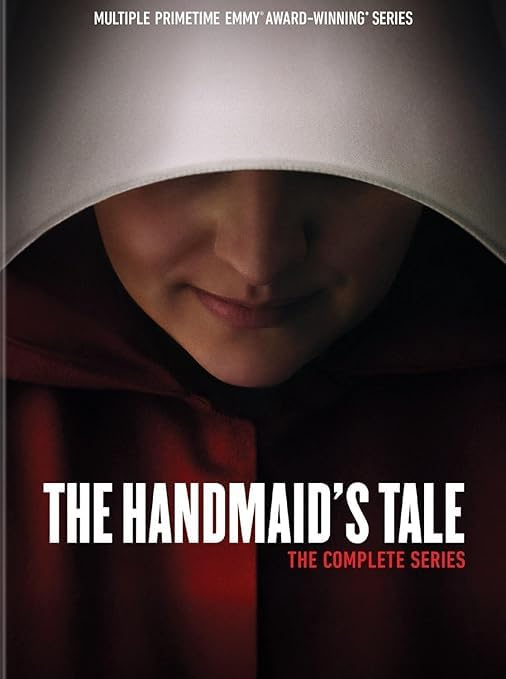

I think I see your problem. You have this list. It’s a list of people you need/want to buy a Christmas gift for. The trouble is that they’re into home theater, and you don’t know Star Trek from Star Wars. You couldn’t tell a Wolf Man from a Wolverine. And you always thought that Paranormal Activity was something too kinky to talk about. Fortunately, Upcomingdiscs has come to the rescue every Christmas with our Gift Guide Spotlights. Keep checking back to see more recommendations for your holiday shopping. These gift guides ARE NOT paid advertisements. We take no money to publish them. This time we turn our attention to Warner Home Video’s release of The Handmaid’s Tale The Complete Series on DVD
“I used to think of my body like an instrument for the accomplishment of my will. I could use it to run, pick things up, make things happen. There were limits, of course, but my body was nonetheless one with me. It obeyed my commands, mostly without complaint. Not any more. Now there’s tending to be done. I almost died when we first got here, they said sepsis. Pain makes your world very small. My world has been this room. Today I venture forth. My world can’t be small. Not now. Because the others need me to protect them. Gilead is out there. Gilead isn’t afraid. It does not hurt or sleep. It keeps coming forever and ever and ever …”
The most amazing thing about The Handmaid’s Tale — other than a powerhouse lead performance from the best actress working in television right now — is that this harrowing, suddenly timely cautionary tale about what happens when society falls asleep at the wheel is based on a story that was published more than 30 years ago. Of course, the show has a lot more going for it than impeccable timing. The Handmaid’s Tale is based on Canadian writer Margaret Atwood’s 1985 novel of the same name. Some time in the not-so-distant future, the world is in chaos after environmental pollution and sexually transmitted diseases result in a catastrophic decline in human fertility rates. In the U.S., the result was Second Civil War, which led to the establishment of a totalitarian, Christian fundamentalist government known as Gilead. And while life isn’t exactly a picnic for anyone outside of Gilead’s elite ruling class, life is especially dire for women: they are not allowed to own property, work, handle money, or read. Much of this information is revealed in dribs and drabs over six eventual seasons of the production.
The Handmaid’s Tale is created by Bruce Miller, a writer/producer who worked on SyFy’s Eureka and The CW’s The 100. The former series offered a cracked-mirror, off-center version of reality, while the latter is a post-apocalyptic drama: both sensibilities proved extremely beneficial for Handmaid’s. A large share of the credit also goes to Reed Morano, who won a directing Emmy for her work on the pilot and established the show’s spellbinding visual tone by helming the first three episodes.
This series is Hulu’s first big prestige television swing, and the streaming service clearly spared no expense. With the help of a 20th Century Fox budget, production values here are top-notch; The Handmaid’s Tale has a dystopian/militaristic vibe that is all the more captivating when you realize most of the prominent characters are women (not the usual protagonists for this sort of story). It turned out to be an even smarter investment. Now that Disney owns these Fox titles and they now own two-thirds of Hulu, the marriage of these two properties has become an even bigger win. Disney needs to establish an adult outlet for material now that they own those kinds of IP’s, and Hulu is where they will be sending properties like the FX library and R-rated films like the Deadpool franchise. The Handmaid’s Tale fits perfectly into that mold.
Elizabeth Moss became a star thanks to her tremendous work on Mad Men as Peggy Olson; Don Draper was the main character of that classic show, but Peggy was our entry into that world — the series starts during Peggy’s first day on the job — and her character had the most pronounced arc as the world at large changed drastically between 1960 and 1970. In Handmaid’s, Moss gets to play another woman radically out of step with the times. She projects incredible strength, a gallows sense of humor courtesy of June’s cynical internal monolog, and an ocean’s worth of emotion in this performance. (The standout is a scene in the episode Night when Serena emotionally tortures her.) The result was a loooooooong overdue Best Actress Emmy for Moss.
The supporting cast is strong as well. Dowd won a Supporting Actress Emmy for her ferocious work as Aunt Lydia. The character could’ve been a one-dimensional torturer, but Dowd manages to sneak in genuine affection in Aunt Lydia’s strict treatment of the handmaids. This season is her best work. Aunt Lydia has some huge ups and downs. She finds herself out of the job and finds a way to battle herself back to the top of the food chain. I find this character’s arc to be as compelling, if not more so, than June’s. Dowd is exceptional, and she gets a lot more meat to work with this season. There are moments you almost feel for her. She’s a “bad guy”, sure, but has become somewhat more sympathetic.
Fiennes is appropriately oily as Commander Waterford, but it’s Strahovsky’s work as his cruel, conflicted wife that has gone criminally unrecognized. She once again gets the chance to prove it. She is distancing herself from her husband even as the couple find “fans” in Canada and more support than you would imagine. There are so many great actors and characters here and as the series makes its way to the finale they all get nice “rewarding” story arcs. In the final two seasons Moss and her pre-Gilead husband Luke (Fagbenle) and her pre-Gilead friend Moira (Wiley) become superstars in the resistance helped by American government spook Marc Tuella (Jaeger) and they learn to kick serious behind. For me the best story arc in the series, with the exception of June, of course is Bradley Whitford’s nuanced portrayal of Commander Joseph Lawrence. Whitford and Moss were castmates on The West Wing with Whitford playing writer Josh and Moss playing President Bartlett’s daughter, Chloe. They share incredible chemistry here, and I wish there could have been more of it. There’s plenty in the final episodes. Lawrence was one of the men who created Gilead, and now he’s regretful about what it has become. For years he avoided doing the things expected of men in Gilead, which basically means raping women. His regret turns to a push for reform and eventually a true hero exit from the series.
Moss became a director for the first time on this series, and she ended up doing many of the key episodes. She directed the final two. There is a sequel series on the horizon that takes us 15 years into the future, and as far as I can tell, the Aunt Lydia character is the only one returning. Dowd also has a arc very close to that of Whitford’s in that she comes to regret her own actions. Dowd had wonderful chemistry with Madeline Brewer, who plays the often tragic Janine. In just a couple of years she went from torturing the handmaidens who refused to stone the girl to death to finding herself a protective and motherly figure to her. It’s nice that for Lydia it isn’t June that shows her the error of her ways, but Janine, and it’s a rather compelling and touching relationship.
You get all of the episodes and all of the extras from each season release. There’s not much there, but I’m sure you’ll find them informative and entertaining.
There is so much more that you can say here. The final two seasons saw a long delay, and I do believe it hurt the show’s momentum, but it survived, and now you can give an incredible gift of the entire series to that videophile on your list. There are so many great performances there just isn’t room to cover here. Let’s just say, “They’re all worth remembering.”
Parts of this review were written by Gino Sassani
