


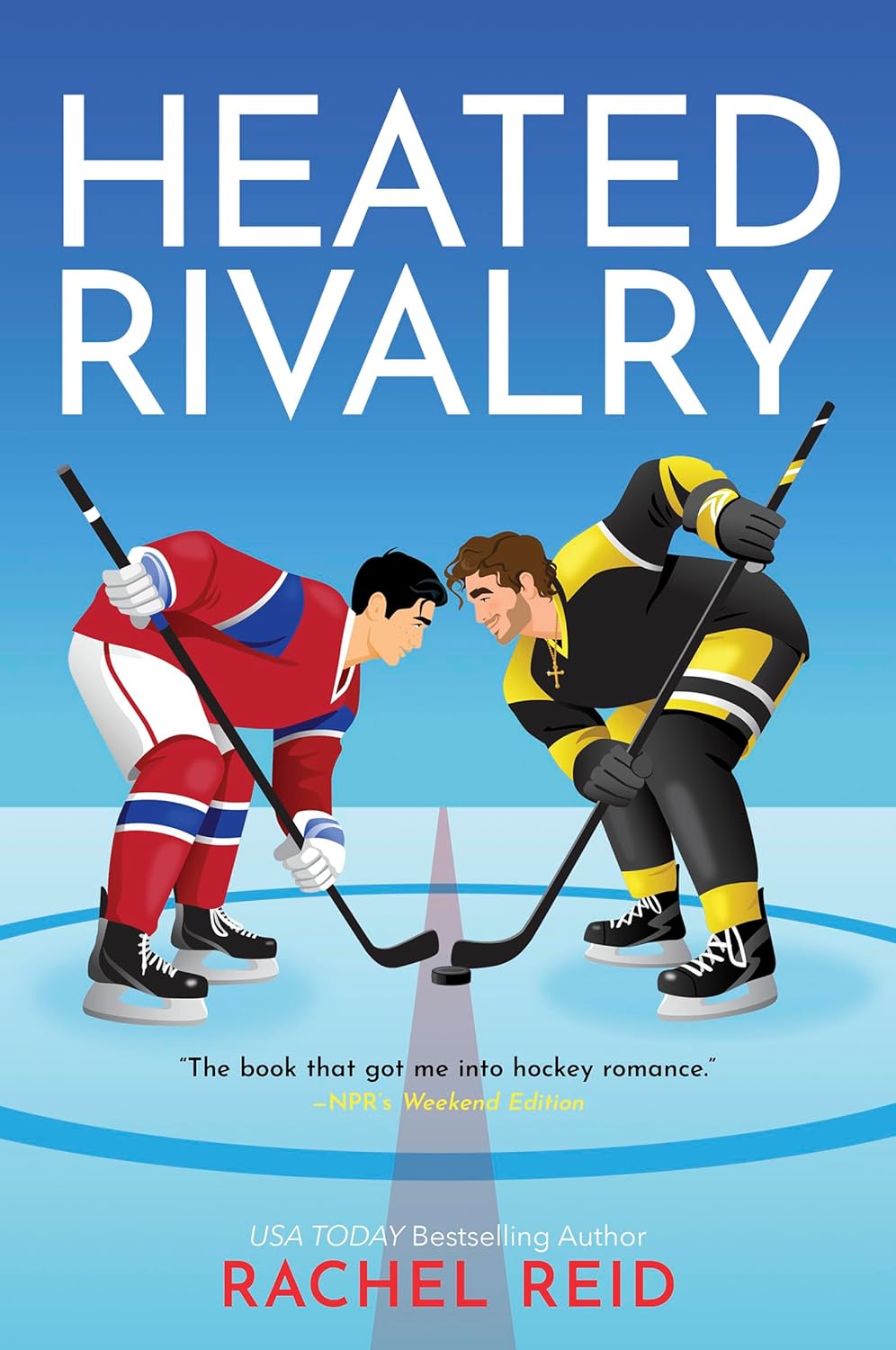

Going into 2026, Heated Rivalry (2026-) is probably the most talked-about series circulating on social media right now, with many fans already ascribing it as their favorite comfort show. It has proven to be a sensationalized hit among queers and wine moms alike. After all, it was renewed for a second season almost immediately following the finale. The HBO series is a gay hockey romance built on the enemies-to-lovers trope, loosely based on Rachel Reid’s novel Heated Rivalry (2019), and created, written, and directed by Jacob Tierney. At its center are the two dreamboats, Illya Rozanov (Connor Storrie) and Shane Hollander (Hudson Williams), who play on opposing teams and are naturally positioned as rivals, hence the namesake.
One of the more striking, and probably distasteful, aspects of Heated Rivalry (2026-) is its use of progression and time jumps. However, I’d argue that the story does good to not rush intimacy, nor does it romanticize permanence too early. It breaks away from Hallmark-esque heteronormativity entirely with the grudging evolution of acceptance. Instead, the season unfolds across years, tracking a relationship that begins almost entirely in lust and secrecy. Early episodes feel impulsive and experimental, driven by tension, exploration, and desire rather than love and security. As the season progresses, the time jumps allow the audience to witness how repetition slowly turns into attachment, and how attachment becomes something far more fragile and frightening than hedonism alone. Love is not presented as a revelation, but as something that sneaks up on both characters despite their best efforts to bury it.
This evolution is deeply entangled with the stigma of being gay, which the series explores through contrasting cultural experiences. Shane’s fear is shaped by Western locker room culture, media scrutiny, and the threat of professional consequences. Illya’s fear, however, is heavier and more existential. His experience as a Russian player adds a deeper layer of risk, one rooted in family, national identity, and survival rather than reputation alone. The show is careful not to equate these fears, allowing them to exist as distinct but intersecting realities.
My favorite scene in this season comes during the phone conversation following Illya’s father’s death. It is raw and beautiful precisely because Illya does not know how to express himself in English, so he stops trying. It made me shed tears to see him finally open his heart. He switches to speaking Russian, not to be understood, but because it is the only way he can speak truthfully at that moment. What began as grief turned into confession. Reality was setting in, and he no longer had to deal with the pressure of his father. He admits his love and the fact that he is no longer able to turn away from it, even if he had no idea how to navigate this understanding. He said, “? ??? ?????? ???? ????? ? ?? ????, ??? ? ???? ??????.” In this scene, Shane has no idea what Illya is saying. For all he knew, Illya could be rambling about his father, about family, about loss. Yet, that is what makes the scene so beautiful. Illya is not confessing for Shane’s understanding; he is confessing because saying it out loud lifts the weight from his shoulders. In the end, Shane’s first response, a comment about needing to learn Russian, breaks the tension. He had no idea the weight of what was just expressed to him.
The series also uses secondary characters, Scott Hunter (François Arnaud) and Kip Grady (Robbie Graham-Kuntz), which are actually from the first book by Rachel Reid, titled Game Changer (2019). They are used to explore a poorly represented trope in media that is the fear associated with being closeted. Rather than presenting this fear as cowardice or weakness, Heated Rivalry (2026-) treats it as something learned, safe, and internalized. These characters demonstrate different responses to the same pressure, showing how concealment can fracture relationships long before the truth is ever spoken. This distinction becomes especially clear in the contrast between being forced to come out and choosing to come out on one’s own terms. The series does not necessarily romanticize exposure. Being caught is depicted as destabilizing and violating, such as when Hollander’s father accidentally catches Shane and Illya during a moment of intimacy, while voluntary disclosure, even when terrifying, is shown as an act of agency.
That emotional honesty contrasts sharply with the fear embodied by the two side characters. Their storyline climaxes after the championship win, when Scott brings his lover onto the ice in front of everyone, refusing secrecy any longer. It is a moment of catharsis, not just for them, but for the audience, a public reclaiming of love after it had been hidden and diminished. Following this coming out on live television, Illya calls Shane, who had previously invited him to go on a meditation retreat, saying he’ll go. It showed how encouraging this act of love was, a step across the threshold of denial to be with each other without discretion.
An interesting conversation surrounding Heated Rivalry (2026-) has emerged around its origins, particularly the fact that so many gay romance stories are written by women. Rather than dismissing this outright, the series invites a more nuanced interpretation. There is something psychologically interesting about why women are drawn to writing stories about men loving men, especially in hypermasculine spaces like professional sports. In many ways, these narratives remove women from the emotional labor traditionally assigned to them, allowing male characters to be vulnerable with one another without defaulting to heteronormative dynamics. Whether one views this as projection, empathetic, or fetishistic likely depends on personal perspective. If I’m going to be honest, I was happy that the story was put to screen by a fellow queer man.
At its best, this season succeeds because it highlights the nuances of being a gay man rather than reducing queerness to spectacle. Desire, fear, pride, shame, tenderness, and resentment all coexist. No one is perfectly brave. No one is entirely wrong. The series understands that being queer is not just about who you love, but how you navigate the world while loving them. Of course, the show has not been without controversy. Some critics have accused it of being overly romanticized or unrealistic, and others have criticized its pacing or emotional restraint. Tierney’s responses have been direct, emphasizing that the series was never intended to be a universal representation. In some ways, I feel sorry for the gay men who come to feel that this passionate type of love is idealistic and aestheticized.
Ultimately, Season 1 of Heated Rivalry (2026-) resonates because it allows its characters to grow without demanding they arrive at perfection. It understands that love is not the absence of fear, but the decision to keep choosing someone despite it. In that sense, it earns its reputation not just as a comfort show, but as one that lingers with a lasting cultural impact. The season is steamy and accurately depicts the nuances of the gay experience. I can see why it would be easy to get caught up in sex scenes and hot bodies, but the underlying narrative is what sets it apart.
