


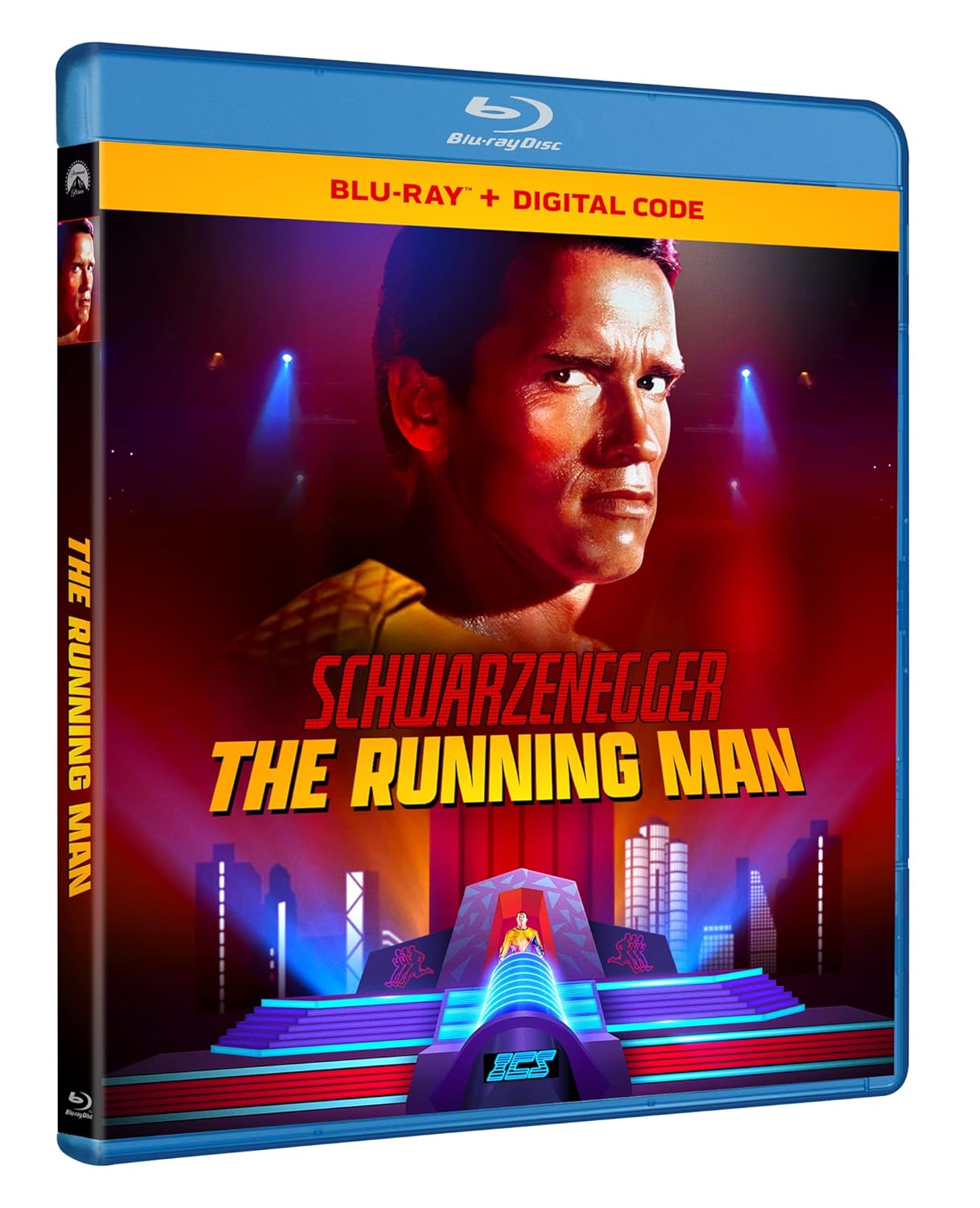

“By 2017, the world economy has collapsed. Food, natural resources, and oil are in short supply. A police state, divided into Paramilitary Zones, rules with an iron hand. Television is controlled by the state, and a sadistic game show called “The Running Man” has become the most popular program in history. All art, music, and communications are censored. No dissent is tolerated, and yet a small resistance movement has managed to survive underground. When high-tech gladiators are not enough to suppress the people’s yearning for freedom … more direct methods become necessary.”
This is quite a unique experience for me. Having recently reviewed the 2025 remake, I now have the opportunity to review the 1987 version. So, I essentially get to this in reverse. Naturally, I’ve seen the 1987 version years ago, but it being years ago, there a details that were no longer fresh in my mind, which essentially gave me the unique position of it being a new experience again. I relished that. I enjoyed the 2025 version, and I was curious about how I would view the original film post watching the remake. Answer: I like them both, and while I give the remake credit for its modernization, there is still something intriguing about the Arnold Schwarzenegger cult classic. Part of it’s the backstory from the original film, which deviates away from the book source material. Schwarzenegger is a former cop framed for a crime he didn’t commit, and his path to freedom is through a dangerous life-or-death game.
The main differences between the original film and the remake have to do with the plot and character’s motivation. In the remake, which is more in line with its book source material, Ben Richards is a desperate man living in poverty who volunteers for the game to win money for his sick daughter’s medical bills, whereas in the Schwarzenegger-led film, Ben Richards is a framed former police officer who is forced into the game as a prisoner. He has no family ties and eventually joins a rebellion to take down the network. As I said, I enjoyed this plot better because it was more easily digestible. In the 2025 version, the idea of the rebellion felt like an afterthought, whereas while it was still a late shift, it felt more central to the story in the 1987 movie.
On the one hand, one thing that I give the remake over the original is the setting. In the 1987 version, the game takes place in a closed, 400-block underground arena filled with theatrical “Stalkers” (like Sub-Zero and Buzzsaw) who have distinct, wrestler-like personalities. This setting was fine and still exciting. However, I think the real-world setting of the 2025 remake was more exciting, because it added an air of realism to the situation and was more expansive.
Richard Dawson was a more compelling Killian in my opinion. Drawing on his real-life experience as the host of Family Feud, Dawson blended public-facing charm with private ruthlessness. It showcased the two-facedness of the character, which was a much-needed attribute. It made for a more larger-than-life, satirical villain, which was very much needed for fitting the campy story. Of course, this also being Richard Dawson’s final film is a factor in my nostalgia for his portrayal.
Interestingly, this film shares a close connection with another Schwarzenegger film that was also released in 1987. Four actors from the Predator film franchise appear in this film. Arnold himself, Jesse Ventura, and Sven-Ole Thorsen (Arnold’s stunt double) all appear in the original feature film Predator, while Maria Conchita Alonso appears in the 1990 sequel Predator 2.
The 1987 film was also more of collaborative experience, featuring an actual love interest. This does deviate from the original source material, given that in the book Ben is married and his whole purpose for entering the game was to earn money from his family, specifically his sick child. In the case of the original film, Schwarzenegger’s character forms a bond with María Conchita Alonso’s Amber Mendez, a network composer, who is initially mistrustful of Ben, but grows to become his partner. This relationship grounded both characters and established an important bond for the story in my opinion.
In summation, the 1987 version was just more fun. The villain is more over-the-top, and the outfits are more ridiculous. It adds a comedic element to the film and makes for a amusing experience. While some elements of the film may not age well, the overarching themes and plot still resonate with a modern audience.
