
Last November New York City was the center of one of the largest attacks by monsters, or as Japanese monster movie fans know them better, kaiju. They took over the city, but there’s no need to worry, because Ultraman was right there with them. In fact, there was no danger and no huge battles to be won. They were there for two weeks to celebrate the 60th anniversary of Ultraman. Plenty of the actors were on hand, and there were demonstrations and displays galore. It was one of the biggest film fan fests in the world. The event also made sure to include some of the city’s Japanese neighborhoods, but Ultraman is a worldwide phenomenon, and I wish I could have been on hand to celebrate. Ultraman held a special place in my own youth and if it weren’t for Ultraman and Dark Shadows to keep this 6-year-old off the streets, who knows what kind of trouble I might have gotten into. Ultraman is a huge part of Japanese culture and pretty much has been since the original live-action show in 1966. Perhaps Godzilla started the ball rolling, but Ultraman brought us these monsters on a regular basis. In Japan, Ultraman is like our Superman. He’s an iconic hero and a huge part of the pop culture. Since the 60’s he has appeared in many forms, most of them animated. But it is the 1966 series that made a ton of us kids fall in love with him and an entire genre. Yes, there were many from the era: Space Giants featured a giant fighting robot who fought monsters and sometimes converted into a spaceship (yes, before transformers were ever thought of); Johnny Socko had his giant robot; and the list goes on. But it was Ultraman who started it. Eiji Tsuburaya, who created the original Godzilla, formed a new company outside of Toho Pictures. Ultraman was pretty much the first thing out of the new shop.
It started with a series called Ultra Q. It was a popular series in Japan. There was no Ultraman here, but some of the elements of what would be the Science Patrol started there. When it was finished, the staff was approached to create a new show, and fast. But this one needed more action, and also something that could be sold to the American markets. That was Ultraman. In some form or another, the character has been around for over 60 years and is still plugging.
Ultraman was a space being who was chasing an escaped monster. When his spacecraft collided with that of Science Patrol Officer Hayata, he inadvertently killed the young man. To make up for his mistake and also offer Earth a way to fight the endless row of monsters unleashed, he merged his life with Hayata. Now, whenever a monster threatens, Hayata uses his “beta capsule” and morphs into Ultraman, complete with martial arts moves and an array of ray weapons, Ultraman fights these creatures in hand-to-hand combat. The downside is that Ultraman’s solar energy diminishes rapidly in Earth’s atmosphere. As he weakens, a light on his chest flashes. A narrator reminds us each time that if it stops, Ultraman will die. Since that original show we still get the blinking lights, but it is rarely explained anymore.
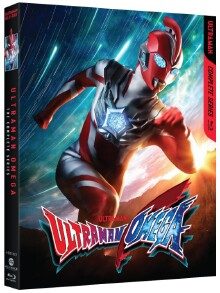
At this point the franchise puts out a different version of the hero pretty much every year. The 25 episodes are not very connected and often take place on alternative versions of Earth and Japan. The 2025-26 release was called Ultraman: Omega, and this show takes place on an Earth that has never had a kaiju attack. It opens with our old faithful hero on some dark world where he is fighting some rather large bugs. We never really learn a lot about what’s happening here. It is addressed later in the season, but not in great detail. What we do know is that some strange ball of fire fell from the sky, and video shows there is what appears to be the shape of a mine inside.
Enter Ultraman: Omega and meet Kosei (Yoshida). He works at a warehouse in Japan, and it appears he mostly works alone checking in orders and filling shelves. He also has a little room there were he lives. One night a stranger shows up who doesn’t know his name. The stranger (Kondo) is a bit of a pest asking what everything is and getting in the way. He also wants to eat all of the time. Suddenly there is the first ever kaiju, and before long Kosei discovers that the stranger can become a giant alien man who does hand-to-hand combat with this new wave of kaiju. Eventually, the stranger recalls his name as Omega, but Kosei understands he must keep his true identity a secret and names him Sorato and calls him a long lost cousin. They quickly become very good friends, and I love the chemistry that develops between the two. For the first time, at least to my memory, Ultraman has a kind of sidekick. Eventually Kosei starts to actually help. Throughout the season Ultraman captures four kaiju that Kosei keeps as large action figures. But he can use them to send friendly monsters to help Ultraman, and also each has a weapons mode where Ultraman gets cool armor and new giant weapons to use. So the two become very much a team, and I love how that works.
They also often run into biologist and explorer Ayu Ichido (Kudo) who eventually joins as a third member of the team. For most of the season she’s not in on the secret until she catches Kosei sending one of the kaiju to help Ultraman. For pretty much the first half of the season episodes are pretty much standalone. The team hear about the kaiju appearances from a radio show that also acts as a kind of amusing Greek chorus and throws out some of the show’s exposition. The second half brings the show a little more together. Episodes start to relate to each other more, and stronger threads are brought together. They eventually form an official team under the leadership of Uta (Yamamotta). They coordinate with the NDF and start to develop weapons and strategies to deal with the new threats. It’s a good thing, because as Sorato begins to regain his memories he is visited by a version of himself. He learns he’s a stargazer, and it’s really his job to observe the human and kaiju interactions. He wasn’t intended to take part. It’s a conflict that boils in himself before he and Kosei join together and create the best version of Ultraman. There are some standout episodes. There’s a riff on Jurassic Park where a rich guy wants to collect kaiju for a Kaiju Park. There’s a time travel episode and one that riffs on the paranormal “reality” shows out there.
The big story here, at least for me, is that while there are plenty of computer graphics here, the monsters and Ultraman are still those guys in suits. There is CGI enhancement, and particularly the Transformations and weapon f/x, but you can still tell these are guys in suits romping around on a set with models. I hope that never changes, because that’s where the charm of the show has always been. We even get the return of some old favorite monsters, including Pigmon, who goes all the way back to the 1966 series. There are other returns as well. Yeah, CG is invading more and more each new show, but the fights are still what they were 60 years ago, and I just love that. Is it hokey? Absolutely, and I hope they don’t change a thing. Of course, each Ultraman character has a slightly unique look of his own, but the basics remain just as they were when I was a kid. Sometimes this armor looks like it’s too much, and I can’t figure out how the actor moves around so well when he’s weighted down with accessories. I do pine for the days when Hayata just pushed a button on his beta capsule and the transformation was complete. Now there’s this whole choreographed series of motions that appear to be a bit of a problem when seconds count. I guess it’s there for the kids. For us veteran fans, that beta capsule was enough. It was also easier to imitate when we were playing.
You get all 25 episodes on four discs. There are no extras. The case comes with the traditional full-color book that shows you the various forms of Ultraman and a field guide to the kaiju. With a name like Omega, you might think this is going to wrap up. That couldn’t be any less true. The new season is already in production and should started airing in July. It’s called Ultraman: Teo. It’s a 60th anniversary where you get the goodies. You can choose from the original Japanese or English dubbing. I went back and forth just to see the variations, and there are a few. There are still comic books, animated shows, and these live-action runs, so Ultraman is going strongly after 60 years. Just look back at how much there’s been. “That’s a lot of stuff.”