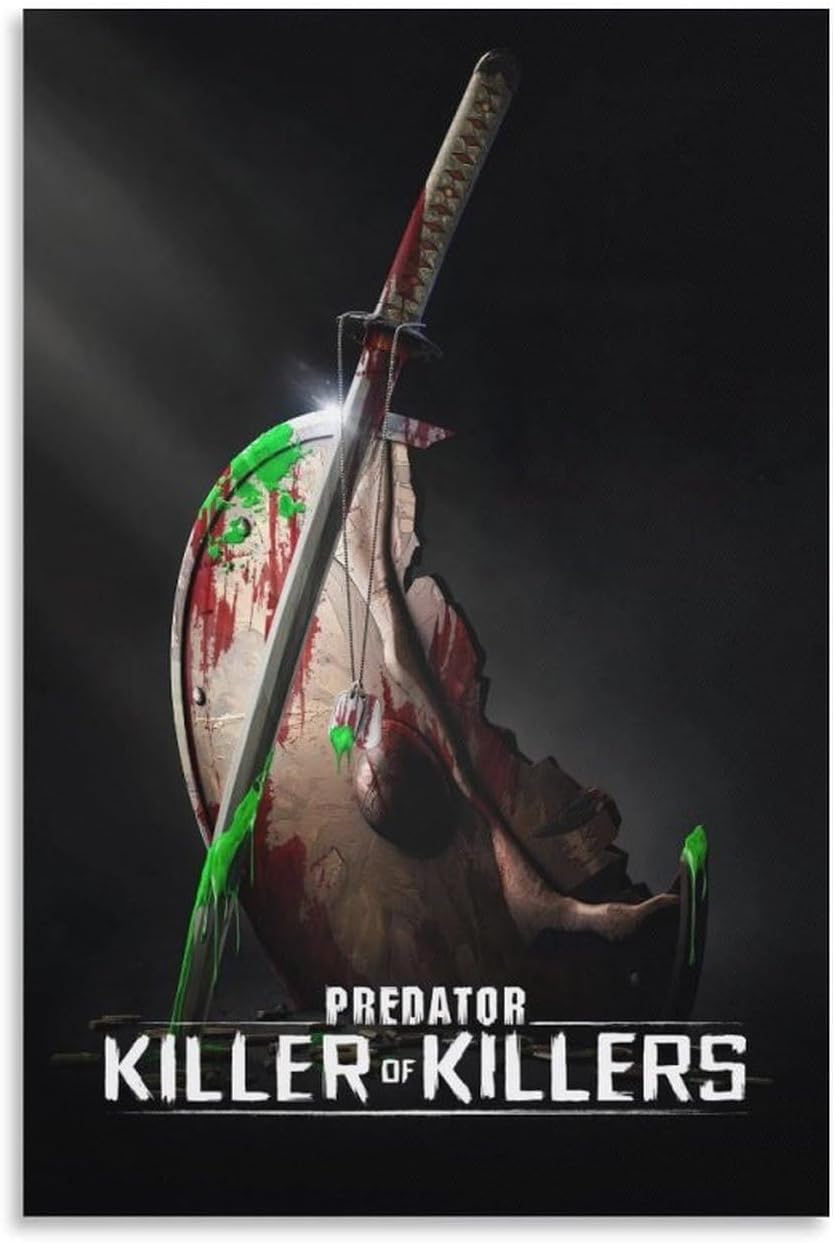
I originally watched Predator: Killer of Killers (2025) as suggested by my boyfriend, which was released on Hulu in June. To be candid, I stopped following the Predator franchise after its cultural peak with the iconic crossover Aliens versus Predator (2004) and its respective sequel in 2007. Once franchises start to feel more like money grabs, like with the Jurassic World franchise (2015-2025), the magic becomes evanescent, and the cinematic experience is severely diminished for me. That said, this movie is so creatively gory, with such a stellar story, you can’t help but be impressed! This film acts as a standalone animated anthology, which serves as the eighth installment for the franchise, released after Prey (2022) and preceding Badlands (Nov 2025). Both the style of animation and the creative use of vantage points distinguished this production from the rest in the franchise and amazingly keeps you invested in the story, despite it initially seeming disconnected.
The point of the anthology clearly was to connect more warmly with the respective characters, and what they’ve endured to reach the point of rendezvous. Despite its grotesque fight scenes and generally horrific outcomes, you grow to feel compassion for each character, understand their interactions with greater insight, and feel hope for them in moments of despair. Additionally, I loved the nuances in historical timelines featured in each story, with the first set during Viking-era Scandinavia, the second exploring feudal Japan, and the third unfolding during World War II.
The stories featured, as part of the anthology as a whole, are deeply connected to love and what makes us human: “The Shield” with vengeance, “The Sword” with honor, and “The Bullet” with valor. The movie starts off with Ursa, a Viking warrior, depicted as a leader of her clan, slaughtering all those in her quest to find the warlord responsible for her father’s death, Chief Zoran. After which, a Predator reveals himself, who has been observing invisibly the entire time, and starts brutalizing the entire clan. Similarly, Kenji, a shinobi ninja, is also attacked by an observing Predator after he infiltrates his brother’s castle, the successor his father chose after refusing to duel in boyhood. This was the most heartfelt for me, with the switch in dynamics between the dueling brothers to battle the Predator and their ultimate reconciliation. Finally, John Torres, a drafted U.S. Navy pilot, has to navigate through his own treacherousness using little more than his wit and a questionable fighter jet after his base is attacked from above. “Hooks coming out of the sky!” one man shouts, just before being speared and whipped from the ship. By the end, the three characters clearly shared a common denominator, in that they survived their attacks and were subsequently abducted to eventually meet, despite their own incognizance and being across timelines.
Each Predator that was fought by a character notably had their own special skillsets, with the first being tactical, the second being stealthy, and the third being aerial. It was obvious after the first segment that the Predators sought to snuff out champions, but it was a surprise for me when the purpose of the rendezvous was for their own gladiatorial entertainment. After all, the games were being orchestrated by a Predator warlord named Grendel King! It revealed the complexity in their own social structures, much like our own, even with established power dynamics. There was even a sacrifice of their own kind, which implied deviance among the Predators, with their own form of institutional punishment like prisons. The film was rich with lore on the Predators, which revealed there being many parallels between the Predators and us, as humans.
I deeply appreciated both the cultural relativism and cross-cultural theme with each character, how it influenced their decisions, and how they were able to reconcile. For example, when Kenji chose not to engage while Ursa remained fierce and unyielding, despite both facing the same pressure from fate, it showed how differing cultures can shape our responses to distress. Similarly, Torres approached his challenges with calculated logic that reflects a more militaristic worldview shaped by 20th-century warfare. On a structural level, the film relied on cryogenic stasis rather than time travel to make the cross-cultural theme possible, which enabled the characters to exist within the same timeline. It was a thoughtful detail that deepened the cultural perspectives, created an artistic convergence, and highlighted the scale of technological advancement in their species compared to ours. By the end of the movie, a much deeper component emerged, with legendary characters from Prey (2022), Predator (1987), and Predator 2 (1990) revealed in cryogenic stasis.
Watching the movie felt like reading a deep philosophical essay on humanity and perseverance. It offered a beautiful blend of cultures, with different timelines coalescing in unexpected ways. The scenes don’t always unfold as you’d anticipate, making it more effective to simply immerse yourself and let the story take shape, especially with some parts remaining ambiguous until the very end. I ended up watching it twice, not because I needed to, but because I genuinely wanted to. This is a production for those versed in the social sciences who can appreciate the level of historical and cultural accuracy, as well as for Predator fans who enjoy theorizing and picking up on subtle details.