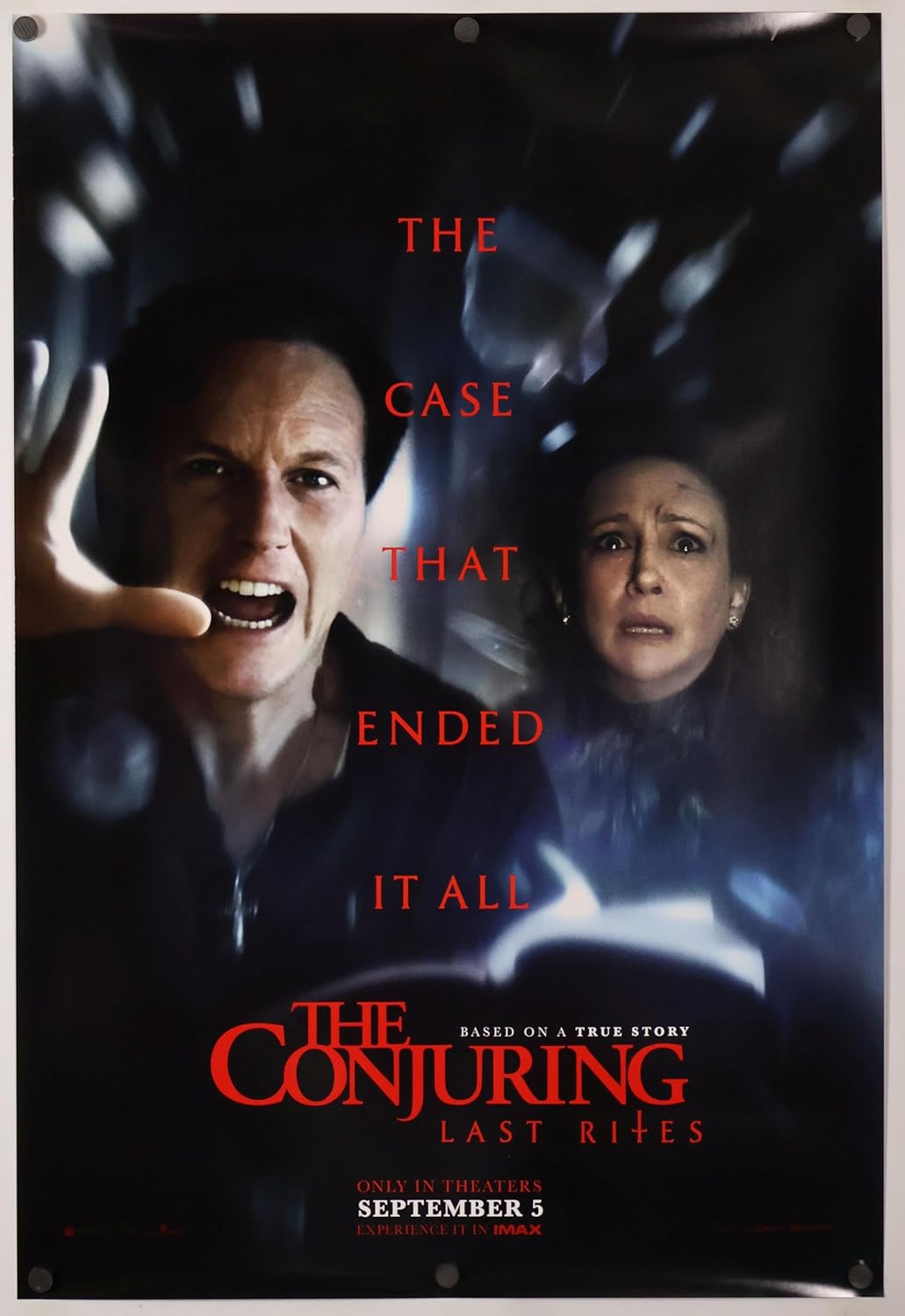
Watching a production as high-caliber as The Conjuring: Last Rites (2025) naturally comes with a lot of hype, with its Hollywood budget and immense popularity. It is refreshing to see a Hollywood horror film treated with real seriousness, the kind that draws both genre diehards and casual viewers, and my theater was packed as evidence of that. Within its shared universe there are nine, debatably ten, entries you can binge, including Annabelle (2014-2019) and The Nun (2018-2023) with their sequels. The debated tenth, The Curse of La Llorona (2019), is only loosely connected through Father Perez from the Annabelle films. As the title suggests, The Conjuring: Last Rites (2025) positions itself as the capstone to this first phase, and it is wrapped with a cathartic finality. I think one of the main reasons for its success is the fact that these movies are based on real events and experiences from the perspective of the Warrens. While you are watching something horrifying and seemingly fictional, you keep in mind that these are lived experiences as recounted by Ed and Lorraine Warren. It is haunting to think such paranormal events happened, and to imagine the bravery it takes for the Warrens to dedicate their lives to helping others confront such phenomena. Whether you believe in the paranormal or not, the cases in these movies are drawn from reported events, and the claims from the families they helped are well documented. For me, I err on the side of phenomenology, accepting these experiences as truth while accounting for the mind’s power to shape perceived reality, even amid skepticism and the possibility of fabrication.
In the film, The Conjuring: Last Rites (2025) is loosely based on the Smurl haunting, which took place in West Pittston, Pennsylvania in the 1980s, where the story is also set. Although the Warrens lived in Connecticut, they decided to help the Smurl family after their daughter, Judy Warren, was drawn there through supernatural forces she could not explain. Shortly after, they discovered a previously unknown connection to the house through a mirror the Warrens had encountered before Judy’s birth. The writers took creative liberties suited to the big screen, deviating from real accounts in ways that still felt tasteful and respectful to the family involved.
I believe the actors, Vera Farmiga and Patrick Wilson, chosen for the quadrilogy were well matched to the roles, both in their performances and in their resemblance to the Warrens, almost uncanny in fact. Although they have substantial work beyond this franchise, you still know them first as Ed and Lorraine Warren, the couple from The Conjuring (2013-2025). I can see how this might bother some actors who risk being typecast, but I hope they take pride in these portrayals rather than grow bitter in the acknowledgment. Despite this being their fourth film as the main actors, their sentiment and joy in The Conjuring: Last Rites (2025) are evident. This likely contributes to their continued returns across both the main films and the spin-offs. Their chemistry remains strong, and each installment feels like a cherished addition as a result.
As far as the story goes, The Conjuring: Last Rites (2025) was a slow burn, ripe with gloom, but it spent too much time building toward the climax and emphasizing its role as the end of the quadrilogy. It felt like the film was leading to a bigger peak, but instead it moved straight into resolution, which felt atypical. In my screening, this pacing issue was obvious, as many in the theater were highly disengaged. People around my boyfriend and me talked through much of the film, and even the group seated next to us scrolled on their phones only until the final scares. The story failed to hold the audience’s attention, which diminished the experience for me. Perhaps this was a result of the film’s broad appeal drawing casual viewers rather than dedicated horror fans, but I think the writers should have accounted for this.
Even so, the scary parts are actually scary. The film is not filled with gratuitous jump scares that add nothing to the story. While I do not dismiss the psychology of occasional fake-outs, the film’s restraint with them makes it feel like a bona fide horror film. You see the entities early, and they are used liberally throughout, unlike many horror films. I particularly enjoyed the focus on their daughter, Judy Warren, being psychologically tortured by the entities. Her pivotal role is signaled by the opening with her miraculous birth, but the full significance is not revealed until the end. This also sets up the next phase of the franchise, however they choose to continue.
The production made an effort to connect the story more to the broader franchise than to the core quadrilogy. The heavy presence of Annabelle and Judy’s connection to the demon that possesses the doll makes this link explicit. I usually roll my eyes when a franchise leans on its mascot, but here it actually serves the story and gives Judy’s arc some weight. Unlike the earlier entries, The Conjuring: Last Rites (2025) brings Judy to the foreground as a main character. I had nearly forgotten about her, since she was barely featured in the previous film, so I credit the writers for a transition that feels seamless rather than forced. While we already know Judy has supernatural sensitivities from the earlier films, her abilities are more fully developed here.
What surprised me most was how much The Conjuring: Last Rites (2025) centers on love and connection, not only between Ed and Lorraine Warren, but also between their daughter Judy and her partner, Tony Spera. The film takes a traditional approach in portraying them as young sweethearts who have not been together long, falling deeply in love very quickly. Despite Judy’s unusual family dynamic, Tony embraces it with curiosity and support. As their relationship accelerates, his goal becomes proving to her parents that he truly loves Judy and is the right one for her. This dynamic provides the film’s primary comic relief as Tony tries to win Ed’s approval, knowing he already has Lorraine’s. Ed is initially apprehensive but eventually changes when he recognizes Tony’s importance to Judy. She needed not only support but also protection, and Tony is that for her.
I honestly did not give in to the hype, and for that reason The Conjuring: Last Rites (2025) did not disappoint me. Still, I can see how some may really enjoy this movie, while others may find it a snoozefest. In my view, it is a film you can appreciate if you do not want to pay close attention to the dialog and only tune in during the scary moments. Either way, you come away with the essence of the film. It is mostly steady, apart from the ending, with the occasional high point that quickly settles back into gloom. After watching, you sense the formulaic approach the director, Michael Chaves, uses to appeal to casual audiences. The story itself is predictable, and the final release from the entities is frustratingly anticlimactic. For an ending to the quadrilogy, it should have been much more. I believe this may be intentional, since the film’s conclusion takes a sharp turn into heartfelt sentiment that deviates from the rest of the cinematic universe. After all, the story is based on reported events and is framed in the film as the last case the Warrens took on.