


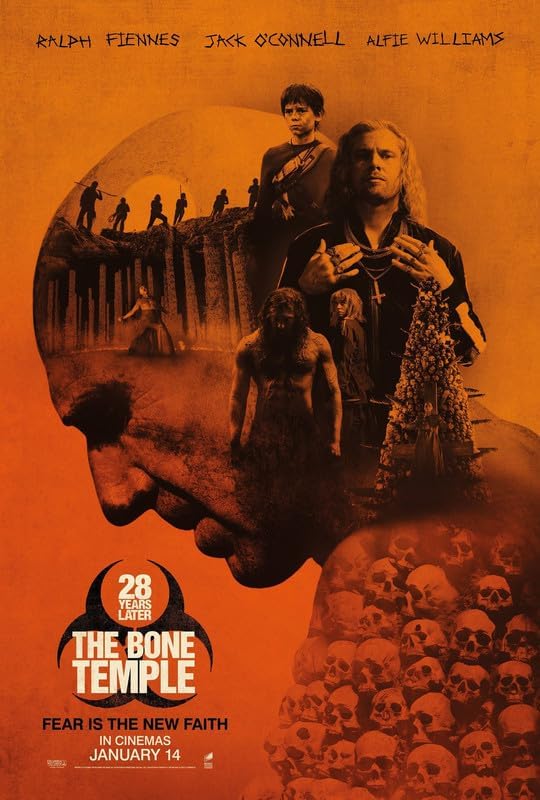

Something I was really looking forward to going into the new year was watching 28 Years Later: The Bone Temple (2026). The movie series, 28 Days Later (2002), 28 Weeks Later (2007), and 28 Years Later (2025), holds cultural significance in the post-apocalyptic horror genre. Its revival last year after 18 years was a big deal for those who have been following the franchise since the first release of 28 Days Later (2002), starring Cillian Murphy. It is somewhat unique in that it is less about the infected being “undead” and more about the “rage virus.” Part of what makes these movies so great, really, is how plausible this virus is in terms of epidemiology, as well as the downfall of civilization as a result. The original 28 Days Later (2002) details the nature of the virus, while 28 Weeks Later (2007) showcases how it seemingly cannot be contained, even with strict quarantine efforts. 28 Years Later (2025) is more about how what’s left of humanity has learned to cope with the virus as the new norm, and the second installment, The Bone Temple (2026), features a revelation about the virus that changes everything we are made to believe about it.
As noted, this second installment is a direct continuation of the events that transpired in 28 Years Later (2025), which featured a young boy, Spike (Alfie Williams), who is trying to help his mother, Isla (Jodie Comer), after she becomes sick. He hears of a doctor in the area over yonder, but instead discovers the Bone Temple. We learn that this structure serves as a memento mori, a reminder of death, meant to represent what we have lost and choose to remember. In fact, it is a Latin phrase that translates to “Remember that you must die,” which is meant to acknowledge our own mortality. While the doctor, Dr. Ian Kelson (Ralph Fiennes), was unable to save Spike’s mother, he performed a ritual meant to honor her death and help process grief.
By the end, Spike goes on his own but encounters a horde of infected in a seemingly dire circumstance. Serving as a deus ex machina, he is saved by a group of eccentrics named the Jimmys. It was unclear who these people were, other than his saving grace, and it added a rather comical ending to an otherwise melancholic movie.
One of the aspects of the movie I liked was the exploration into treating the symptomatology of the virus, associating it with psychosis and finding a way to reverse it. The doctor, Dr. Ian Kelson, from the first installment reprises his role and goes more in-depth with his experimentation on the alpha infected he named Samson (Chi Lewis-Parry). Not only did the previous movie introduce the idea that the infected exhibit social structures and status, this film revealed that there may be a method to mentally subdue the infected, unveiling a clinical psychological dimension of the “rage virus.” Throughout the film, you see the doctor sedating Samson multiple times, and Samson seemingly learning to come to the doctor for treatment.
The doctor takes his experimentation to the next level when he hears the alpha mutter a word, and by the end of the movie, a miraculous discovery is made. I appreciated the doctor’s role in the film, particularly how his need for companionship motivated his exploration of the virus’s symptomatology. There were multiple scenes where he was simply relaxing with the alpha, and even dancing with him. It showed that he wasn’t some Machiavellian physician, but rather someone acting with compassion, choosing to believe in the alpha’s humanity.
My favorite scene from the movie was when the doctor put on a show for the Jimmys, taking on the role of Saint Nick, otherwise known as Satan. He hooked up loudspeakers and rocked out. In the theater, I was jamming with him. I felt this moment perfectly complemented the overall Satanic angle the film took, especially after we learned that the Jimmys weren’t innocent people despite saving Spike in the last movie.
Essentially, the doctor was fawning, a psychological term used to describe when someone is essentially “faking it until you make it” as a survival tactic, akin to the fight, flight, or freeze response. Iron Maiden’s “The Number of the Beast” was used, which felt truly perfect in representing Satan himself and reinforcing the doctor’s performative submission.
The frontal nudity was also more tastefully featured, and it even seemed as if the prosthetic that led people to jokingly call the franchise “28 Inches Later” was downgraded to appear less distracting and more intentional. Rather than feeling gratuitous or played for shock value, the nudity felt more subdued and contextual, aligning better with the bleak, stripped-down reality of the world being depicted. It no longer served as a momentary spectacle that pulled attention away from the narrative, but instead blended into the film’s atmosphere in a way that felt more deliberate and restrained. This adjustment made those scenes feel less sensationalized and more in line with the franchise’s grounded tone.
Conversely, I didn’t like that Spike’s role in the movie was overshadowed by the story line of the Jimmys. The movie has very little to do with Spike at all, despite him being present in most scenes. We learn that the ambiguous ending of the first installment took a turn for the worse, with the Jimmys revealed to be literal devil-worshipers. In order for Spike to join the group, a sacrifice has to be made, coined “charity.” Through this process, Spike is renamed Jimmy, as every member bears that name. The group is led by Sir Lord Jimmy Crystal (Jack O’Connell) whose actual name is Jimmy, and he appears to suffer from clinical mental illness, seemingly schizophrenia and complex trauma, which is interestingly connected to the Teletubbies.
I couldn’t really appreciate that the movie became less about the infected, who serve more as an undertone, and more about human conflict, uncannily similar to The Walking Dead (2010–2022). About 30 minutes into the film, I found myself thinking how similar this felt to watching nearly every season of The Walking Dead (2010-2022). The pivotal, dire situations were largely the result of survivor conflict rather than the infected themselves. For example, the torture and mayhem stemming from the Jimmys’ concept of “charity” and their devotion to Saint Nick drove much of the tension.
The simplicity of the movie’s dynamics was also an annoyance for me. There were two overarching story lines, the doctor’s endeavors and the Jimmys’ endeavors, which were ultimately juxtaposed by the end to reach a finality that sets up a fifth film. By the end of the movie, it becomes clear that the next installment will focus more on Spike and more on the “rage virus,” which I did find redeeming.
What made the original films likable is also what this one lost. The original series was very nuanced and stimulating, and the formula used was genius. In the earlier movies, we saw many types of horror: body horror, psychological horror, and escape-based tension, used in ways that made them truly thrilling and horrifying. In my opinion, 28 Years Later: The Bone Temple (2026) deviated too far from this formula, resulting in a noticeable loss of essence. It feels as though you don’t even need to watch the original films to understand what’s happening, which I found distasteful. Ironically, it seems the filmmakers were aware of this criticism, as only by the very end of this installment is the film firmly tied back to the original franchise through Cillian Murphy’s reprisal.
The movie sets itself up too well as a side-quest film or spinoff. Much of what transpired felt redundant, especially when considering how little of the runtime truly advanced the mythology of the rage virus itself. Several of the revelations introduced here could have been easily integrated into a film more focused on survival and the evolving nature of infection, rather than centering so heavily on in-group conflict. As a result, the movie often felt like it was spinning its wheels, delaying meaningful progress until the final act.
Had the first installment not ended with the Jimmys saving Spike, this installation would have felt entirely unnecessary. Its primary narrative function appears to be setting the stage for what comes next rather than standing confidently on its own. While there are moments of brilliance, particularly in the doctor’s story line, the film ultimately feels like an extended bridge between stronger entries in the franchise rather than a fully realized continuation of what once made 28 Days Later (2002) so impactful.
