Posted in: Disc Reviews by Gino Sassani on April 7th, 2010
"We're back..."
The Chipmunks began life oddly enough as a singing group, of sorts. They were the brainchild of struggling songwriter Ross Bagdasarian and were named after the three chief executives at Liberty records. His own alter ego David Seville’s name came from his World War II Army station in Spain. The Chipmunks first appeared in a 1958 record called The Witch Doctor, but wouldn’t officially become The Chipmunks until later that year when The Chipmunks Christmas Song was released. It is for that Christmas music that I most remember the group. They first appeared as puppets on The Ed Sullivan Show. Alvin and the boys got their own television show in 1961. When Ross died in 1972, the Chipmunks would continue on under the guidance of his son. In 1983 The Chipmunks had yet another popular cartoon show and had appeared in countless specials and films. Today they are pretty much a hallmark at the holidays, and a Christmas song collection just wouldn’t be complete without them.
Posted in: Disc Reviews by Gino Sassani on April 2nd, 2010
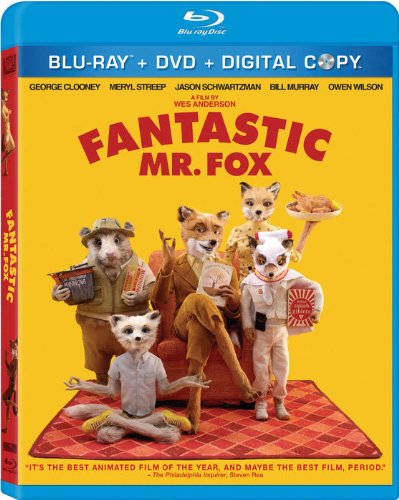
"Boggis, and Bunce and Bean. One fat, one short, and one lean. These horrible crooks, so different in looks, were none the less equally mean."
Roald Dahl was one of the more eccentric writers to come upon the scene. While he often wrote for children, his work is most decidedly dark and often quite sinister. He's most known for such tales as Charlie And The Chocolate Factory. His work has not been adapted to film as often as you might suspect given his popularity. The most famous was certainly Gene Wilder's Willy Wonka And The Chocolate Factory, which was far brighter and more cheerful than the original work. It took Tim Burton and his trademark brand of darkness to create the story Dahl intended in a more recent film which used the correct title of the work. This is not the first stop motion film to be adapted from his stories. Quite a few years ago we were given James And The Giant Peach, which enjoyed little box office acclaim. Wes Anderson is obviously a Dahl fan and immersed himself in the author's world as he prepared his screenplay for Fantastic Mr. Fox. The effort shows in the way Anderson captures Dahl’s pointed wit and social sarcasm. I think that if you're looking for something Dahl himself might have created, this is your movie.

Posted in: Disc Reviews by Gino Sassani on March 31st, 2010
"More of this is true than you would believe."
What was intended as a somewhat thought-provoking quirky comedy looks a lot like something you would expect to see on a late night rerun of The X-Files. All of the subject matter has been covered there, just not quite in this way. It all started with a non-fiction book written by Jon Ronson. He claimed to have researched various government studies in human behavior that entered into the world of the paranormal. It was part of an ideology of waging non-lethal war. It was a strange combination of 1980's new age mysticism and actual studies that showed that soldiers in World War II were, in fact, quite reluctant to kill or even harm the enemy. The study claimed that almost 80% of the soldiers deliberately looked for excuses not to fire or merely aimed inaccurately to avoid killing. The study went further and claimed that of the minority that did shoot with deadly results, most of them suffered terrible guilt over the experience, often making them unable to remain effective soldiers. The study regards the remainder of the study group, the ones who did fire accurately and did not suffer guilt as psychopaths. In short, the book gathered a lot of speculative ideas and put them into a rather oddball collection of "facts".
Posted in: Disc Reviews by Gino Sassani on March 30th, 2010
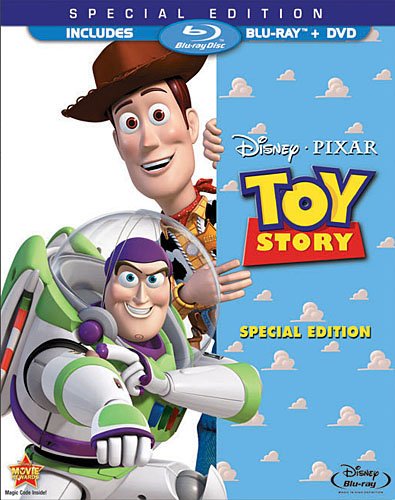
In the long run what was more important to Pixar and its relationship with Disney wasn't the milestone that Toy Story provided being the first computer animated feature. Movies are, as much as we'd like to think otherwise, a business. In the end, a film has to make some money. Toy Story was like a private printing press for the two companies bringing in nearly $200 million at the box office. Add another nearly $200 million in foreign receipts, and this prototype of a movie pulled in nearly a half billion dollars before the first DVD was released. That's huge for what was basically a children's cartoon. The second Pixar film would be A Bug's Life, and it would bring in nearly the same kind of jingle. The cry was too loud to ignore. The people wanted to see more of Buzz, Woody, and the rest of Andy's toys. The edict came down from on high, and what once took them 4 years to do, Pixar was asked to do in about 18 months. Now we would find out if Pixar was a viable company that could produce films reliably and on a faster turnaround. Would the studio compromise on quality just to answer the gate call of millions of dollars waiting to be plucked from the pockets of eager moviegoers? Several films later we know the answer to that question, but it was very much an answer in doubt in 1999. But another $485 million later in worldwide box office settled the question once and for all. Pixar didn't just start the computer animation business. They didn't just define the industry. They would continue to lead it for the next decade ... and apparently, beyond.
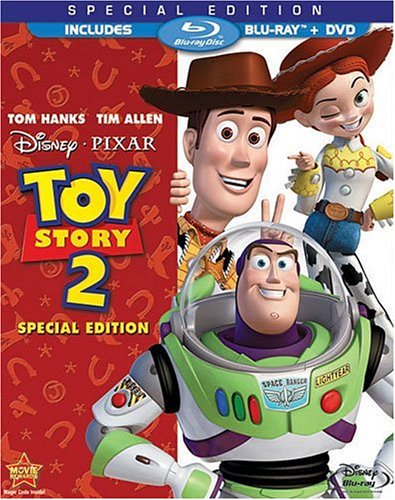
All of your favorite toys came back with their original voice cast. This time Woody (Hanks) attempts to rescue Wheezy The Penguin (Ranft) from the 25 cent box at Andy's mom's garage sale. The rescue brings him to the attention of Al (Knight) from Big Al's Toy Barn. Unfortunately for Woody and his friends, Big Al has the largest collection of Woody's Roundup collectibles on the planet. He's been trying to close a deal with a big Japanese firm who want to buy the collection for huge bucks. But Big Al has been missing only one piece in the collection, the most important piece, however ... Woody himself. The Japanese won't buy any of it without Woody. So Al steals Woody and brings him back to complete the collection. There Woody learns about his roots and the television show that he was based upon. He meets Jessie, The Yodeling Cowgirl (Cusack), Stinky Pete, the hapless old prospector (Grammer), and Woody's trusty horse Bullseye. While Woody's friends stage a rescue lead by his now best buddy Buzz Lightyear (Allen), Woody begins to feel sorry for his new companions. They've been kept in dusty old storage for years waiting for that final piece so they can be put on display at a museum and be admired by generations of new kids. When his friends finally arrive to save the day, Woody must decide between his old friends and his television comrades.
Posted in: Disc Reviews by Gino Sassani on March 30th, 2010
It's hard to believe it, but Toy Story was the very first computer generated animated feature film. CG graphics had already appeared as parts of films starting with the "Genesis proposition video" from Star Trek II: The Wrath Of Khan. It was a rather fitting movie for this Hollywood and technological first to occur. The piece was rather short and not as breathtaking as we've come to expect today, but, it did herald the beginning of a new era in filmmaking, to be sure. What better place for such an historical technological breakthrough than in Star Trek?
Pixar had already been making short subject computer animation. If you ever have the opportunity to check out their collection of shorts, you can't help but be impressed with the evolution of the process as evidenced in these short films. The awards were rolling in for the upstart company, and it was only logical that sooner rather than later they would be the ones to attempt a full length feature film. Of course they were quite a small company at the time with no distribution network in place to launch a major motion picture. There wasn't much of a promotional arm to the company to create the kind of buzz, pun intended, a full length film would require. The truth was that Pixar's small size, which was so much of a creative asset, just wasn't up to the kind of task they were taking on. The first step would have to be to find a partner with the name recognition and resources to back up such an ambitious project. They would likely be betting the future of the company on this one effort. The choice was obvious. They would tie their fortunes together with the same company that took the very same risk 70 years ago. Walt Disney had created the very first animated feature film with Snow White And The Seven Dwarfs. The result started an entire industry and put that one-time fledgling company on the map. Would Pixar be able to make the same impact on the industry that Disney had so many decades before? Anyone who has had the pleasure of seeing Toy Story knows the answer to that question. Lightning did indeed strike twice, and Toy Story would open the floodgates to an entire new industry of computer animated features.
Posted in: Disc Reviews by Michael Durr on March 28th, 2010
Around Thanksgiving of last year, I started to see trailers of a particular movie that quite literally made me laugh out loud. The reason behind it is because I knew with the title of the movie and the obvious plot, there was no way I was not going to review it when it came to dvd & blu-ray. I have a reputation for certain movies, I guess you could say. That movie was Ninja Assassin. Several months later, I am reviewing it for a mass audience. Funny how that works.
An old man and master of tattoos (played by Randall Duk Kim) is filling in an elaborate tattoo on a young gangster named Hollywood (played by Sung Kang)’s back. A henchman brings Hollywood a sealed envelope. The envelope is opened and out spills black sand. The old man is startled. He starts to spin a tale about ninjas and how he saw an envelope just like that before everybody around him was assassinated.
Posted in: Disc Reviews by Gino Sassani on January 19th, 2010
"Nature did not intend for you to survive out here. But here you are, and here I am to teach you how not to die..."
Whiteout has taken about as long and hard a road getting made as the characters in the film find themselves on stuck in the Antarctic. It began life as a crude graphic novel written by Greg Rucka and drawn by Steve Lieber. It developed a rather loyal cult following and was conceived as a film at around 2002. At one point it was intended as the launching point for a franchise featuring the federal marshal played by Kate Beckinsale. She might have been producer Joel Silver's first choice to play the character, as he has been heard to say. But the part was originally created for Reese Witherspoon. There were countless troubles developing a script, and studio support came and went throughout the period. Even when the film was ready to go with a street date, some troubles caused the release itself to delay its opening. Usually all of these development troubles spell disaster for a film in the end. Whiteout is no exception to that steadfast rule. The film scored a disastrous $10 million at the box and only $1 million foreign on a $35 million budget, and disappeared faster than your footprints in an Arctic blizzard.
Posted in: Disc Reviews by Gino Sassani on January 13th, 2010
"Have you ever felt like you were a little bit different. Like you had something unique to offer to the world, if only you could just get people to see it? Then you know exactly how it felt to be me."
The title is taken from a very short children's book written by Judi and Ron Barrett. I say the title and not the story because this movie takes only the most basic concept from the book to create the movie. Most of the characters are brand new creations, and the plot of the entire film deals with events not covered in the book. You have to credit Phil Lord and Chris Miller for pretty much everything you see happen in this film. I have only a passing familiarity with the kiddie book, but have now had the chance to see the movie in this Blu-ray high definition release.
Posted in: Disc Reviews by Gino Sassani on January 11th, 2010
"Every day I get letters. I think I get more letters than Santa Claus, Zac Efron, and Dr. Phil combined. I'm kinda the shit. Sometimes the letters are from people who say they are praying for me. They tell me everything will be OK if I just accept Jesus Christ into my heart. I say the words, but nothing ever happens. Nobody comes back. Nobody gets off the cross."
There hasn't been this much hype for a mainstream horror film in quite a long time that I can recollect. Certainly, quite a few have created more buzz after their release and subsequent box office power. But this one was supposed to be the real deal. It didn't hurt that the titular body in question would belong to Megan Fox. With the huge dominance of the Transformers films at movie theaters across the globe, Fox has had a lot of ... eh ... exposure over the last couple of years. She's made a ton of those “sexiest” polls, and combined with this somewhat provocative title, I'm sure there were expectations of, at least, reasonably large draw. Unfortunately, it just never happened. The film barely made back its modest $16 million budget.
Posted in: Disc Reviews by Gino Sassani on January 5th, 2010
"To everyone's surprise, the ship didn't come to a stop over Manhattan or Washington or Chicago, but instead coasted to a halt directly over the city of Johannesburg. The doors didn't open for months. Nobody could get in. They eventually decided, after much deliberation, that the best thing to do would be to physically cut their way in. We were on the verge of first contact. The whole world was watching, expecting, I don't know, music from Heaven and bright shining lights..."
It all started when Peter Jackson's long anticipated Halo project went belly up. You might recall it was that project which had Jackson deferring directorial duties on the upcoming Hobbit films, electing to act as producer instead. But Halo didn't happen. Jackson was in search of an ambitious project to fill the void. Enter Neil Blomkamp, a native of South Africa, who had come up with the basic imagery for District 9. A short film was the end result, but it would be far from the end for the idea. Blomkamp incorporated his own firsthand experiences as a boy living in the infamous days of South Africa's apartheid. It's completely impossible to see this film in any other light than an allegory to that era. Teaming together, Jackson and Blomkamp have taken these very basic ideas that were at best loosely held together by the concept and worked them into the most provocative science fiction film of the last decade.