Posted in: Disc Reviews by Gino Sassani on October 11th, 2010
There hasn't been a show quite like Human Target on television. There are certainly action shows, and there have been many shows that have taken on the "private" bodyguard or dedicated do-gooder. But I haven't seen a series yet that managed to capture the kind of action that you only find in big-budget feature films on the smaller scale and more limited budget of television. That is, until I saw the 12 episodes of the first season of Human Target. I remember seeing a huge advertisement blitz around the time of the Super Bowl, but I've seen a ton of these dramatic previews that only seemed to lose the sizzle over the course of a season, or even a single episode.
Christopher Chance (Valley) has a mysterious past. We get the idea he was a paid assassin for some sinister organization. He, at some point, has had a change of heart. It's an incident that is only hinted at until the final episode of the season. He now works with former San Francisco detective Winston (McBride). They provide protection services for people who find themselves in danger or in need of being rescued. They function outside of the normal boundaries of the law. Winston has some pretty impressive connections that allow them to have access to sensitive information. These connections also come in handy during a pinch. Many of these people are folks that they had already protected at some point in the past. The team is often assisted by Guerrero (Haley). He is another former bad guy from Chance's old organization. Their old boss is trying to track down Chance. We don't completely understand the relationship Chance had with his boss, but we know that they were close and the Boss considered it a personal betrayal when he left the company. We know that the falling out involved a woman named Katherine, and she's a source of great guilt for Chance. Of course, much of this will be revealed in the last episode of the season.
Posted in: Disc Reviews by Archive Authors on October 11th, 2010
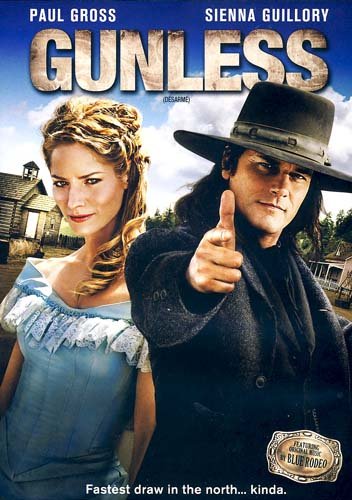
In the opening scenes of Gunless, a horse trots into what appears to be a tiny western town. Atop the horse is an unconscious man, slumped backwards in the saddle with a noose around his neck attached to a large tree branch that drags along behind them. An iconic Western opening if ever there was one. Reminiscent of Clint Eastwood in High Plains Drifter or Hang ‘em High. However, things soon begin to stray from formula when we realize that this tiny town is actually in "The Dominion of Canada" and the man turns out to be the Montana Kid, a notorious American gunfighter.
The ‘Kid’ is soon helped out by a polite bunch of Canadians, and before you can say “American stereotype” he has tried to start a gunfight with the kind local blacksmith. The reason? Why, the blacksmith had the gall to shoe the Kid’s horse. Unfortunately (or fortunately, if you are the blacksmith) he has no gun and therefore, according to the code of the West, can’t be shot. The solution? Why, the Kid will get the blacksmith a gun. But since this is Canada, there are no guns in the area, except for a broken antique owned by the local Brit-accented hottie widow.
Posted in: Disc Reviews by Michael Durr on October 8th, 2010
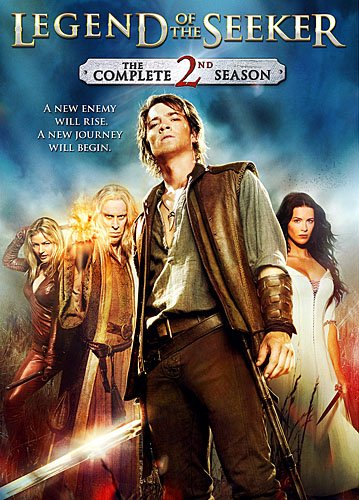
As mentioned before, reviewing television series can be very rewarding since I don’t watch as much television as I used too. I’ve found series that I never knew existed until the discs showed up in my mailbox. One of these great series is named Legend of the Seeker. I was fortunate enough to review the first season and it got great marks. So, I was even more delighted to see the second season hit my hands as well. This might be the final season for the show but let’s hope they saved the best for last.
So boys and girls, do you remember what happened in the first season? Well the Seeker, Richard Cypher (played by Craig Horner) defeated the evil Darken Rahl (played by Craig Parker) and sent him to the underworld. There will be much rejoicing and celebrating now that the lands are free and maybe finally the people can live in peace. Or will they? *insert dramatic music here*.
Posted in: Disc Reviews by Gino Sassani on October 6th, 2010
One Flew Over The Cuckoo's Nest was the first movie I ever saw on HBO. These were the very early days of the cable network. It was before the dawn of any real home video. It was at my Aunt Shirley's house that several members of the extended family gathered in dining room chairs around a 19-inch television to watch a movie uncut and without commercial interruption for the first time in our lives. A lot has changed since that 1970's afternoon at my aunt's house. Today we have hundreds of such choices on our television dials. I've seen a huge wave of home video technologies since that day that have included CED video discs, VHS/Beta, laserdisc, DVD, and now high-definition Blu-ray and movies on demand. The entire game has changed since that gathering 35 or so years ago. One thing has not changed a bit. One Flew Over The Cuckoo's Nest was a dynamic and compelling film that day. It remains so today.
R.P. McMurphy (Nicholson) is a repeat criminal who has caused more than his share of trouble in the system. He is sent to the Oregon State Hospital to have his sanity evaluated. There the head psychiatrist Dr. Spivey (Brooks) doesn't really think he's crazy. But McMurphy is held over for observation. He's placed inside a general population ward where he comes into contact with the resident "crazies" of the hospital. He takes a particular liking to Billy (Dourif) who is a sexually repressed teenager who stutters and lacks any kind of self-confidence. In a big way, he is the opposite of McMurphy himself, who is quite the extrovert and borders on manic most of the time. There is an Indian man who is about as big as a mountain who the staff and inmates simply call Chief (Sampson). At first Chief is the subject of mockery from McMurphy, but the allegedly deaf and dumb Indian soon earns McMurphy's respect, something we quickly understand is a rarity for McMurphy. Other patients include the childish Cheswick (Lassick), the shy and naive Martini (DeVito), the borderline psychotic Taber (Lloyd), and Harding (Redfield) who was pretty much the crew's unofficial leader before McMurphy came along. In charge of the ward is the indominable Nurse Ratched (Fletcher). A battle of wills soon develops between McMurphy and the cold nurse. What McMurphy doesn't know is that she has the power to keep him even after his original jail sentence has expired.
Posted in: Disc Reviews by Michael Durr on October 5th, 2010
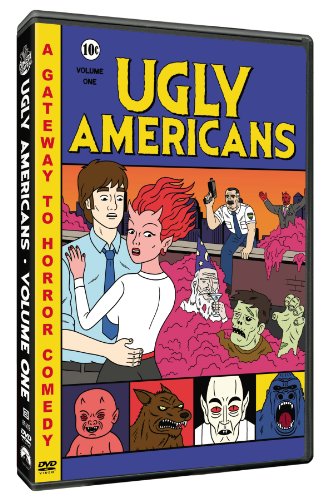
For somebody who does a lot of the cartoon reviews on this website, I often miss many new cartoons that crop up on Saturday mornings, Comedy Central, Nickelodeon, etc. One such animated show cropped up on my review slab. In the spirit of Halloween, (but not an official Nights of Terror post), it is my pleasure to take a look at Ugly Americans, the newest animation from Comedy Central.

Mark Lilly is a newcomer to Manhattan. He moves into his first apartment that he found on Craiglist, a nice two-bedroom with a roommate. One little problem, his roommate is a flesh-eating zombie named Randall Skeffington. Randall became a zombie in an attempt to win over a hot girl who was into zombies. The only issue is that the hot girl had moved on to warlocks by the time Randall had turned.
Posted in: Disc Reviews by Gino Sassani on October 4th, 2010
"1.2 billion TV viewers saw the home-made autopsy film in 1995. Experts have been divided over its authenticity ever since ... until now."
Posted in: Disc Reviews by William O'Donnell on October 2nd, 2010
Three friends, who have been close since grade school, are approaching their 40s and feeling like they are well past their prime. One friend had a 4.0 grade point average, works at a retail store. One was a star athlete bound for a scholarship, is 25K deep in gambling debt. The final of the three was a successful working rock musician, now drives a beer truck and lost his knack for song writing. As they all hit rock bottom, they venture on a road trip with a pair of tickets to a major College Football match and the hope of starting fresh...or end it all on a high note.
So much seems to happen in this film, as it plays out like a series of bits that have been sewn together. Things happen so quickly that it is hard to keep track of what is motivating these men. They seem to go back and forth between seeking a meaning, then redemption, then they want to kill themselves, and then the cycle starts over again. The “bits” (as I just called them) are amusing enough but it is hard to connect with characters when you're not sure how seriously to take them. They play for beer-fueled, road trip laughs more often then not, but then confuse you with a sudden heavy desire for catharsis (and overload of which comes at the end). One might assume that because so much happens so quickly in a movie that is 90 minutes long, that it has a good pace, but it doesn't. The funnier bits certainly pick things up but then we hit a grinding halt on more than several occasions with inexplicable scenes like this Ed Harris cameo at a carnival which has nothing in the way of exposition or character revelation, thus doesn't feed the film at all.
Posted in: Disc Reviews by Gino Sassani on September 30th, 2010
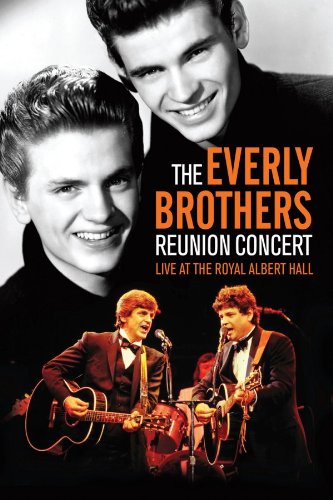
A lot of musical acts have broken up over the decades. Some of those breakups have included public feuds and plenty of hostility between the members. You would be hard-pressed to recall a breakup as public and hostile as when the Everly Brothers called it quits. If you think Glen Fry's "When hell freezes over" remark was pretty definitive, you should have been at the final Everly Brothers concert in 1973. The argument occurred on-stage in front of a live audience. Harsh words were exchanged, and a guitar got smashed. When Phil Everly walked off the stage to leave Don to finish the show alone, it would not only be the last time the brothers would appear on stage together in a decade. They would barely even speak to each other throughout most of that time. Lots of broken bands get back together for reunion tours and shows. But if you had to lay odds, the smart money would have bet against this brotherly duo ever singing together again. But, in 1983, a full ten years after the split, the smart money lost. The Everly Brothers reunited for a special concert at London's Royal Albert Hall in front of a sold-out crowd that included a ton of stars that credit the brothers as their own early inspirations. The cameras were on hand to capture this historic moment. Now you can own it on DVD.
Unlike many groups, the Everly Brothers were more than just a performing and writing duo. They sang together, often sharing the same microphone. Part of the act was the intimacy that the boys displayed in their concerts. It made those harmonies sound just that much tighter. So the question going into this performance was rather obvious. How would the acrimony and the years effect that style of performance? You would be very surprised to find that they didn't appear to miss a beat. This is one of those moments where it appears time stood still for those ten years and the boys managed to pick up at the moment before the famous fight. And it wasn't just a one night wonder. The brothers went forward after that night in London and continued to perform and record for over 20 more years. While they never found themselves back on top again -- the times had, of course changed -- the brothers continued to pack concert halls all over the world.
Posted in: Disc Reviews by William O'Donnell on September 30th, 2010
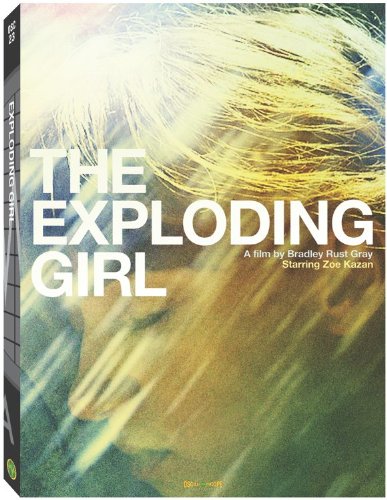
A young epileptic girl returns to her home in New York while on spring break. She stays with her mother and her best friend Al, whose room is now being rented out by his parents. While there she loses touch with her college boyfriend and reevaluates how she feels about her friend Al.
I wish I could say that opening paragraph was the launching point for the film's plot, when in fact it is a basically a summary of the entire film. This film is a very understated character study of our female lead and offers little by way of action or complex plot. Writer/Director Bradley Rust Gray's approach to this film is a sort-of casual, fly-on-the-wall approach to shooting the action (or lack thereof). Gray succeeds when using very long, uninterrupted shots, at very odd angles, as if the cameraman were spying on these these 20-somethings mumbling and fumbling through their awkward feelings and the lame parties they attend in order to capture their unadulterated actions. Whenever a typical shot-reverse-shot occurs (for those not up on film school lingo: an example is simply when the camera is watching one person speak, then cuts to a shot of the person they are speaking to and back again) it actually distracts from the moment for its artificiality removes us from the voyeuristic feel of the camera's positioning. The 'captured reality' approach to the presentation makes it so that I cannot tell if I should attribute the mishandling of situations (mainly some really lame and awkward dialogue) to the characters within the film, or to an awkward script. That is to say, I am able to buy into what is happening in such a way that I forget that there is a team of people working on this film that I cannot see and so I place all responsibility onto the characters.
Posted in: Disc Reviews by Gino Sassani on September 30th, 2010
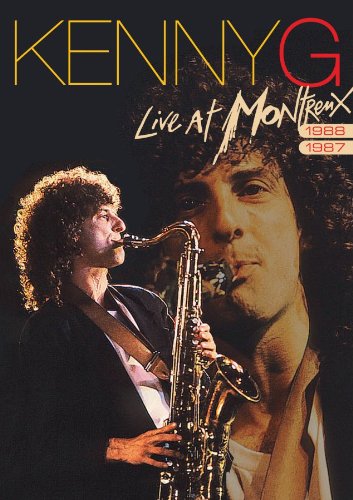
In 1987 Kenny G had released three albums already, but most of the world still didn't know who he was. He was already an accomplished musician who had played as part of Barry White's orchestra. He had dreams of taking his talents a bit further than that. But it's incredibly hard to get on the pop charts with instrumental music. It doesn't happen very often. That's not to say that it's unheard of. There have been a few instrumental pieces and musicians that have found huge success riding the international pop charts. Up until now Kenny G could not be counted as one of them.
All of that changed with the release of Duotones and the single Songbird. Both captivated the mainstream audiences and began to garner serious attention for the sax player. One of the results of that new-found recognition was an introduction to the world famous Montreux Jazz Festival. You had to show something to be invited to that stage. Kenny G appeared there in both 1987 and 1988. This DVD captures both of those performances. Fans won't need much of an inducement to pick up the release. It was an historic moment for the musician and his mostly Seattle-based band. It was the introduction of Kenny G to the world stage.