Disc Audio

During the Korean War, a platoon led by Laurence Harvey and Frank Sinatra is captured and sent off to Manchuria. Here the men are brainwashed into believing that Harvey saved them all in an incredible feat of heroism (which he did not) and that he’s a loveable guy (which he isn’t).The unfortunate Harvey is programmed to become a remote-control assassin. Back in the States, Sinatra is plagued by nightmare memories of the experience, and gradually comes to believe that something … really did happen. The question is whether he and Harvey can solve the mystery and discover the target before Harvey is triggered.

The Manchurian Candidate accomplishes a spectacular balancing act. It is simultaneously one of the most intense suspense thrillers ever to emerge from Hollywood, and an absolutely corrosive satire. Said satire is all the more brilliant for savaging both the extreme right and the extreme left of the political spectrum. Also of note is Angela Lansbury’s ferocious performance as Harvey’s gorgon mother. Only 37, and but three years older than the man playing her son, she is utterly convincing, and a villain for the ages. Unquestionably, this is director John Frankenheimer’s masterpiece.

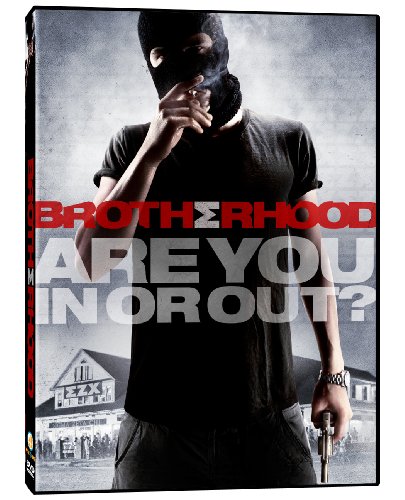
When I got to college, I had no idea what I wanted to be. I had signed up for computer science so I could go on to be a video game programmer. The truth is, I placed that as my major because I did not know what else to put. As luck would find it, five years later would get me a degree in Finance which I have never used in the professional world. But there was one thing in college I knew for sure. I wanted nothing to do with any fraternity and I am guessing Brotherhood is not going to change this opinion.

We start off the story with four frat guys in a van (if that van was down by a river, I’m out of here). Frank (played by Jon Foster), the pledge leader puts on a mask and runs out to rob a convenience store and comes back. He demonstrates that he wouldn’t ask the pledges to do anything he wouldn’t first. The other three are noticeably frightened because they think they will be arrested. Eventually one of the pledges decides to do it and when they hit the next store, he completes his task quickly.

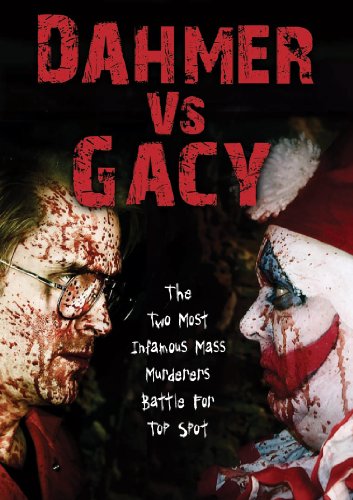
"The two most infamous mass murderers battle for the top spot."

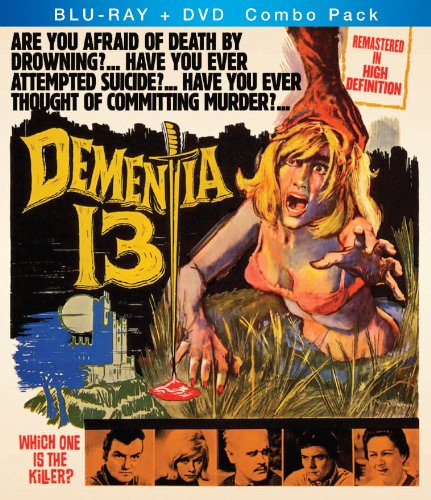
In 1972 he made us an offer we couldn't refuse. A couple of years later he followed it up with one of the finest sequels in Hollywood's history. Of course, I'm talking about Francis Ford Coppola. His movies are often considered epics. When Coppola paints, he tends to paint big. But it wasn't always like that for the once young director. He learned his trade, oddly enough, from the master of the B movie, Roger Corman. It was there that he learned to do more with less. It was there under the tutelage of Corman that Coppola and Jack Hill gave us one of the most atmospheric films to come out of the B movie machine: Dementia 13. It was another one of Corman's attempts to squeeze everything he could out of his resources. Coppola was working, mostly as a sound designer, on Corman's The Wild Racers. He offered Coppola the remaining resources to crank out one of his quick specials. Coppola put together a quick script that was intended to capitalize on the Psycho craze of the time.  The result was a creepy film that might have been better than the feature the funds came from, at least horror fans think so.

Louise (Haloran) is arguing with her husband in a row boat when he has an inconvenient heart attack and dies. The inconvenience for him is quite obvious. For Louise it means she won't be getting her hands on any of his family's money when Mother (Dunne) finally kicks the bucket. So Louise develops a quick plan. She dumps hubby in the lake and arranges things so it looks like he had to leave suddenly for business in New York. Meanwhile, she'll stay with his family at their castle and estate in Ireland. But, things don't go as planned. The family is still mourning the death of Kathleen (Dowling) many years ago in a drowning incident. Each year they have a private little ceremony, and the event has shaped their very existence at Castle Haloran. There's also someone with an axe to grind, preferably in the heads of unlucky victims. Good old family Dr. Caleb (Magee) plays detective and has the pond where Kathleen died drained, revealing an even deeper mystery. Who killed Kathleen and now members of the Haloran clan and anyone else unlucky enough to be in the wrong place at the wrong time?

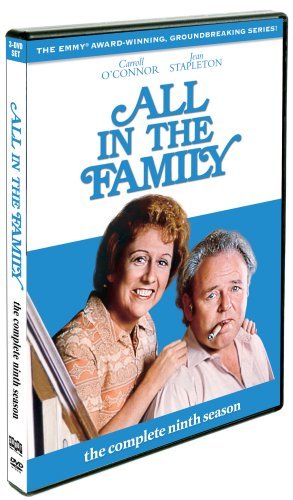
There were a lot of changes in store for the Bunkers in the 9th and final season. The biggest change was the addition of Stephanie played by Danielle Brisebois. She was the daughter of one of Edith's cousins. The girl was originally left with the Bunkers for what was supposed to be a temporary situation. Of course, the couple gets stuck with the 9-year-old girl and have to raise her. The matter is made worse when Archie discovers she's Jewish. Mike and Gloria have moved out to California but are not completely out of Archie's life. Archie and Edith make a trip out to see them and their grandson in a three-part episode, only to discover they have split up. This would lead to yet another All In The Family spin-off called Gloria. The release includes the three-part All In The Family Retrospective hosted by Norman Lear.

The series was first released through Fox for three seasons. Sony took over the releases for the next three seasons. Finally Shout Factory has stepped up and has taken over the release chores for this classic comedy.

Clowns have been a recurring obsession for Fellini, by the director's own admission, and after having been memorable presences in his films (perhaps most notably in La Strada), here they have an entire film devoted to them. Fellini here offers a mixture of biography, documentary and comedy. The film opens with a young boy (meant to be Fellini) first encountering (and being frightened by) clowns at the circus. Fellini's narration recounts how the clowns reminded him of real characters from the village of his youth, which cues recreations of those people, their actions essentially circus clown routines transposed to world outside the circus tent. Fellini then heads off to Paris in search of clowns and their history.

Fellini incorporates many clowning routines, and how well the gags work will, of course, depend on the individual viewer. But the value here is less that gags than the history and broader meaning of the circus itself. What clowns mean, what we take from them, what the different figures represent – these are the kinds of meditations the film engages in, and there is a great deal of melancholy and poignancy to go along with the broad slapstick. A fascinating piece then, originally done for Italian television.

Recently, I saw the brand new live-action film of Thor in 3d on a giant IMAX screen with some close friends (watch for the Hawkeye cameo!). All of us thought the movie was pretty good (though we really didn’t see the point of 3d, big shock). As to be expected, I knew (and hoped) an animated feature of Thor with his big hammer was right around the corner. However, when I received said feature, Thor was right on it, but he was holding a sword? This requires some further analysis.

We open the film to somewhere in Asgard, Thor is fighting a bunch of warriors, armed with swords. The shot suddenly pans up to an appreciative crowd. This would be what one would call a spectator sport. Thor goes back to playing for the crowd and even loses his sword in the process. But one of the combatants lets him pick back up his sword and continue the fight. This is also the time when Sif, a female who is handy with any weapon, shakes her head and walks out of the arena.

LXD is a two seasons of collected web shorts, originally appearing on 'Hulu.' A secret society is recruiting dancers and each short reveals prospects who demonstrate masterful performances of different, modern dance techniques.

At first glance, the concept seems to be a bit hammy and contrived. A random, elderly black man (Morgan Freeman must have been out of their price range) narrates in a almost broken hearted yet ever-wise tone, speaking in fortune cookie sayings with promises of mystical yet adventurous things to come. Thankfully, less time is spent on this and more time spent on profiling each dancing character.

"Once upon a time in the projects..."

Eddie Murphy co-created this controversial situation comedy that aired first on Fox and was later picked up by the WB. It was quite an original undertaking. The show was made using stop-motion. The process was very much like the traditional claymation process that brought such classic favorites like Gumby to life. But since the models were made of foam instead of clay, the process was dubbed foamation. There's a bit of a coincidence at play here since Eddie Murphy often played a version of the Gumby character on a regular basis during his stint with Saturday Night Live.

Sometimes I miss the days of my youth. Huddled in front of a thirteen inch color television set with the knobs you had to turn but not too quickly (or else you were forced to break out the pliers) to your desired channel. It seems like I watched so many sitcoms back then. Silver Spoons, Different Strokes, Facts of Life, etc. But I do seem to remember a show about a small child named Emmanuel Lewis who would play Webster. It was awfully cute back in the mid eighties, I wonder if it holds up today.

If you missed the first season of Webster, well all came to know Emmanuel Lewis as the little boy with a big heart that everybody loves. His original parents get killed in a car accident and then he is taken in by the Papadapolis’. The new parents are made up of George (played by Alex Karras), an ex-football player and Katherine (played by Susan Clark) who is just your average high maintenance socialite.