Disc Audio

“One night stands can be murder.”

That’s the tagline for 1987’s Fatal Attraction. Perhaps it’s no coincidence that both Fatal Attraction and the later Indecent Proposal were both directed by Adrian Lyne. Both were quite controversial upon their release. Both dealt in a kind of “what if” scenario that got people talking around their water coolers and watering hole gatherings. While the latter was pretty much a morality or ethics drama, the former was a gut wrenching morality tale with a Grimm’s Fairy Tale twist. Even if you’ve never seen the film you’ve at least heard of the “Bunny Boiler”, a term that’s entered the pop culture lexicon describing a woman who is likely to go psycho on you. The film was almost never made.

“Not like the brazen giant of Greek fame, with conquering limbs astride from land to land; Here at our sea-washed, sunset gates shall stand a mighty woman with a torch, whose flame is the imprisoned lightning, and her name: Mother of Exiles. From her beacon-hand glows world-wide welcome; her mild eyes command the air-bridged harbor that twin cities frame . ‘Keep, ancient lands, your storied pomp!’ cries she with silent lips. Give me your tired, your poor, your huddled masses yearning to breathe free, the wretched refuse of your teeming shore. Send these, the homeless, tempest-tossed to me, I lift my lamp beside the golden door!”

The inscription above can be found inside the pedestal of The Statue Of Liberty, and while it’s not actually printed where most depictions appear to suggest, it has become somewhat of a motto for this country. I certainly have a warm spot in my own heart for this welcoming attitude to immigrants from around the world. I am a product of Italian grandparents who made the journey here in the 1930’s for a better life. But that ideal has been somewhat abused as of late. Those brave ancestors that many of us can be thankful for our American life did so at great personal sacrifice. Without ever giving up their individual cultures, beliefs, and lifestyles, they did manage to blend into the American landscape and took pride in both heritages. They did not demand that America coddle them. They never imposed their language on the already present society. They practiced their beliefs and traditions without requiring others to accommodate them. They worked hard so that their descendents might not have to labor so much. In so many ways they became models not only for their descendants, but for what good citizenship means. They cherished this new country.

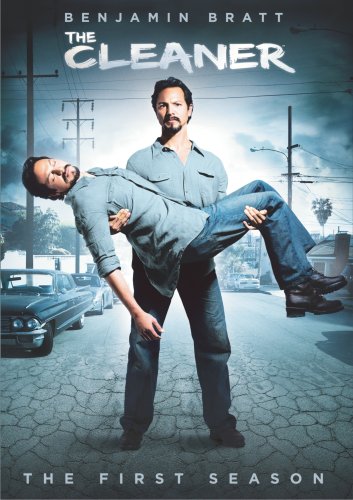
“William Banks has saved 257 people from addiction to drugs, sex, and gambling. He’s not a cop. He’s not a superhero. He’s just a man with a calling. This is his story.”

What he is, is Benjamin Bratt, returning from the thespian dead as William Banks, better known to the show’s fans as The Cleaner. Bratt hasn’t been seen much since he left the gig at Law & Order. I almost didn’t recognize him here. But, he’s returned in style. The Cleaner has all the characteristics of a police procedural series with a lot more excitement. His methods are often harsh. He’s your worst nightmare of an intervention. When Banks is called in, you haven’t hit rock bottom. Rock bottom has just hit you. The character is a recovering addict himself and does this as a kind of making amends. Of course he doesn’t work alone. He’s assembled a kind of Impossible Mission Force style team that helps with each case. Together they form a private company that a family member can call when they tire of a friend or family member’s addiction. The series was based on the real life story of Warren Boyd, who also acts as one of the show’s producers.

We’ve seen many instances of American television shows that have been inspired by or directly copied from British shows. This has been particularly true of comedy series and is not a new phenomenon. All In The Family and Sanford And Son from the 1970’s are great examples of American sit-coms based on British hits, Till Death Do Us Part and Steptoe And Son respectfully. Recently The Office has been a successful British import. In the inspired by category you have to include Mistresses. There’s no question that the show comes from a combination of Desperate Housewives and Sex In The City. Like those shows, this series tells the story of friends who have somewhat risqué love lives. The episodes delve into their quests for sexual excitement. It’s very much a chick thing. Unfortunately, we don’t have any members of the fairer sex here at Upcomingdiscs, so I ended up with the short straw. I got to see Mistresses.

The problem with this series is that it’s not even terribly exciting from the bedroom point of view. The plot is so slow and plodding that the girls talk a lot more than they do. If there’s one thing I learned as a writing minor in college it’s the old axiom: “Show us. Don’t tell us.” This series never took that writing class, and so I’m afraid we hear a lot more than we ever see. None of the girls are that particularly interesting. The show takes on the pace of a daily soap opera with far less installments. The whole thing is a big tease.

“The power of the Sun drives the seasons, transforming our planet. Vast movements of ocean and air currents bring dramatic changes, create some of the greatest wildlife spectacles on Earth.”

The Planet Earth series from the BBC brought with it critical acclaim and 11 hours of some of the most spectacular video footage from around the globe that we’ve seen on television. It was a particular treat to anyone who was fortunate enough to catch it on an HD broadcast. Not content with that work, the same team assembled once again to create this follow-up series, Nature’s Most Amazing Events. At first I was a bit skeptical and more than a little worried when I read that the series was going to focus on the effects of global climactic phenomena. I immediately expected another propaganda piece on global warming. If that’s what you fear/hope for out of this series, it’s going to surprise you. Instead the BBC crew takes the Planet Earth cameras to some of the most extreme climactic places on Earth. The piece examines not so much the climate, but the animals that thrive under these intense conditions.

“1941: Germany occupies Belorussia. SS death squads and local police round up Jews. Within weeks 50,000 are murdered. 1,000,000 more await deportation and death.”

Tuvia (Craig) and Zus (Schreiber) Bielski are brothers hiding in the forest surrounding after the abovementioned invasion. They are Russian Jews, which means concentration camps or immediate execution if they are caught. They are foraging and surviving on their intimate knowledge of these surroundings they have known since they were children. Before long other Jewish refugees make their way to the Bielski camp. Unable to turn away the suffering hordes, they welcome each arrival, stretching their already limited resources to the limit. The camp eventually becomes a force of freedom fighters. They are looked down upon by the Red Army because Jews weren’t expected to fight. For several seasons the growing number of refugees makes a stand for survival and even answers a call to arms in an ultimate act of defiance. The brothers split. Zus joins the organized army while Tuvia remains to lead the camp.

Back in the 1960’s the Beatles were telling, preaching, “Can’t Buy Me Love”. Of course this wasn’t a novel concept even then, and Lennon and McCartney certainly didn’t invent the phrase. In 1993 Indecent Proposal came along to question the age old expression. The film sparked one of those cultural philosophical debates that Hollywood loves to start. It meant that people would be talking about the film, and talk about it they did. Television and radio talk shows would spend a great deal of time talking about the morality or ethical questions involved. Experts in morality and psychology would earn a living talking about the subject. It caused quite a stir, but in the end Indecent Proposal was a one trick pony. After the debate got old, the film aged quickly. Watching it again now, it seems almost impossible that it’s really only 16 years old. It seems like decades ago that like a frightening tsunami, it made its splash and disappeared almost as quickly as it had arrived.

David (Harrelson) and Diane (Moore) are a young couple very much in love. It’s the kind of ultra-sweet relationship that could send you into insulin shock if you had to watch too much of it. Thankfully the plan here is to put a serious kink into the relationship. David is budding architect, while Diane is a successful real estate broker. Both run into hard times when recession hits and they lose their jobs. Their dreams appear on the brink of disaster. Down to their final cents, David takes a loan of $5000 from his father. As he admits in the film’s narration, it wasn’t nearly enough. They needed 10 times that to get back on their feet. So what do they do? These supposedly educated smart people decide to take the 5 grand to Vegas and turn it into the 50 grand they need. (Why didn’t I think of that?) Bad luck at the tables isn’t the most dangerous thing the couple faces. They meet John Gage (Redford), international billionaire and playboy. Sort of a Bill Gates, if Bill Gates looked like… well… Robert Redford instead of Alfred E. Neuman. Gage notices Diane and is quite taken with her. He befriends the couple to get close to her. After a part one night in his suite, Gage and David are shooting some pool. The conversation turns to wealth and what it can or cannot buy. Diane makes the statement that money can’t buy people or love. Gage proposes to test the concept. He offers the couple one million dollars for one night with Diane. They immediately refuse, but their situation eats at them and they eventually agree. What it does to their lives is predictable and inevitable.

Steven Bochco has amassed quite a nice little television empire over the years. He’s one of the most award winning producers in television history. He cut his teeth on Columbo and has never looked back. You know his work, or at least you’ve heard of it: Hill Street Blues, L.A. Law, and NYPD Blue are the most famous of these works. Bochco wrote the book on the ensemble police and legal drama. He counts as his students Dick Wolf and David E. Kelley, both of whom got their start working on Bochco shows. He’s had a few misses, to be sure. Does anybody out there remember Cop Rock? I didn’t think so. But, it’s been a little while since Bochco has graced the small screen, so it was with some eager anticipation that I attacked the new DVD release of his latest series, Raising The Bar.

The series involves a group of young folks in the legal profession. Some work in the public defender’s office. Some work for the prosecution. The catch is that they were all college buddies and attempt to keep the camaraderie together outside of the courtroom. Needless to say, it doesn’t work most of the time, as their interests often conflict. The characters include: Jerry Kellerman (Gosselaar). Jerry’s a character you’ve seen a hundred times before. He’s young, rather unkempt, and too principled for his own good. Yes, the series starts out with him willing to go to jail on contempt charges before bowing down to the tyrannical judge. He often faces Michelle Ernhardt (Sagemiller) who is determined to prove she’s more than just a pretty face in the courtroom. She’s desperate for respect, so winning becomes something of an obsession. It doesn’t help that, as the series begins, Bochco has them in one of his trademark opposite sides romances that he appears to plant in every series he’s ever done. The two are often refereed by Judge Kessler (Kaczmarek). She’s a rather morally bankrupt individual with political designs of her own. She doesn’t appear to think that the courtroom is any place for such quaint ideals such as fundamental fairness or justice. Of course, that sets the stage for many of Jerry’s dramatic stands. The public defenders are led by Roz (Whitman), who is rarely in the courtroom and is more of an administrator and shoulder to cry on. Then there’s Richard Wooslsley (Sears). He’s the mandatory rich kid who is rebelling against his father’s establishment mentality. So he works in the public defender’s office instead of in his dad’s political machine. Charlie (Scarfe) is the judge’s clerk and attempts to be the conscience she doesn’t have on her own. He flirts with her to manipulate her but is secretly gay, which is going to cause its own special set of problems. It seems that Angel’s Gunn (Richards) kept the legal knowledge he received through a spell at the infamous evil law firm on Angel. He’s now Marcus McGrath, but make no mistake. He’s still Gunn. He’s the smartest of the group and the most unfeeling. He constantly wants to prove he can overlook race and poverty in his cases and so is extra tough wanting to put them all away. He’s the ace prosecutor here. The prosecutors are led by Nick Balco (Graham) who doesn’t think guilt or innocence should play a part in the equation. It’s a constant source of irritation to him that these young lawyers try so hard to be friends.

What if you took the Desperate Housewives and placed them on an Army base? If that thought has been keeping you awake at night, sleep tight, gentle reader. You can find out simply by picking up a copy of Army Wives on DVD. I’m not exaggerating about this at all. Army Wives has the very same soap opera plotting and tone as the ABC hit does. You gotta really be into that sort of thing if you have any hope at all of keeping up with the antics of these four friends, or of having any desire to. I’m afraid I have to confess that I am not in that group and so found the 19 episodes to be very trying indeed.

The series follows the trials and tribulations of four wives of enlisted Army personnel. They call themselves “The Tribe”. Claudia Joy (Delaney) is the unofficial head of the group. The other women are Denise Sherwood (Bell), Pamela Moran (Brannaugh), and Roxy LaBlanc (Pressman). The show often focuses on their rather emotional situations and makes a center for itself in the idea that these women are there for each other. In this second season the Army life aspect of the show was intentionally held back somewhat, and the stories dealt more intimately with the wives. Likely a good move for the target audience that would have very little interest in the military aspects of the setting.

“You’ve gotta know what you’re doing when you go in. You gotta have it figured out. Those are the rules. How you get in. How you get out. How many shots you’re gonna need. Make sure you know where everybody is. Make sure nobody sees you. Don’t hang around. Don’t get interested. Then you don’t make mistakes.”

How many times have we seen some criminal looking to do that one last job that can get them out of the business forever? This time it’s a hit man known as “The Chief” or “blackbird” (Rourke). He’s an American Indian, and he’s considered one of the best in the business. He sticks religiously by his rules. As the film opens we see that he kills a young woman in the shower just because she saw his face. Unfortunately for Blackbird, the girl happened to be sleeping with the guy who hired him. That guy’s not so happy that she got killed during the job. Now the hunter’s going to become the hunted as the boss wants revenge for the girl’s death. Enter Richie Nix (Gordon-Levitt) who’s a young punk super crook wannabe. He’s been threatening a car dealer he intends to shake down. To get wheels for that job he jacks a car that happens to be driven by Blackbird. The two end up becoming somewhat kindred souls, and Blackbird needs a place to lay low, so he agrees to school Richie and help him pull off the job. Of course, that doesn’t go well, and a woman at the dealership gets a good look at them. She and her husband get away, but now Blackbird and Richie have to track them down and kill them. The couple, Wayne (Jane) and Carmen (Lane) have already had their share of problems and were about to split up when they’re forced into witness protection. The two rekindle the old romance somewhat while trying to stay alive.