Posted in: Disc Reviews by Gino Sassani on April 10th, 2009
Doubt is a case of art imitating art imitating life. John Patrick Shanley based the character of Sister James on a real sister that he knew as a child. He grew up attending Catholic school, and Sister James was one of the nuns he knew during that experience. While the character was based on something real, the events were not. He took this familiar character and developed the fictional story of Doubt around her. This story became a play. W hen it came to adapting the successful play into a movie, John Patrick Shanley took on the job nearly singlehandedly. Now, I’m not a huge fan of these one man writer, director, producer affairs. The infliction of a single voice on a film often results in a movie that plays too much like an inside joke. Nothing is more tedious to watch than a person laughing at their own jokes. So, I went into Doubt expecting that recipe for disaster. Much to my surprise, I discovered that there really are rare exceptions to any rule. Doubt is that rare exception, without a doubt.
Meryl Streep is Sister Aloysius. She is a very conservative sister who can’t let go of the strict traditions of the past. She has taken a strong disliking to the new parish priest, Father Flynn. Flynn is a progressive priest who embraces the new changes the Church has undergone under the recent Second Vatican Council. The film is set in the early 1960’s shortly after the Pope John XXXIII’s proclamation. She takes exception to the fact that he writes with a ball point pen, takes sugar in his tea, and likes Frosty the Snowman, which she believes promotes such ideas as witchcraft to children. She admonishes the nuns under her supervision to watch the priest for anything suspicious. When young Sister James (Adams) calls a particular incident to her attention, she latches on to the information in an effort to bring down the priest. It appears that Father Flynn has taken a young boy under his wing. The boy, Donald Miller (Foster) is the Catholic school’s first black student and not the most welcome young lad. Father Flynn’s special attention is at first interpreted by Sister James as suspicious when Donald returns to her class from a conference with the priest acting considerably distraught. Now Sister Aloysius suspects the boy was molested. She confronts the priest and engages in a brutal campaign to have him exposed, or at least removed from the parish. All the while Sister James becomes more and more convinced she has misjudged the situation and set in motion a terrible injustice that she is now powerless to contain. Her doubt wears heavily on her soul.
Posted in: Disc Reviews by David Annandale on April 10th, 2009
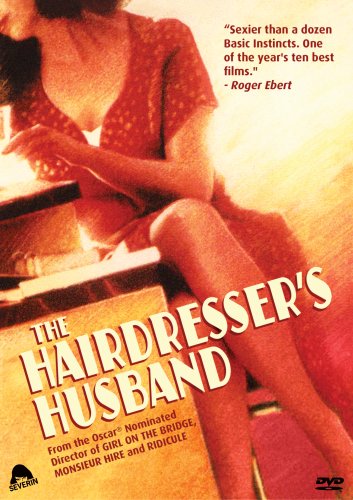
A middle-aged man (Jean Rochefort) recounts his youthful sexual awakening to the charms of the local hairdresser. Developing a fixation on the erotics of a women cutting men's hair, he resolves to marry a hairdresser, and decades later, he gets his wish. His wife is the lovely Anna Galiena, and once wed, they rarely leave her little shop (indeed, they also get married there).
Writer/director Patrice Leconte is dealing with a pretty specialized fetish here, but he in the early goings, he actually comes close to making us understand Rochefort's obsession. Leconte's precise attention to sensual details sells us the young boy's developing passion, but in the long run, the older Rochefort's inclination is rather harder to take seriously, or even be that interested in. The couple's idyllic life in the salon is obviously not mean to be seen in any realist sense, but even as a parable, it's rather thin. Rochefort spends his days doing crossword puzzles while Galiena reads gossip magazines, gazing adoringly at her as she tends to various customers (whose eccentricities feel like the inevitable conventions of this sort of art film, even as they do provide a necessary spark of life to the very still narrative), and launching, at the drop of a hat, into improvised dances to Arab music. This last quality is supposed to be charming, but by the third number (in a short, 82-minute film), it is simply irritating. Having created a situation where, once the courtship is accomplished (a matter of mere minutes of screen time), nothing can happen, Leconte decides to wrap things up with a conclusion that is clearly supposed to be poignant, but is utterly fatuous. The film is delicately wrought, and quite lovely, but also fundamentally empty-headed. In the end, it comes across as little more than a precious presentation of a middle-aged, rather misogynist fantasy.
Posted in: Disc Reviews by Gino Sassani on April 10th, 2009
Jim Carrey’s life and career are in a sort of mid-life crisis. He has avoided doing his usual goofball comedy films and opted for more serious roles. His appearance in Number 23 was a bit of a shock for most of us, but he pulled it off reasonably well. Even his more recent comedies have often been less about one crazy character and more about the story elements. It seems that he has decided it was time to return to the parts that made him a household name with Yes Man. But after watching Yes Man,,I have to wonder if maybe that genre has passed him by. For the first time, you really start to see age catching up on the crazy actor, and while he still has tremendous timing, he doesn’t look altogether quite right when he brings out the twisted faces and expressions anymore. It’s not a dig at Carrey at all. Still, it can’t be very good for a comedy, particularly one with a romantic element to it, when your first reaction is that the lead’s starting to look a little old. It’s not even that he looks bad. He just might need to tone down the goofy and concentrate on being more sincere. When Carrey takes that approach in this film he’s far more believable and, yes, that much more funny.
The story is almost a direct riff from his Liar Liar plot. In this one Carrey plays Carl Allen. Carl is a loan officer at a local bank. He was divorced three years ago, but he still hasn’t gotten over it. He’s become somewhat reclusive and self absorbed. He finds all manner of excuses to avoid doing anything with his friends. Instead he spends each night falling asleep watching rented movies on television. What’s worse is that he doesn’t even know that he’s miserable. One day at lunch a former coworker, Nick (Higgens) approaches him as he’s eating lunch in front of the bank. He tells Carl about how a motivational seminar has changed his life. He invites Carl to come to a workshop, but Carl drops his usual no thanks on him. But later Carl begins to realize how detached he’s become and has a scrooge-like epiphany at just how lonely he is. So, predictably, Carl goes to the seminar. Here motivational Guru Terrance (Stamp) preaches the gospel of Yes. He challenges Carl to merely accept every opportunity that comes his way. He commits him to a covenant to say yes to anything. As soon as Carl leaves the building the expected situations arise, where most sane people would say no. In a series of Yes’s that involve a homeless man, Carl begins to have second thoughts when his affirmative replies appear to put him in a bad situation. That is, until he meets Allison (Deschanel). Suddenly his new life appears to bring him a bounty of experiences and pleasures. As you might expect, it’s all leading to some rather uncomfortable consequences. But, as all “feel good” films must, Carrey eventually learns to live his new life in moderation and lives happily ever after.
Posted in: Disc Reviews by William O'Donnell on April 8th, 2009
This is the fourth film in the Poison Ivy series and its star power has descended from Drew Barrymore, to Alyssa Milano, to Jaime Presley, and has finally fallen on Degrassi: The Next Generation actress Miriam McDonald; which is sure to fulfill a handful of strange Canuck fantasies.
McDonald plays Daisy, the new girl on campus who is apparently a "tom-girl" because she wears jeans...and is from the country (I guess). It's a fish-out-of-water story to start where she is scoffed at by the cool girls for showing up in a taxi, and gets a meet-cute moment with the richest boy on campus. She turns out to be the biggest prospect in the whole Political Science Department, despite being a freshman, which makes her a target of the "Ivys."

Posted in: Disc Reviews by Gino Sassani on April 8th, 2009
John Patrick Shanley brings his thought provoking play to the big screen in 2008’s best picture, in my book, Doubt. The Academy likely shied away from the controversial content, likely because it doesn’t make it clear this priest must have done what he’s accused of doing. Many of the actors received deserved nominations, but the film was generally snubbed in the final verdict. While I enjoyed Slumdog Millionaire, for Doubt to not even get the Best Picture nomination is a crime.
Posted in: Disc Reviews by Gino Sassani on April 8th, 2009
“Some of the old time sheriffs never even wore a gun. Most folks find that hard to believe. Jim Scarborough never carried one, that’s the younger Jim. Gaston Boykins wouldn’t wear one up in Comanche County. I always liked to hear about the old timers. Never missed a chance to do so. You can’t help but compare yourself against old timers. Can’t help but wonder how they would have operated in these times.”
I know I’m getting old myself when a film set in the 1980’s is now considered a period piece. And No Country For Old Men is about as much of a period piece as anything else. More than any part of the story, it’s the mood and the atmosphere of this movie that makes it work on so many levels. Trouble is, no matter how many times you see the dang thing it doesn’t get any easier to categorize what exactly it is. Sure, it is set in the 1980’s, but truth be told it could have just as well been set in the 1880’s. Has West Texas even changed all that much in those 100 years? Watch this movie and you’ll be asking the same question. No Country For Old Men is as much a western as it is anything else. Some call it a “modern western”, but I don’t like that term a whole lot. I mean, when you stop and think about it, what exactly is a “modern western”? I guess you could just as easily answer, No Country For Old Men.
Posted in: Disc Reviews by Gino Sassani on April 8th, 2009
It’s official. I’ve just totally given up on Adam Sandler. Honestly, I haven’t laughed at anything he’s done since the music video for The Lonesome Kicker. How many times can the same absurdity and Romper Room antics work on a film audience? Even in a Walt Disney film that required Sandler to clean up his act a bit, the same sophomoric humor was showing through the threadbare shtick. You just knew there were times he wanted to let loose with some off color remark or obscene gesture. While I was pleased that he gave it the effort, it’s like asking a mute man to talk after you just tied up his hands. There are some moments of genuine warmth with the kids. The guy’s probably a very nice and likable guy, it’s not personal. I’m just tired of the same Happy Gilmore character, just stuck in different situations. Think about it, aren’t they all the same person: Zohan, Gilmore, Little Nicky… The list goes on ad nauseum. A shame, really, because this thing might have had legs with another lead in the role.
Once upon a time in a small hotel, Marty Bronson (Pryce) was trying to run his small family business. Unfortunately, while Marty might have been a great guy, he didn’t have a head for business. He’s forced to sell out to a large hotel chain, owned by Barry Nottingham (Griffiths). The thing that put the deal over the top was Nottingham’s promise to let his son Skeeter (Sandler) run the hotel when he was older. Alas, as I always told my law students in my teaching days: Get it in writing or the promise isn’t worth the paper it’s not printed on. Nottingham does keep Skeeter around, however, as a handyman. Unfortunately he’s treated as a nobody by the entire staff, accept Mickey (Brand). Skeeter’s life is about to change. First, he is given charge of his niece, Bobby (Kesling) and nephew, Patrick (Heit) while his sister, Wendy (Cox) is out of town looking for a job. She’s the local elementary school principal. She’s also a crazy control freak liberal who feeds her kids cakes made out of sawgrass and prohibits such wasteful activities as television watching. Of course, brother Skeeter is going to change all of that. Wendy leaves her friend, Jill (Russell) to help out with the kids and take the “day shift” since she’s also a teacher at their school. But Skeeter’s life might change for the better when he’s given an opportunity to run the new and improved Nottingham Hotel that will replace the current one. If he can come up with a better theme than Nottingham’s future son-in-law and all around kiss up, Kendall (Pearce), he’ll be allowed to finally run the hotel. It doesn’t hurt that he discovers magic in his niece and nephew. It seems that when the three of them engage in some ad lib storytelling (the kids’ books all look like they were written by Captain Al Gore) the stories begin to come true. If he can only manipulate what the kids come up with in his favor, he might just get the big chance he’s been waiting for and even win the girl of his dreams, which he thinks is Nottingham’s Paris Hilton knock-off daughter, Violet (Palmer). Needless to say, it won’t be easy, but Skeeter finds a way to become the hero. Oh, and there’s one of the worst CG creations since Lucas unleashed Jar Jar on an unsuspecting Star Wars fan base. In this case it’s a CG enhanced guinea pig named Bugsy, because of his obnoxiously large eyeballs.
Posted in: Disc Reviews by Gino Sassani on April 8th, 2009
“The Black Freighter, the Hell bound ship’s black sails against the yellow Indies sky. I know again the stench of powder and men’s brains and war…more blood”
Zack Snyder had a big problem. He was trying to make a film out of a graphic novel that many acclaim as the best graphic novel ever written. Many directors before him have declared the project unfilmable. Alan Moore, the writing part of the book’s creation team, was dead set against a film version of the book and refused to have his name associated with the film. A lawsuit had broken out between Warner and Fox over who exactly owned the rights to even make the movie. The fans were making their expectations known loud and clear: Mess this up and we’ll get you for it. Did I say Zack Snyder had a problem? On second thought he had several, and not the least was that he found himself staring into the abyss of an unreleasable four hour film. Cuts were going to have to be made, severe cuts. One of those cuts was the comic within a comic story of The Black Freighter.
Posted in: Disc Reviews by Gino Sassani on April 6th, 2009
“A dog has no use for fancy cars, or big houses, or designer clothes. A waterlogged stick will do just fine. A dog doesn’t care if you’re rich or poor, clever or dull, smart or dumb. Give ‘em your heart and he’ll give you his. How many people can you say that about? How many people can make you feel rare and pure and special? How many people can make you feel extraordinary?”
In the name of full disclosure, I should probably give you a little background in the circumstances in which I find myself watching and reviewing Marley & Me. If you’re a regular reader of this site and my reviews, you have come to learn that I have a Siberian Husky named Athena. You’ve come to know this because I have, from time to time, allowed her to “review” many of the various dog films that have come my way for this site. You also know that Athena retired recently with her review of Walt Disney’s Bolt. What you don’t know is the reason behind the retirement. About three weeks ago, Athena was diagnosed with bone cancer in her front left shoulder. At 14 years old, there really isn’t much that can be done. She was given anywhere from two weeks to a couple of months, on the outside, to live. We’re able to control any pain she has with medication. In fact, the medication has often given the illusion that she’s getting better. We know she’s not, and that it’s only a matter of time from here on out. It’s a tough situation to be in, as I’m sure any dog owner out there realizes. So far, Athena’s still with us. She’s beaten the lower estimate and continues to avoid too much discomfort. But, the sad reality is that my wife and I are watching our 14 year old companion in her final days. This is not the place you want to be in your life while watching Marley & Me. It might have been the toughest film I’ve had to watch in nearly 10 years of reviewing movies, in one form or another. Enough about my situation.
Posted in: Disc Reviews by Gino Sassani on April 6th, 2009
Slumdog Millionaire has become the latest “must see” Best Picture award winner. While I actually liked the film better than I imagined I would, it’s precisely because the movie is not what it appears, or at times claims to be. If I just took the buzz and advertisement campaign to heart, I would expect a Bollywood picture to the extreme. If you’re not really sure what that term means, I can tell you that this movie will not really clarify anything for you. The traditional Bollywood, Indian made films, feature intense tragedy and love stories. They are usually swimming in song and dance numbers.Looking at the film’s television spot, it would seem that that’s exactly what this movie is. The problem? The song and dance that tends to dominate these spots is not even in the film proper. Rather, the only musical number occurs over the closing credits. Now, while all of this may sound like criticism, it’s actually not. I’ve seen Bollywood productions, and they’re just not up to my tastes. I never fidgeted and yawned so much in my life. That doesn’t mean they’re bad, by any means. I’m sure that there are some that are quite good and entertaining for some people. I’m merely not one of those folks. So, when I discovered that Slumdog Millionaire was going to land on my front door to watch and review, I began to sweat a little bit. How, I asked myself, am I going to handle having to blast the darling of the Hollywood circuit? Am I ready for the barrage of hate emails a negative review is likely to elicit? Fortunately, for us all, this is nothing at all like a true Bollywood film, and try as he might, Danny Boyle just can’t escape his own natural tendencies. In fact, I didn’t fidget or fuss at all. It’s a pretty good film, after all.
A few years ago Who Wants To Be A Millionaire was quite a large phenomenon on American television. The original game show, hosted by Regis Philbin, dominated the primetime airwaves. ABC milked that cash cow for all it was worth, and before long it seemed Millionaire was on just about every night. But, like all fads, the luster wore off, and the show began a steady decline. It survives today, but with lesser known hosts and as a half hour syndication show, usually aired pre-primetime. I’m told the show continues to be a hit abroad, and particularly in India. Whether or not that’s true, I can’t confirm. You do need to accept that premise, however, to buy into the movie. It doesn’t hurt to have at least a passing familiarity with the game’s general format. It looks very much like it did here. A new host and, of course, the currency is in local tender. Still, the spirit of the game we know here exists in India, according to the film.