Genre

"The Invasion" is a remake of the classic "The Invasion of the Body Snatchers". This time around, Nicole Kidman and Daniel Craig are the heroes that uncover the diabolical truth behind a secret plot to take over the world. This is a film that has been re-made several times before, in various forms. Each time, the film is turned into a heavy-handed metaphor for the current political climate. That is most certainly the case this time around as well, as the oblivious citizens are expected to accept everything their leaders tell them, no matter how implausible that information might be. I'll spare you the pop politics, but the parallels between the Bush administration and the story are rampant.

I don't have the slightest problem with films that use metaphors as long as they are done in a subtle and graceful way. Unfortunately, there is absolutely nothing subtle and graceful about this film. Forty minutes in, there is a montage scene that is meant to shock the viewer, "The Usual Suspects" style, by showing a series of fast cut images to help the viewer put together the plot in their own minds. The real problem is, by the 15-minute mark, the whole of the plot is obvious to even the most oblivious viewer, and the remaining hour-and-a-half are spent laboriously trudging through to the inevitable conclusion.

Blackgate Prison is built on ground where massacres of one sort or another have occurred throughout the history of the United States. When a disused wing of the prison is reopened, all sorts of nastiness emerges. Michael Paré is the officer called in when a guard mysteriously commits suicide, but that is only the first of many unexplained deaths yet to come.

So here we go with another haunted prison film, and a great deal that we have seen before. Take a cinematic tone that seeks to borrow the eeriness of Session 9 (but fails), mix in creepy little girls in jump-cuts (from the J-horror remake of your choice), and season with a cast that’s a collection of down-on-their luck pros (Tom Sizemore) and a lead in Paré who clearly took the part when From Hell It Came’s tree turned the role down for something with more range. Wake me when it’s over. Our hero’s performance is not helped by a script that appears to be composed entirely of lines from CSI fan fiction.

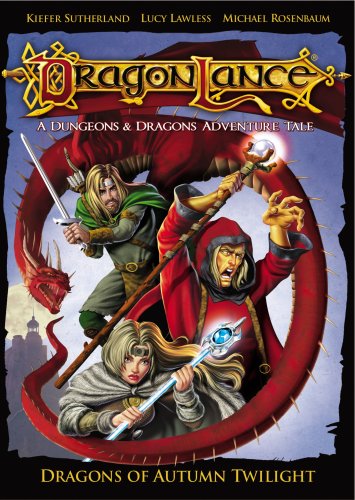
My college life was usually spent doing two things. Okay, actually three things. One, studying (nearly unsuccessful) . Two, trying to get women to sleep with me (mostly unsuccessful). Three, playing Dungeons & Dragons. I owned a good dozen dice from a D3 to many assorted D20's. Want to scare a fellow gamer? As DM, roll for damage and bring out 5 D20's. Anyhow, around this time I also discovered D&D adventure books. I read primarily the works of R.A. Salvatore & Ed Greenwood (Drizzt & Elminster). So needles to say, I was a little intrigued when I saw a Dragonlance movie in my pile. The original book was published in 1984, a few years before I really got into D&D. But with dragons, elves & a mad mage; it was a surefire recipe for something wonderful.

Tanis (voiced by Michael Rosenbaum), a half-elf comes upon his old friend, a dwarf named Flint Fireforge. The two are also joined by a kinder named Tasslehoff Burrfoot. They decide to go to their local hometown tavern where they meet up with their other friends. First there is a knight named Sturm Brightblade. Beside him are two brothers, one a warrior named Caramon Majere. The other, a young mage named Raistlin Majere (voiced by Kiefer Sutherland). Off in the corner, an older mage named Fizban is telling tales of long ago (what he can remember anyways)about the gods of light and their ultra powerful healing magic that has since left this world.

I’m going to be honest with you, I can’t stand the stand up comedy of Robin Williams. Growing up, I used to like it and thought it was pretty hilarious, but two things have changed since then. First off, my voice changed and I grew hair in strange places, but secondly, Williams stopped doing cocaine, which as any artist will tell you, seems to neuter them creatively (Eddie Van Halen, I’m looking at you). But hey, at least in his later years he seems to have mellowed out and Patch Adams seems to be a progression of that.

Steve Oedekerk (Bruce Almighty) adapted the book that Tom Shadyac (Evan Almighty) directs here. Williams plays Hunter Adams, a man who attempts to commit suicide and admits himself to a mental institution, where he finds a connection with his roommate in the ward. He decides to rededicate himself, and goes to medical school where admittedly he’s a little bit older than some of the other students there, including his highly qualified roommate Mitch (Philip Seymour Hoffman, Capote). His intellect is exemplary, but he seems to throw off the school’s staff and president (played by Bob Gunton of Shawshank Redemption lore), because his personable nature goes against his vision, and Adams’ “excessive happiness” eventually cracks the visage of Corinne (Monica Potter, Without Limits), who becomes the requisite love interest to the film’s protagonist.

Beowulf is one of the oldest written stories known. The story began as a heroic tale passed from generation to generation only by word of mouth. Naturally there’s no way to know how much the story changed during those years of oral tradition. The author of the piece is unknown, and it is likely several persons contributed to the work. By the 8th Century an epic poem was written that forms the story as it is remembered today. Several translations have followed over the years, resulting in many variations of the story. This very impressive history makes Beowulf a natural to be filmed. There are so many versions that there is little worry about following a beloved canon. Second, the story is flourishing with wonderfully imaginative creatures that can now be savored ever so much more with the development of CG technology over the last 20 years. I’m honestly quite surprised that it has taken this long for this kind of a movie to find its way into release.


Dorky romantic comedies have been around forever. Usually there is nothing I can't stand more than some movie telling me how people fall in love when it never happens like that. Like a street walker falling in love with a rich guy or the nerd getting the cheerleader or a dozen people having sex with some girl named Jenna. (well maybe on the last one) Love is mystical and special but it rarely has any set pattern that makes sense. So what would happen when I watched a dorky little New Zealand romantic comedy that featured two people in animal costumes? Hopefully not the norm.

Lily (played by Loren Horsley) is in love with Jarrod (played by Jemaine Clement). She works at a local burger joint (Meaty Boy) asc a cashier. Jarrod comes in everyday at lunch but Lily rarely gets to wait on him since he has a crush on another employee. Opportunity knocks when Jarrod gives Lily an invitation to go to an animal costume party. She decides to go as a shark. There at the party she participates in the "Fight Man" tournament which is a video that vaguely looks like Way of the Warrior (an old 3do fighting game) and Mortal Kombat. Somehow she makes it to the final where she faces Jarrod (dressed as an eagle) in the final challenge. However, she becomes lost in Jarrod's eyes and loses out to him.

Guy Pierce fascinates me. He first broke on the scene in a big way in LA Confidential, which just happens to be one of my favorite films. Instead of taking the path of his co-star Russell Crow and chasing the big Hollywood dollar, however, Pierce chose to explore smaller, more interesting fringe films. Sometimes, this decision pays off for him, as was the case in the amazing Memento, or the recent The Proposition. Other times, however, the gamble falls flat, as was the case with The Hard Word. Pierce is consistently excellent, but the films he picks are hit and miss. That's the problem with interesting projects, they either turn into surprise hits, or predictable failures. So the big question is, is First Snow a hit or a miss?

First let's talk about the plot. Guy Pierce plays a salesman whose car breaks down in a remote part of the country, and while he is waiting for repairs, he visits a traveling fortune teller to pass the time. What starts out as a lark turns into a profound experience that alters the course of his life forever. The fortune teller informs him that his life will be over at the first snowfall of the season, and he slowly begins to believe him.

Written by Jane Austen, Pride and Prejudice has been made into a film several times, with varying results. The novel itself is a classic, written by one of the most pioneering woman in literature history. This 2005 film version stars Keira Knightley (Atonement) as Elizabeth “Lizzie” Bennett, one in a family of five sisters, living in Hartfordshire, a small English country town. Lizzie is the second-oldest sister and should already be married, according to her overbearing mother (Brenda Blethyn, Beyond the Sea). However, much like Jane Austen herself, Lizzie wants to marry for love, and not just to please her parents (although her father (Donald Sutherland, JFK) just wants her to be happy). To add to her parents concern, once they die, the girls will have nowhere to live, as back in those days, property and money passed only to males, and in their case it goes to the girls’ cousin, Mr. Collins (Tom Hollander, A Good Year).

The family gets a reason for excitement when they find that the rich and single Mr. Bingley (Simon Woods, Rome) is coming to town. What they didn’t realize is that he has a few people with him—his sister, the stylish and snobby Caroline Bingley (Kelly Reilly, The Libertine), and Mr. Darcy (Matthew Macfayden, Grindhouse), his best friend. The Bennett family meets the Bingley’s first at a ball, where Lizzie’s older sister, Jane (Rosamund Pike, Fracture), comes into contact with the handsome Mr. Bingley. They’re both smitten, but Jane is shy and doesn’t show her emotions readily. Lizzie finds Mr. Darcy to be quite rude, and clashes with him and his opinions of “country folk.” Before it seems as though Jane will be offered a marriage proposal from Mr. Bingley, he and his posse leave Hartfordshire, giving essentially no reason except to say that Mr. Darcy misses his sister. They do return, but before that, Mr. Collins comes and stays with the Bennetts, looking for a wife. He has his sights set on Lizzie and offers her marriage, something Lizzie wants nothing to do with.

Just another working day in Los Angeles. Lexi (Mary McCormack) heads off for the commute, while hubby Brad (Rory Cochrane) stays home. His morning ablutions are interrupted by the news that a series of dirty bombs have just gone off in the city. Stymied in his attempts to reach his wife, Brad retreats home, where he acts on the instructions to seal up the house, as the bombs have released a deadly toxin. When Lexi does return, Brad cannot let her in, as she is contaminated. How's that for a strain on a relationship?

The first act of Right at Your Door is a propulsive exercise in panic. There is a genuinely alarming realism to the depiction of LA under terrorist attack, accomplished through a judicious and restrained use of FX and convincingly freaked-out radio news reports. This section of the film will not only conjure unpleasant memories of 9/11, but will generate a deeply distrubing you-are-there sensation for viewers. Once Lexi returns, the film becomes less about the attack then about the individual responses to it, and the action shifts to the emotional domain. After the frenzy of the first half hour, the second act inevitably feels a bit slower, and one has the impression of the plot marking time until the conclusion can begin. Said conclusion is dark and twisty, and very much in keeping with the bleak zeitgeist the film is tapping into.

World War II has just ended, and the recently discharged Robert De Niro hits New York on the prowl for sex. He runs up against WAC Liza Minnelli, and the more she resists his advances, the more determined he becomes. There is more: he is a saxophonist, and she (of course) is a singer). So begins a tempestuous relationship between two artists whose enormous talents and equally enormous personalities mean they can neither live with nor without each other.

The idea of Martin Scorsese taking on the form of the classic musical is so bizarre that it had to happen, and here it is. Scorsese’s conceit is ingenious: all the conventions are there (the meet cute, the songs, the artificial sets and colours), but they collide with the naturalism of the performances and the emotions. A perfect case in point: wandering the streets at night, De Niro sees a sailor and his girl perform a dance together. It is a classic musical moment, but the only sound is that of a train passing. It is a scene of extraordinary beauty, grit, and cinematic truth. And it belongs in an extraordinary film.