Genre

A group of former college friends (now apparently weathered by life, though they look as if they are CURRENT college friends) gather at beach cottage for a reunion. Stresses and resentments within the various marriages and couplings quickly put a damper on the weekend, and a desultory evening’s conversation leads to a few members of the group playing the party game that consists in reciting “Dead Mary” in front of a mirror. Inevitably, the evil spirit is summoned, and people start being killed off. Victims have the unfortunate habit of reanimating, however, which leads to mounting paranoia, as no one knows who can be trusted to still be human.

So the rather odd cross-fertilization that we have here is Friday the 13th with John Carpenter’s version of The Thing. Miraculously, an abrupt ending with several loose ends aside, the mix works, thanks in no small part to a strong cast and sharp dialogue that make our group far more believable (and thus sympathetic) than one has come to expect in films of this kind. It ain’t perfect, but it sure ain’t bad, either.

It's really hard for me to review films such as this one. On the one hand, I firmly believe in film preservation, and the importance of not shying away from history, no matter how painful it may be. On the other hand, it's difficult for me to enjoy a film that so casually deals with the trade of humans. Band of Angels tells the story of the daughter of a plantation owner who is sent away to school. Her father is a good and kind man, for he has never beaten his slaves. When he falls deathly ill, she rushes back...to the plantation to be by his side. Upon his arrival, she finds her father dead, and slave traders waiting for her. As it turns out, her mother, which she has never met, was a “negro”, which means that she is to be sold at market with the rest of the slaves.

Starting to see why I was so uncomfortable now? The thing is, I can see the noble intentions behind this film, originally released in 1957. Clearly, this is a film that means to convince audience members that slavery and racism are wrong. However, it's hard for me to hear that message when the dreaded “n” word is being thrown around so much. To be fair, the second half of the film is much more friendly for modern audiences, but I just can't say that I felt right about watching this thing. It's a shame too, because both Clark Gable and a very young Sidney Poitier have major roles which they handle quite well.

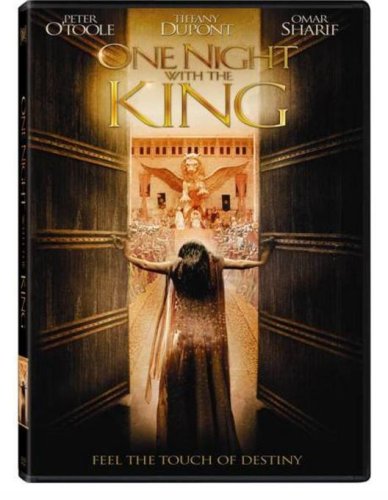
The Holy Bible has been the source for many incredible epics. One might argue that the Book itself is the first epic. From De Mille's Ten Commandments to Gibson's recent Passion of the Christ we have been enthralled by tales of faith and the divine since the very birth of the cinema. One Night With The King has all the essential elements to take its place with these classics. The cast includes some of the greatest actors alive in Omar Sharif, Peter O'Toole, and John Rys-Davies. The settings are some of the most beautiful desert lands on earth. Sadly, One Night With The King stands very small in the midst of such brilliance. The film means well, certainly. The story of Esther is not one that has been told on any scale before and is very much worthy of the effort. There appears to be an overwhelming lack of spirit throughout the overlong film. The film always feels staged and the dialogue often too modern sounding to create the necessary illusion. Sharif must have suffered immeasurably opposite a rather forced and dull Luke Goss. Unfortunately a great amount of talent and effort appears wasted on this sub-par film.The supporting cast is simply horrible. There is no dialog discipline at all. Phrases constantly move from modern to mock Shakespearean to gibberish. James Callis is reproducing his Baltar role here.

The story of Esther is actually a compelling one. Based more on the novel Hadassah than the Biblical account, the film has a story with enough potential. She was a young Jewish woman living in Persia. Jews have lost favor in the kingdom and are openly persecuted. Hadassah changes her name to Esther to avoid the ethnic liability. When the Queen defies a summons by her King, she is released from her royal position. Esther finds herself in competition to become the new Queen. It is from this position she hopes to better the plight of her people. The story soon descends into the clichéd plots of intrigue about the crown. Various plots are made and uncovered that put Esther in a vulnerable position. She must eventually reveal her true heritage and once again win over the King's heart. The script ventures down far too many side roads and soon becomes tedious to follow.

KISS fans will likely feel like they're in heaven with this quasi-intimate look at the long-tongued demon of rock. All others might be tempted to stay away, and yet, that might be a mistake. Let me first admit that I'm no fan of reality television or KISS. With that said, you might be expecting me to trash this particular program. Wrong! Honestly, as an outsider I have the unique ability to judge the show without all of the trappings of the band's fame and history.

I'm not sure if it's a case of morbid curiosity, but I ended up somewhat liking the show. At about 21 minutes an episode, it's just the right length. Even if I did find this stuff entertaining, there was only so much of Gene's family I could take in one sitting. The premise is simple and has been done to death by now. Cameras follow some famous person or family in the hopes of providing compelling drama for millions of viewers. OK, so that's a bit of an exaggeration, but so is the idea that we're going to get an intimate inside look at these folks while the cameras are rolling. It's a lot like wrestling. If you don't buy into that what you're seeing is actually real, you can get a few laughs out of the whole thing. I will also admit this show destroyed a lot of the Gene Simmons mystique for me. Let's face it. Can you ever watch the stage persona in the same light again after watching Gene scoop kitty litter or wash his dog by throwing him in the pool? Let's not even talk about an attempt to get semen from a bull. Still, Gene turns out to be an interesting character very much removed from the one we're so used to seeing. While Gene dominates the show, there is plenty of time given to wife Shannon Tweed, from Playboy and soft porn films.

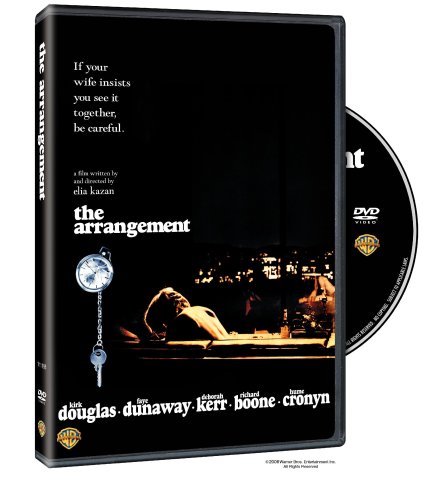
The Arrangement is a film that I had always heard the name of, but never really heard anything about. It's rare for a film to be directed by the author of the book that it is based on. In fact, I can't recall ever seeing that before. Upon watching the film, it is obvious to me how important it is for a director to have a clear understanding of the story he is trying to tell. Kazan knows this story inside and out, and even the slightest nuance of the least-important scene contributes to the story being told.

The arrangement tells the story of Eddie, a high-powered advertising executive who has a very unexpected midlife crisis within the first few minutes of the film. As viewers, we spend the rest of the movie examining his life, and slowly discovering what led him to this tumultuous point in his life. The film actually reminded me a lot of The Graduate, if Dustin Hoffman had been in this 40's. Here, Kirk Douglas plays the Benjamin Braddock role, with just a bit of Sybil thrown in for good measure.


Well, after the worldwide success of Dr. No, producers Albert Broccoli and Harry Saltzman went back to figure out what to do about a sequel, and following a nod to the series by then-President Kennedy, From Russia With Love was the next candidate in line to be given the Bond treatment from the library of Ian Fleming novels.

In this film, Bond (the returning Sean Connery) has recently vanquished Dr. No, and the organization that he worked for, SPECTRE, decides to try to eliminate Bond, using two things that will lure any well-respecting secret agent, a decoding machine that the Russian government currently is in possession of, and a Russian defector that wants to turn it over to James specifically. The defector in question is Tatiana Romanova (Daniela Bianchi), who is recruited by a Russian general who has turned over to the SPECTRE side.

Portions of this review were lifted from the previous Criterion Collection edition review.  Now on to the review...

After making such internationally renowned samurai period films such as Rashomon and The Seven Samurai, Akira Kurosawa did make another film, Yojimbo, with a decidedly different tone, bordering on dark comedy. The opening shot is of Sanjuro (Toshiro Mifune, Throne of Blood), a samurai without a master, who look  at a mountain, and suddenly scratches his head, as if his hair is on too tight. It's almost the breaking down of a facade, helping to show you that the film will be bit different from other Kurosawa samurai films. The introductory cards say that the film is set in the 1860s, and the samurai comes into a town ruled by rival gangs. He doesn't know this when he comes in, but the first thing he sees in town is a dog carrying a human hand. People have said that the way that this film was told reminds them a lot of the Clint Eastwood/spaghetti westerns that came out several years later, and it's easy to understand why, with the quiet main character whom you can never really tell if he's a hero or villain. He deals with some situations with a toothpick in his mouth, reminding me of Chou-Yun Fat in Hard Boiled. Kurosawa does action flicks? That's probably the best way to characterize it, but he does it well, without a lot of one-liners or lack of common sense seen within a lot of today's action films.

The Departed, a basic remake of the Hong Kong film Internal Affairs, tells the story of Boston mob boss Frank Costello (Jack Nicholson) and his ruling ways of the streets. An early scene in the film shows Costello recruiting a young boy inside a convenience store (where he naturally picks up his commission promising to keep his men out of the neighborhood). The film soon flashes forward to a semi-present day where we meet a man named Colin Sullivan (Matt Damon). Turns out that this is the child Frank recruited in the previous scene. Luckily for Costello, Sullivan has just joined the prestigious Massachusetts State Police. His ultimate role is to make sure the cops never get to Costello. Now we know why the Department thinks Costello is so "clever" and can "always anticipate their every move".

We soon meet another character named Billy Costigan (Leonardo Dicaprio), a man who wants nothing more than to be a cop. Costigan is interviewed by two detectives named Dignam (Mark Whalberg) and Oliver Queenan (Martin Sheen) who ultimately decide that Costigan has to go undercover as a mole joining the ranks of Costello's mob group. Costigan's ultimate goal is to find out which man Costello has working as a mole in the State Police. The rest of the film follows convincing sequence after sequence as each group tries to undercover each other's mole all while trying to keep their act up.

Let me get this out of the way right up front; I really enjoyed Memoirs of a Geisha. Now, I am certainly smart enough to understand that the film was not entirely realistic, and there were some plot developments that pushed suspension of disbelief pretty far, but I wound it charming and entertaining. It was so charming, in fact, that it was often times easy to forget that you were essentially watching a movie about whores. You can romance it all you want, but at the end of the day a Geisha is really nothing mo...e than a high-paid escort.

When a Woman Ascends the Stairs is sort of the realistic companion piece to Memoirs. The story here revolves around a modern-day Geisha, where the lifestyle has moved out of the Geisha-houses and into the bars. The lifestyle is still basically the same; women are “companions” to wealthy male bar patrons, making long-term relationships with one woman. The women pay a portion of their income to the owner of the bar, and keep the rest for themselves (though most of it is spent on kimonos and personal upkeep). Our heroine, Mama, is a Geisha that is well-respected amongst her peers, but she is starting to feel the pressure of age. As she is advancing in years, she is not able to rely as much on her youthful good looks. The time has come for her to either get married or open a bar of her own. As she is so well liked, it is not too long until she has suitors offering to pay for her own bar. Now she must decide how she is to proceed with the rest of her life.

There are a few early sequences in Hollywoodland that show two important aspects of the film. First these sequences show us the type of man that George Reeves was trying to become (simply trying to get noticed) and, possibly more important, the type of actor that Affleck is becoming as his career becomes more about making quality films than making sure-fire moneymakers.

Based on the true story of the Hollywood unsolved murder of TV�s George Reeves, Hollywoodland stars accomplished actors Ben Affleck, Diane Lane, Bob Hoskins and Adrien Brody. Each plays a rather pivotal role in the film either as Reeves� lover (Diane Lane), her estranged husband (Bob Hoskins), a private investigator (Adrien Brody) or the man himself George Reeves (Ben Affleck in quite possibly his finest peformance to date).