Genre

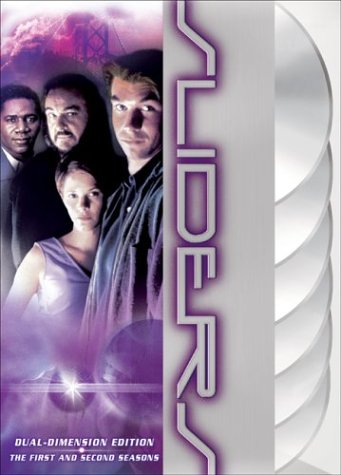
While Sliders may not rank in the upper echelon of sci-fi/fantasy series like Buffy the Vampire Slayer, Angel or its predecessor Quantum Leap, it is a very watchable show with endearing characters and witty writing at times. Quinn (Jerry O'Connell), a brainy San Francisco physics student, has perfected a device – in his mom's basement, no less – that opens up a temporary wormhole between alternate Earths. By leaping into the wormhole, one can "slide" between worlds; but of course there's ... catch, which is the foundation of the show's appeal. It seems there's no way to return back from whence you came, so Quinn, along with his college professor Maximillian Arturo (John Rhys-Davies), Wade (Sabrina Lloyd), and, through an odd turn of events, fading R&B singer Rembrandt "Crying Man" Brown (Cleavant Derricks), are left to slide from alternate world to alternate world each week, finding themselves in some very strange places trying to find their way home.

Each episode finds our heroes exploring alternate realities - What if the Americans lost to the British during in 1776, what if the atomic bomb was never invented, what if modern medicine never discovered penicillin—those are some of the scenarios Quinn, Arturo, Wade, and Crying Man find themselves in; once you get past the all too convenient plot reliance on having one of the main characters just happening to be a key character in the alternate world (or one of their friends), you can focus on the fact that the writing is generally a whole lot smarter than most if the sci-fi series out there.

While Sliders may not rank in the upper echelon of sci-fi/fantasy series like Buffy the Vampire Slayer, Angel or its predecessor Quantum Leap, it is a very watchable show with endearing characters and witty writing at times. Quinn (Jerry O'Connell), a brainy San Francisco physics student, has perfected a device – in his mom's basement, no less – that opens up a temporary wormhole between alternate Earths. By leaping into the wormhole, one can "slide" between worlds; but of course there's ... catch, which is the foundation of the show's appeal. It seems there's no way to return back from whence you came, so Quinn, along with his college professor Maximillian Arturo (John Rhys-Davies), Wade (Sabrina Lloyd), and, through an odd turn of events, fading R&B singer Rembrandt "Crying Man" Brown (Cleavant Derricks), are left to slide from alternate world to alternate world each week, finding themselves in some very strange places trying to find their way home.

Each episode finds our heroes exploring alternate realities - What if the Americans lost to the British during in 1776, what if the atomic bomb was never invented, what if modern medicine never discovered penicillin—those are some of the scenarios Quinn, Arturo, Wade, and Crying Man find themselves in; once you get past the all too convenient plot reliance on having one of the main characters just happening to be a key character in the alternate world (or one of their friends), you can focus on the fact that the writing is generally a whole lot smarter than most if the sci-fi series out there.

There was a time, even as late as the 90’s, when making an anti-American film was still taboo in Hollywood. Of course today, movies like Fahrenheit 9/11 are big money makers, but for many years, such films were discouraged. Air America is one of the rare exceptions to this rule. This may be due to the fact that it was disguised as a comedy about the Vietnam conflict, but no matter how you look at it, the film is quite critical of the US government, and it makes some pretty scathing accusations about our...involvement there. Only in a comedy would audiences openly accept the accusation that the US government ran drugs for rebels in Laos during Vietnam.

These accusations would have been taken much more seriously had the film actually have been any good. See, that’s the problem… if you are going to use a film to make a serious statement, it better be a darn good film. Otherwise, your statement will be lost in the mire of mediocrity. Such is the case with Air America. Films like Platoon and Good Morning Vietnam were able to make effective statements about the government’s actions in the 60’s because they were great films first. What we have here is a film that is average at best, which makes the political statements look average at well.