Ultimate Edition

Synopsis

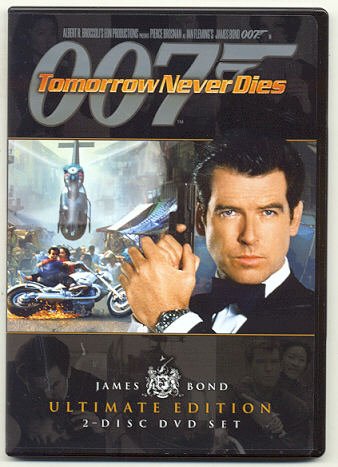
Well in the ever ongoing series of reviews of the James Bond series, this particular installment is the last of the Pierce Brosnan collection (the others are on the site, so go find them). And in Tomorrow Never Dies, I saved it for last because well, I needed some form of drama to keep me going.

Synopsis

Well, time may not have been too kind to George Lazenby since he assumed the tailored suits of James Bond for On Her Majesty’s Secret Service, but considering how well Daniel Craig did in Casino Royale, and the basic storyline is the same for both films, why do people still want to bash Lazenby now? Is it because he wasn’t a carbon copy of his predecessor, Sean Connery? Who knows?

Synopsis

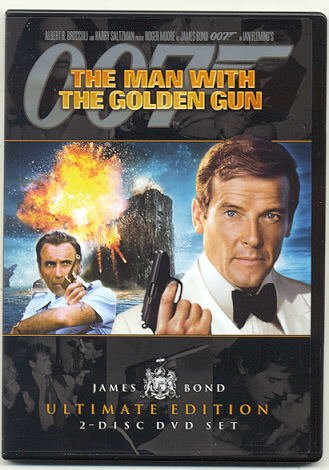
Ian Fleming’s The Man With the Golden Gun was the only posthumous release for the established actor, and the book was such a success that producers Albert Broccoli and Harry Saltzman decided to try and recruit Roger Moore for the role immediately after You Only Live Twice to capitalize on the success of Fleming’s book. However, it wasn’t meant to be, and the film’s production was delayed several years while the George Lazenby era came and went, not to mention the Sean Connery era leav...ng and returning, only to leave again. When Moore came on, Live and Let Die was the first book they adapted, and The Man With the Golden Gun finally came to fruition in 1974.

To the credit of James Bond film producers Michael G. Wilson and Barbara Broccoli, they realized that recycling a storyline with Russian antagonists or other satellites of communism, was stale even several years after the Berlin Wall fell. But in its place, the big Bond villain was a Serbian national of sorts named Renard, who was shot in the head, and the bullet, still lodged in his brain, made him magically impervious to pain.

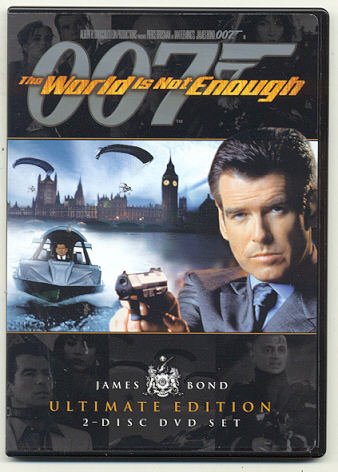
When it comes to The World is Not Enough, the ideas and aspirations (the script was written by Neal Purvis and Robert Wade) were fairly lofty, and the directing choice (Michael Apted of Gorky Park fame) was interesting. In this installment, Pierce Brosnan reprises his role as 007, this time following the death of a wealthy English businessman whose daughter (played by Sophie Marceau, Braveheart) was kidnapped and held for ransom. How does Renard play into it? Well, he's holding the daughter for ransom, part of a larger plot to control the world's oil supply.

Admittedly after George Lazenby left the James Bond franchise when On Her Majesty's Secret Service was released, producers Harry Saltzman and Albert Broccoli wanted to go with a more American-based Bond in their seventh film, and were pretty serious in their intent. At one time, Adam West (yes, Batman) was even involved in negotiations to play the part. Actor John Gavin (Psycho) was signed and sealed for the role a week before principal photography started. But Sean Connery was pitched for it, a bunch of money was thrown at him, and he went upon his merry way to reprise the role that made him famous.

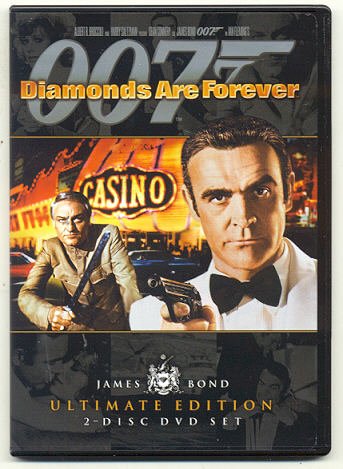
In this film, which was adapted from Ian Fleming's novel by Richard Maibaum (Goldfinger) and Tom Mankiewicz (Live and Let Die) and directed by Guy Hamilton (The Man with the Golden Gun), James finds himself at the beginning of the film thwarting yet another attempt at world domination, this time by Blofeld (Charles Gray, who ironically played a Bond ally in You Only Live Twice). SPECTRE does make a larger plan though, with the planned kidnapping and impersonation of a mysterious and reclusive Las Vegas-based millionaire, in order to proceed with nuclear testing with the goal of mutually based destruction.

Once Roger Moore left the Bond franchise (some would say three or four films too late), quite a few things left with him. When Timothy Dalton, whose most well-known work before this was an excellent supporting turn in The Lion in Winter, was brought in, several things seemed to change. First and perhaps most notably, the return of a James Bond that smoked cigarettes was most startling. Second, supporting characters like Lois Maxwell (who played Miss Moneypenny) and Bernard Lee (M) were replaced with younger, fresher (?) perspectives. Was all this change in the perspective of "modernizing" Bond worth it? Well, Dalton's role in The Living Daylights was the first of two Bond films, so easy come, easy go I guess.

In this installment, based on an Ian Fleming story that was adapted to a screenplay by current Bond producer Michael Wilson and Richard Maibaum (Diamonds are Forever), James helps a Russian general (played by Jeroen Krabbe, The Fugitive) defect to England from Russia, but he is unfortunately reacquired by the KGB and kidnapped. James is dispatched to Russia to kill the Russian general that was presumably behind it (played by John Rhys-Davies, The Lord of the Rings), and along the way encounters a beautiful musician named Kara Milovy (Maryam D'Abo, White Nights), who is also reaching out to the defecting general.

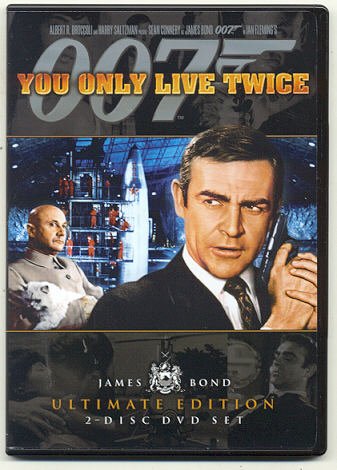
By the time of the fifth James Bond film, producers Harry Saltzman and Albert Broccoli decided to shake things up a bit creatively. Star Sean Connery was probably getting a little antsy inhabiting the suits and drinking the martinis and feared getting pigeonholed (sorry Sean) and announced he was stepping away from the role. However, he still had one more in him, and with You Only Live Twice there was a definite change in style. It may have been based on Ian Fleming's novel, but it was adapted for the screen by Roald Dahl, of Charlie and the Chocolate Factory fame. Lewis Gilbert began the first of his three Bond adventures as director of the Bond films, and in a surprise, Freddie Young took the cinematographer reins, quite a change of pace for the collaborator of such David Lean classics as Lawrence of Arabia.

Moreover, I think You Only Live Twice is probably one o the first Bond films I can recall seeing, growing up back in the day. It's probably because the pre-opening sequence where the spacewalking astronaut gets swallowed by the satellite always stuck with me, who knew? However, the bigger surprise should probably be that there was a pretty good story along with that stunt. In this installment of the film (out of order from the original intent of the producers, who wanted to shoot On Her Majesty's Secret Service), James goes to Japan to continue to thwart the attempts of SPECTRE and Blofeld (Donald Pleasance, Halloween). And because James is in Japan and is as obvious as any tall Englishman can be in Japan, there are some subtle things to make him blend more with the people and the culture.

Poor Roger Moore. He does get a bit of a bum rap when it comes to James Bond movies, but I think that in terms of the character, he actually fits the jacket, Walther PPK and shaken martinis fairly well, but the problem for his work was that it faced a lot of new technology, and thus was subjected to a lot of ridicule as a result. New things like walking in space and the computer revolution were given a tongue in cheek look, and in between this and the visual effects simply not catching up to the imaginations, then sure, some of the films look and feel a bit silly.

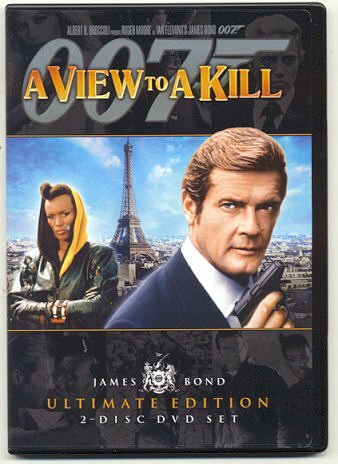
Take the case of A View to a Kill. The film was Moore's seventh (and last) as Bond, and he already had one foot out the door when he made Octopussy. But in this one, Moore may have stuck around a little too long. By my math, he was approaching 60 at the time the film was released to theaters, and seeing him with a Bond girl like Stacey Sutton (Tanya Roberts, Sheena) really wasn't all that believable anymore. The story itself surrounded a microchip that was purchased by a fanatic named Max Zorin (Christopher Walken, The Deer Hunter), who apparently was genetically enhanced somehow or was a descendant of a elite German during World War II.

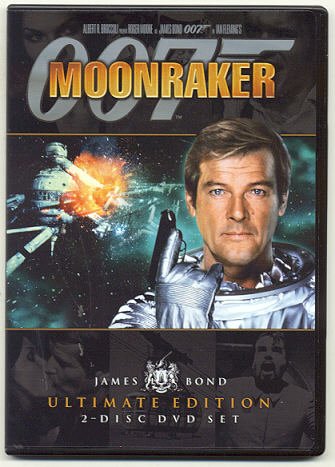
If you want another reason to hate George Lucas, it's that James Bond film producer Albert Broccoli decided to fast track the production of Moonraker ahead of For Your Eyes Only to capitalize on the proverbial Star Wars effect that was occurring through box offices worldwide. However in this one, written by Christopher Wood, who wrote the epic film Remo Williams: The Adventure Begins and directed by Lewis Gilbert (who had just done The Spy Who Loved Me), Roger Moore rides a shuttle into space and takes the dynamic of the film with it.

In this Bond film, Moore's 4th and the franchise's 11th, James tries to find out who is terrorizing the planet using a soon to be astronaut vehicle called the space shuttle and a space station to do it. So James gets a chance to test out the means of NASA, but not before going through the spacious locales of Rio de Janiero and France, eluding the harm and capture of Jaws (Richard Kiel, Billy Madison), who reprised his role from The Spy Who Loved Me due to popular demand. The villain in this film is Hugo Drax (Michael Lonsdale, Munich), who may be soft-spoken, but his plans to mass murder the population are far from rational.

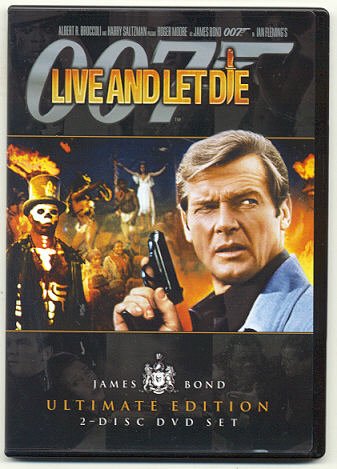
As a relatively topical fan of the James Bond franchise (though not so topical that I'd buy all of the films on DVD), I had a cursory knowledge of the actors who played Bond and the times that they had been cast. Little did I know however that by the time Roger Moore had signed onto the role in Live and Let Die that this was the third attempt to bring him aboard, and that maybe producers Harry Saltzman and Albert Broccoli were hoping that the third attempt brought the proverbial charm. Moore had been approached for the role as early as the Dr. No days, but was in the midst of doing The Saint television show, and Connery was chosen. Connery left and the opportunity came to Moore again, however he was not available and George Lazenby came on to do On Her Majesty's Secret Service. He left, Connery did one more and then finally, Moore was available to take the reigns.

And he came aboard to a Bond film that is probably his best and one of the best Bond films in the franchise. In Live and Let Die, James has to go to America (and subsequently, the Caribbean) to research the deaths of several British agents. He goes into Harlem to try and find out the whereabouts and criminal motivations of a mysterious boss named Mr. Big, and eventually makes his way to a fictional island called San Monique, where a United Nations delegate named Kananga (Yaphet Kotto, Homicide: Life on the Street) is waiting for his arrival, and using the results from a tarot card reader named Solitaire (a very young Jane Seymour, Dr. Quinn, Medicine Woman), he plans for the demise of Bond.