Studio

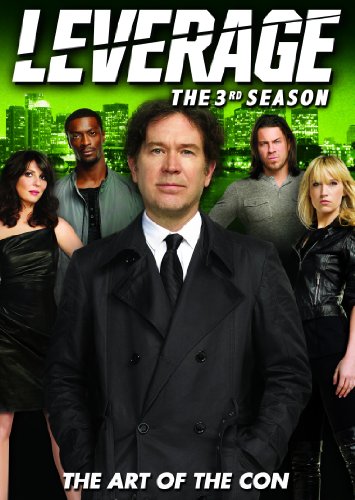
“Corporations… They have all the money. They have all the power, and they use it to make people like you go away. Right now you’re suffering under an enormous weight. We provide the Leverage.”

The series centers on Nathan Ford (Hutton), an ex-insurance investigator. His life was turned around when the very insurance company he recovered millions for turned down his child for treatment to keep her alive. He quits his lucrative job and forms a team to help people who are backed against the wall by large corporations. Cases include: a soldier looking to get medical care, a family ripped off by a mob boss, a company that has allowed dangerous chemicals to harm children, and a real estate mogul trying to take a church away from its congregation.

Jean-Hugues Anglade plays Zorg (yup, that's his name), a handyman living in a beach-front house, scribbling away quietly in his spare time. Not so quiet is his tempestuous affair with Betty (Béatrice Dalle in her debut), whose passions overwhelm both of them. First, she moves in on him with no warning. Then, when she discovers his writing, she decides they must move to Paris so he can have a career as a writer. To make sure Zorg complies, she burns his house to the ground. Once in Paris, her plans for him fall apart, and so, bit by bit, does she.

Writer/director Jean-Jacques Beineix has both audience and characters sweltering from the get-go, setting the tone for another French tale of amour fou. Angalde and Dalle inhabit their characters perfectly (though one might be forgive for wondering what exactly Zorg sees in Betty, beyond the physically obvious). The film is stylish and dramatic, and if, at 185 minutes, it outstays its welcomd, it doesn't do so by much.

As one could probably guess from my tender age of thirty five years, I listen to lots of 80's music. Not only did I grow up in it, the music was energetic and often thoughtful (without being too depressing). But the thing I remember most about the music on a whole is the brilliant videos behind them. David Byrne of Talking Heads was the head (literally) of one of my favorites, Burning Down the House. A great musician and pop legend, David Byrne is back to entertain us in Ride, Rise, Roar.

David Byrne was born in Scotland in the spring of 1952. He knew how to play the guitar, accordion, as well as the violin before he even entered high school. David went through a couple of minor bands before landing his first major gig with the Talking Heads in 1975. The band went on to do great things and several of their albums went gold with sales well over 500,000 copies. Unfortunately, the group broke up in 1991 after creative differences and David Byrne went on to a solo career.

"My father said the army makes all men one, but you never know which one."

There have been a lot of movies about Vietnam over the years. Some are quite political, while others try to capture the sheer horror of war...any war. It's been long enough now that there are even lighter works about the conflict. But this might just be the smartest film about the war ever made, because it never actually goes to Vietnam.

"Two can keep a secret as long as one of them is dead."

"People scare better when they're dyin'"

Mention the name Sergio Leone and you immediately think of Clint Eastwood and their Man With No Name trilogy. The truth is that Leone was the master of the spaghetti western and largely responsible for making Clint what he is today. When the Italian director decided to try his hand at Hollywood, he was welcomed with open arms, except they weren't interested in anything but an American copy of a spaghetti western. Leone had something else in mind. He had a "been there, done that" attitude about the westerns and wanted to do an epic called Once Upon A Time In America. But Hollywood was hearing none of that. So they compromised. If Leone delivered a stylistic western, the studio would spring for the epic he wanted to make. The result of that parlay turned out to be Once Upon A Time In The West.

"Since the birth of time, humanity has endeavored to restrict evil men in prisons. But since Cain fled the murder of his brother, evil men have fled the walls of punishment. So it doesn't matter if you're a badass mother on the run because you think you're better than everyone else and somehow entitled to do what you gotta do. No, because you see, badass mothers are never fast enough. In the end, they will be accounted for."

People have been breaking out of Hell since the days of Dante. In recent years we've had two very good television shows on the subject. Brimstone suffered an early death but was a wonderful character piece with John Glover as the Devil and Peter Horton as a cop and resident of Hell he uses to track down his escapees. Reaper took a more comedic route and had Ray Wise as Satan utilizing the efforts of Jack Black clone Tyler Labine helping out damned soul Bret Harrison to bring in the escaped. Enter Nicolas Cage in the underachieving action film Drive Angry.

One of the best signs that a film is a disaster is when the movie's own star can't seem to stop telling the world just how terrible it really is. Mickey Rourke at first had nice things to say about the film and particularly Megan Fox, calling her the best young actress he knew. Later he backtracked and qualified the statement about Fox. But his rantings about the film Passion Play have not been softened at all. He calls the film "Terrible" and a "Train wreck" while trying to assure us that he still loves director Mitch Glazer. We'd ask Mickey himself to write the review for the film here at Upcomingdiscs, but we tend to try and remain family friendly, and he's not above dropping a few F bombs to make his point. I guess the job of evaluating this rather strange film falls to me, %$@(&.

Okay, I guess we'll start with one of the most ridiculous stories I've ever seen made into a movie. Meet Nate (Rourke). He's a washed-up trumpet player who used to be pretty well known. Now he plays in nightclubs owned by mobsters for small change, small change he likely as not turns into booze. Unfortunately, Nate couldn't help but sleep with the boss's wife. Now Happy (Murray) wants him dead. A couple of his thugs take him out to the middle of the desert for an old-school hit. Nate is miraculously saved by a strange group of white ninjas. He wanders the desert and stumbles into a sideshow where he sees Lily (Fox), a woman with bird's wings. When he finds out they're real, he breaks her out of the control of the abusive carnie and falls in love with her. But not before he sells her out to Happy in an attempt to trade her for his own life. Of course, he regrets the decision and wants to save Lily from Happy's clutches, but she doesn't necessarily want his help. You know, because of the whole betrayal thing. The ending leaves a few questions, but I'm not sure the answers are worth thinking much about. Mickey's right. This is a train wreck. Couldn't have said it better myself.

Somewhere in my family’s history, I have a couple of odd branches. One of them leads to a former Pope (17th century I believe) and the other is even more curious, the mob. Specifically, it leads to the most popular gangster of them, Al Capone. It is pretty far down the branch, but interesting nevertheless. This leads us to our movie review for today: Kill the Irishman which deals with the real life story of Danny Greene, a man who escaped death countless times and took down the mob.

The period in time is Cleveland, Ohio circa 1975. Danny Greene (played by Ray Stevenson) is driving along and listening to his 8-track player. All of the sudden, his player starts to fizzle and then sparks fly. Danny realizes that the car is about to explode and gets out. He narrowly escapes death. He shouts, “It will take more than a few firecrackers to kill me.” Indeed it would.

A mother locks her child in a closet so she can have an uninterrupted tryst with her lover. But the couple is rudely interrupted after all, as they are bludgeoned to death. Ten years later, a group of friends arrive at the deserted house to party down. After doing so for a fair bit of running time, they then fall prey to a hulking masked maniac, who not only has the titular hammer, but also has all sorts of supernatural powers.

This is, according to the box, “the first shot-on-tape slasher movie for the home video market.” This is a warning as much as anything else: don't be expecting John Carpenter or Dario Argento behind the camera. That the film is amateurish goes without saying, but I'll say it anyway. Viewers should be prepared, then, for lots of padding (a slow-motion scene of a couple walking that goes on for minutes), bland camera set-ups, ropey script (let's have a complete food fight sequence!) and whipped-up-in-the-kitchen gore. On the upside, once the supernatural kicks in, logic goes out the window, and all sorts of strange things start happening with no explanation whatsoever, resulting in a rather charming sort of dime store surrealism. This isn't a good film, but it is a likable one.