Studio

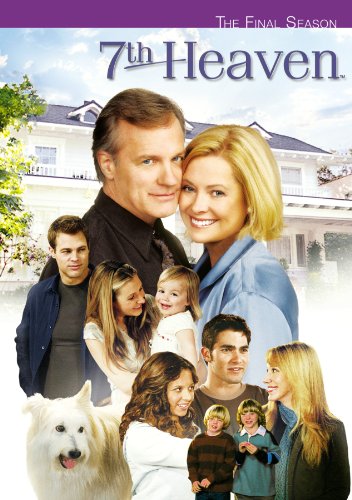
7th heaven reaches its 11th and final season of rampant political correctness and lessons of family togetherness through Christian love. Yes, that was a mildly passive aggressive summary of this show, but I feel sometimes one strong bias deserves another to challenge it. This show, the story of a very large family lead by a Minister (and don't deny it, he leads them) as they convey their socially and politically conservative Protestant Christian point of view of “real-life” situations.

To be a fair reviewer, I shall put aside my personal objections to critique how the show works just as a family drama for a moment. The 11th season is quite hard to get into as there are countless references and relationships that have been building up for a very long time. I'm not asking it to be like a Law and Order brand of storytelling, where a viewer can jump in at any episode to enjoy a fully encapsulated story, but this show becomes an undeniable challenge to watch if you are seeing it without any background knowledge of the characters and their previous stories.

Written by Dave Younger

Young Adam (2003, 98 min.), set in drab postwar Glasgow, Scotland, combines the kitchen-sink dramas of late 50s/early 60s northern England with a Hitchcockian tale – what if you discovered your girlfriend floating dead in a river?  Throw in explicit full-frontal NC-17 sex (most movies, like Blue Valentine, will do anything to avoid this kiss of death, but Young Adam embraces it; they wanted to cut Ewan McGregor’s junk for the American release, but he fought to keep it in) with the sexually-charged characters of Joe (McGregor), Ella (Tilda Swinton), and Cathie (Emily Mortimer), and you have more than enough angry young men and women to overcome the tedium of being one of the working poor in the grimy, coal-infused landscape of the docks of Glasgow.

The comedy team of Jason Friedberg and Aaron Seltzer should be commended for their unwavering attempt to destroy the spoof comedy entirely. Sure, they aided the Wayans brothers in creating the first Scary Movie film (which is decent spoof film) but in 2006 they started their campaign with Date Movie and continued right through Epic Movie, Meet the Spartans, Disaster Movie, and now Vampires Suck. Did they succeed? And did it take the recent loss of Leslie Nielsen to have us be reminded that spoofs where once a glorious and enjoyable thing.

Well, while their previous efforts (I'm cringing at the idea that any “effort” was placed into making their films) where bloated with endless pop culture references that were dated before being made, Vampires Suck mostly just runs on one, the Twilight series. Yes, there is still a parade of references made, mostly to reality TV shows such as Keeping up with the Kardashians and Jersey Shore, but they mainly stick with vampire and werewolf gags that have either been done already or are simply too weak and witless to even register as a complete joke.

The Haunting of Sorority Row has one of those titles that, when you first hear it, you immediately make assumptions about. My initial assumption was that the movie might very well feature a house full of hot young girls in various stages of undress, acting all catty between pillow fights and being menaced by a supernatural entity of some kind. And then I looked down to the bottom of the dvd case and noted that this was produced by Lifetime. Wait, I thought, isn’t a horror movie by the Lifetime Network akin to Spike TV producing a Jane Austen film festival? Or Comedy Central hosting a David Cronenberg retrospective? Or Arts & Entertainment producing a reality show about a guy who traps raccoons….? Oh. Wait.

Never mind.

A mysterious figure or organization going by the name of War on Crime is apparently engaged in just that in the streets of Soweto. Known drug dealers are being gunned down. On the case is Lt. Deel (Nigel Davenport). Caught up in the case is newspaperman Chaka (Ken Gampu), who is contacted by War on Crime and given tips as to when the next attack will take place. Deel and Chaka are friends of long standing, but their friendship is challenged by the fact that the police captain now views Chaka as a possible accomplice in the vigilante killings. The question, too, is whether there is more to these killings than meets the eye.

Now this is an interesting artifact: a South African grindhouse epic from the 70s (and thus the Apartheid era). The case boasts that this is a blaxploitation effort, and while this is only 100% accurate, as a fair amount of screen time is spent with Deel, and ditto a white killer working for War on Crime, it's certainly close enough for government work. The story is a bit meandering, given that there isn't really that much plot (and so we can take time out to watch Chaka eat lunch and feed ducks). But the moments of tedium are made up for by the over-the-top slow-motion violence, not to mention the entertainment value of the hilariously clunky post-synchronization. And the editor, it seems, was having to work while being subjected to random electrical shocks. All in all, a most fascinating oddity.

Bryce and Juli first meet in the second grade. Juli is convinced that Bryce is walking around with her first kiss, while Bryce is not returning any sense of being similarly infatuated with Juli. As the years pass by, Bryce manages to keep her at bay, until things “flip” (as it were) and it is Juli who may be veering away from Bryce.

This will-they won't-they (probably will) romance is told by trading the point-of-view and narrator between Bryce and Juli. This tactic makes the story more interesting to take in, despite the potential tedium of having the entire story essentially being told twice. The audience is privy to the continuous compare and contrast happening between Bryce and Juli's thoughts and feelings and so we get a more immediate understand of who they are, and what they are motivated by.

A suave Tom Cruise and a flustered Cameron Diaz (wow, what a stretch for both actors) bump into each other at Wichita airport, and a few minutes later do so again. Diaz thinks she might be on to something with the charming hunk, but she is more accurately into something, and in far out of her depth, as the plain flight turns into a gun battle and forced landing. Before she knows it, she doesn't know where to turn and whom to trust: the various menacing government officials (headed up by a sinister Peter Sarsgaard), or the cheery but possibly psychotic rogue Cruise. There will be many a narrow escape and an international location visited before she knows the answer.

Tom Cruise's return to action-adventure films was almost more notable for the off-screen backstory than the on-screen action. This, of course, was the film he chose to do when he backed out of the darker-edged Salt, where he was replaced by the rather more convincing Angelina Jolie, and which proceeded to beat Knight and Day at the domestic box office. (In fairness, neither film was a giant hit, and the overall worldwide business of both was pretty close.)

"The war between sorcerers was fought in the shadows of history, and the fate of mankind rested with the just and powerful Merlin. He taught his secrets to three trusted apprentices, Balthazar, Veronica and Horvath. He should have trusted only two."

It was one of the most memorable Walt Disney moments in the long history of animation. The Sorcerer's Apprentice segment in Fantasia would become the most recognizable piece of the film. It would be released many times over the years since 1940, so that even people who had never even heard of Fantasia recognized Mickey Mouse as the sorcerer's apprentice who abused the power he had learned to bring a broom to life and do his chores while he slept. The magic got out of his control and mayhem ensued. The images linger still. Now the combination of Jerry Bruckheimer, Jon Turteltaub, and The Walt Disney Studios has teamed up for a new adventure film very loosely based on that original material. This is the same team that brought us the National Treasure films and part of the team that continues to bring us the Pirates Of The Caribbean films. If you liked those franchise films, you can expect more of the same in The Sorcerer's Apprentice.

"Nobody thinks of it from the whale's point of you."

I think this is the very first film I've ever seen that was made in Iceland. Of course, Iceland isn't one of those movie-making meccas known throughout the world for their movie magic. The truth is, there haven't been too many films set in Iceland and even fewer shot on location there. Now that Harpoon has come along, I don't expect that is going to change any time soon.

In December of 1980, John Lennon was gunned down by a crazy man who was trying to get the attention of yet another celebrity. In 2010, the BBC assassinated the man's character in this dreadful television film called Lennon Naked. I had such high hopes for the film. I rather like star Christopher Eccleston. I enjoyed his take on The Doctor from Doctor Who. He was also quite good in the zombie thriller 28 Days Later with a run as a man who can become invisible on Heroes. What made such a fine actor stoop so low as to take a gig like this is beyond my understanding. If it was the temptation to maybe play an idol from his childhood, I would have hoped he would have stopped short once he'd read the script. As the aforementioned warning tells us, this film is actually a hodgepodge of speculation that doesn't fail to kick the singer at every point.

I'm not a huge John Lennon fan. In fact, I only have mild feelings about The Beatles in general. I respect what they have done but have leaned more toward Paul and George in their years after the super-band. I have no illusions that Lennon was anything but a spoiled brat, particularly at the height of his career. His famous, "We're bigger than Jesus Christ" statement said a lot about his immaturity at the time. It should be expected. The "lads" were mere teens when their music caught fire. Before they had a chance to start shaving, women were throwing themselves practically faint at the band, and money was coming in as if it were the most common thing in the world. It's really no wonder that the band members had a feeling of entitlement and were a bit rough around the edges. There is certainly a bit of fairness to some of this portrayal.