Studio

Portions of this review were lifted from the previous Criterion Collection edition review.  Now on to the review...

After making such internationally renowned samurai period films such as Rashomon and The Seven Samurai, Akira Kurosawa did make another film, Yojimbo, with a decidedly different tone, bordering on dark comedy. The opening shot is of Sanjuro (Toshiro Mifune, Throne of Blood), a samurai without a master, who look  at a mountain, and suddenly scratches his head, as if his hair is on too tight. It's almost the breaking down of a facade, helping to show you that the film will be bit different from other Kurosawa samurai films. The introductory cards say that the film is set in the 1860s, and the samurai comes into a town ruled by rival gangs. He doesn't know this when he comes in, but the first thing he sees in town is a dog carrying a human hand. People have said that the way that this film was told reminds them a lot of the Clint Eastwood/spaghetti westerns that came out several years later, and it's easy to understand why, with the quiet main character whom you can never really tell if he's a hero or villain. He deals with some situations with a toothpick in his mouth, reminding me of Chou-Yun Fat in Hard Boiled. Kurosawa does action flicks? That's probably the best way to characterize it, but he does it well, without a lot of one-liners or lack of common sense seen within a lot of today's action films.

Let me get this out of the way right up front; I really enjoyed Memoirs of a Geisha. Now, I am certainly smart enough to understand that the film was not entirely realistic, and there were some plot developments that pushed suspension of disbelief pretty far, but I wound it charming and entertaining. It was so charming, in fact, that it was often times easy to forget that you were essentially watching a movie about whores. You can romance it all you want, but at the end of the day a Geisha is really nothing mo...e than a high-paid escort.

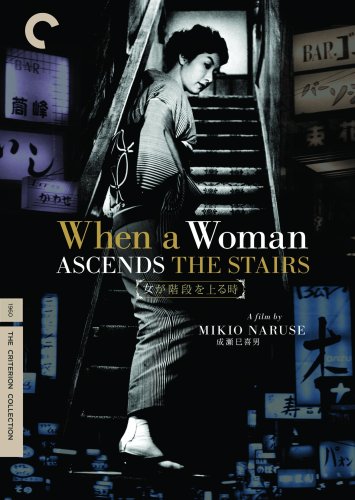
When a Woman Ascends the Stairs is sort of the realistic companion piece to Memoirs. The story here revolves around a modern-day Geisha, where the lifestyle has moved out of the Geisha-houses and into the bars. The lifestyle is still basically the same; women are “companions” to wealthy male bar patrons, making long-term relationships with one woman. The women pay a portion of their income to the owner of the bar, and keep the rest for themselves (though most of it is spent on kimonos and personal upkeep). Our heroine, Mama, is a Geisha that is well-respected amongst her peers, but she is starting to feel the pressure of age. As she is advancing in years, she is not able to rely as much on her youthful good looks. The time has come for her to either get married or open a bar of her own. As she is so well liked, it is not too long until she has suitors offering to pay for her own bar. Now she must decide how she is to proceed with the rest of her life.

The Departed, a basic remake of the Hong Kong film Internal Affairs, tells the story of Boston mob boss Frank Costello (Jack Nicholson) and his ruling ways of the streets. An early scene in the film shows Costello recruiting a young boy inside a convenience store (where he naturally picks up his commission promising to keep his men out of the neighborhood). The film soon flashes forward to a semi-present day where we meet a man named Colin Sullivan (Matt Damon). Turns out that this is the child Frank recruited in the previous scene. Luckily for Costello, Sullivan has just joined the prestigious Massachusetts State Police. His ultimate role is to make sure the cops never get to Costello. Now we know why the Department thinks Costello is so "clever" and can "always anticipate their every move".

We soon meet another character named Billy Costigan (Leonardo Dicaprio), a man who wants nothing more than to be a cop. Costigan is interviewed by two detectives named Dignam (Mark Whalberg) and Oliver Queenan (Martin Sheen) who ultimately decide that Costigan has to go undercover as a mole joining the ranks of Costello's mob group. Costigan's ultimate goal is to find out which man Costello has working as a mole in the State Police. The rest of the film follows convincing sequence after sequence as each group tries to undercover each other's mole all while trying to keep their act up.

There are a few early sequences in Hollywoodland that show two important aspects of the film. First these sequences show us the type of man that George Reeves was trying to become (simply trying to get noticed) and, possibly more important, the type of actor that Affleck is becoming as his career becomes more about making quality films than making sure-fire moneymakers.

Based on the true story of the Hollywood unsolved murder of TV�s George Reeves, Hollywoodland stars accomplished actors Ben Affleck, Diane Lane, Bob Hoskins and Adrien Brody. Each plays a rather pivotal role in the film either as Reeves� lover (Diane Lane), her estranged husband (Bob Hoskins), a private investigator (Adrien Brody) or the man himself George Reeves (Ben Affleck in quite possibly his finest peformance to date).

Ever write off a movie based solely on the buzz? I did that with Hollywoodland before I'd ever heard the actual title - someone asked, "did you hear about Ben Affleck's new movie? I hear it stinks." Given Affleck's recent string of box office flops, that's all it took for me to avoid the film.

Of course, it's not just an Affleck movie; it also stars Adrien Brody (The Pianist), Diane Lane (Under the Tuscan Sun) and Bob Hoskins (Mrs. Henderson Presents). As expected, these actors turn in fine performances, creating characters that keep viewers' interest while the film meanders its way through one of Hollywood's unsolved mysteries. The nice surprise here, though, is that Affleck (Surviving Christmas) more than holds his own with a superb performance as George Reeves. It's easy to forget that Affleck is a talented actor, but if you think back to films like Shakespeare in Love and Good Will Hunting, his performance here is less of a surprise.

Boy, this title really came out of left field. I am one of those DVD collectors who picks out their favorite television shows and collects all the full DVD season sets. I did this with Wonder Woman, with Kung Fu and with The West Wing. I also started collecting full season sets of Mad About You just a couple of months after I started with Friends. I finished all ten seasons of Friends in late 2005, yet I was only two seasons in to Mad About You's seven season run. What...gives? The last season of Mad About You that was released was Season Two, which hit store shelves in April of 2003. Two seasons released in 5 years is not exactly the turnaround that fans look for; especially in a show that is no longer on the air. I, as did many fans, naturally assumed that no more seasons would be released after several years passed without a new season dropping.

So, imagine my shock when I read a news item in January of this year that announced Season Three's surprising release. Maybe the "greatest episodes" set they released in 2005 sold better than they expected. Maybe fan chatter reached those with their finger on the metaphorical button. Maybe Sony made enough off of the sale of the Seinfeld season sets to cover the losses on releasing another season of Mad About You (my personal guess). Whatever the reason, it's probably best not to ask too many questions, but to just be happy that this thing has finally shown up in stores at all.

The prologue to The Covenant tells us of people with supernatural powers. We're told of how these powerful warlocks and witches were hunted throughout Europe and escaped to the New England colonies in the New World. The information is provided with the contradictions of pseudogrunge music and pages of ancient texts. It doesn't take us long to meet young men, descendants from these immigrant families. We discover them flaunting their powers by jumping off a cliff on the way to a teen party. These four special teen boys have the world, or at least their local community, by the short hairs. Soon we are alerted that something has changed. The group feels a strong presence that is disturbing their supernatural force. Newcomer Chase Collins (Stan) has a secret of his own. He is the last of a fifth family once banished from the society. His return means the usual tale of revenge and mayhem is about to unfold. Throw in a generous amount of teen sex, loud music, and fast cars, and we have a quite furious but erratic romp. We're informed in roundabout ways that the society operates under certain rules intended to keep the secret and allow them to remain safe. Unfortunately these rules appear more like suggestions, really, as the boys are usually apt to show off their powers whether being chased by police or merely to remove a girl's pants to win a bet. We also learn that using this force drains the user's life, causing premature aging, if the powers are used too frequently. Of course, there is always a potential workaround to such unfortunate effects. It seems any warlock may will his powers onto another, particularly at their 18th birthday when they come into full possession of their "gifts".

Comparisons to the superior Underworld films can't be helped. The box art invites such comparisons by telling us the film's share producers. The idea of a secret society with sinister history and secrets create a common thread. But warlocks are just not as cool as vampires and werewolves. Blue tints to the cinematography complete the comparisons. The Covenant obviously attempts to stay more grounded in reality and so is far more mundane overall. The film employs an odd combination of complex simplicity. We are treated to hints of this incredibly rich tradition and history, yet it is all cheapened by the one dimensional performance of the cast. We are always tantalizingly close to something larger that never makes its appearance on film. None of these characters exhibit the culture and sophistication that the filmmakers want so badly to convince us they possess. The film wants so much to be epic in its scope, but no power on heaven or earth, supernatural or otherwise, is going to make that happen. Add to these flaws some horrid examples of dialogue looping (dialogue replacement) and one begins to wonder if Renny Harlin was so obsessed with largesse that he simply ignored the critical details. Check out the looping at about 25 minutes into the film.

Three young couples on a road trip leave their turtled vehicle and march through the dark woods, hoping to find the highway again. (Clearly Mensa candidates, each and every one.) They stumble upon an apparently abandoned secret facility, and naturally blunder in. A psychically powered lunatic uses astral projection to do bad things to them. People start to die. No great loss.

Think through this equation for me, will you? Direct-to-video + walking-around-tunnels-plot + Tara Reid = ? What do you think? That the movie is not a COMPLETELY incompetent mess at the technical level is a minor miracle. That it would be anything other than tedious, however, would have required a major one.

All, the early '90s! I spent my time counting the days until my military service ended by drinking as much beer as possible until I got to the bright red circle on my calendar. But when Martin Lawrence (House Party) pitched an idea for a sitcom with an African American cast, Fox picked up the show and added it to a then-fledging group of shows that balanced themselves between evening soap operas and raunchy family comedies.

Martin tells the story of Martin Payne (Lawrence), successful host of an urban radio station program in Detroit. His girlfriend is Gina (Tisha Campbell, Boomerang), whose best friend Pam (Tichina Arnold, Everybody Hates Chris) disapproves of him. And Martin's boys, the guys who will always have his back are Cole (Carl Anthony Payne, The Cosby Show) and Tommy (Thomas Mikal Ford, Q & A), who bumble around a bit, but their loyalty is unquestioned.

The World Cup is unquestionably the greatest sporting event in the world. No other event, sporting or otherwise, pulls nations together like the World Cup does. Once every four years, the whole of the world (save for the majority of the United States) takes a month off to focus their eyes on the efforts of a group of young men to put a white ball into a white net. This film is the story of the 1996 edition of the famed tournament.

This film does a great job of capturing the story of the tournament, while not ...etting bogged down in the details that could drag a film like this one to a standstill. The entire tournament is discussed, but not every game is shown. In fact, the group of 16 is skipped all together. While this does not make for a complete document of the tournament, it certainly helps to keep the film on task. The first half of the film showcases the road to the final, and the second half focuses on the semi-finals and the final match itself. Impressively, the film does not shy away from touchy subjects, as it discusses referee controversies and “the head-butt” openly. Much of the film showcases field-level images of the gameplay supported only by crowd noise, which brings the beautiful game to life in a very real way. This is a compelling and entertaining film even for those that are casual fans of international sport.