Studio

Synopsis

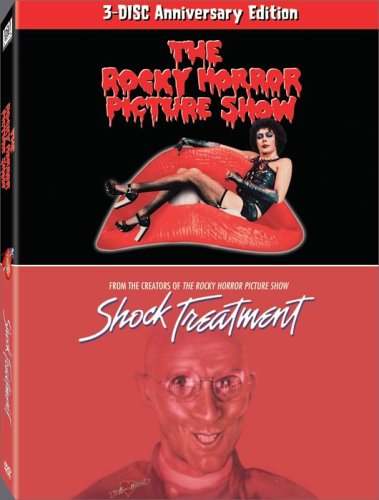
Staid middle-class couple Brad and Janet (Barry Bostwick and Susan Sarandon) wind up, one stormy night, at the gothic mansion of the cross-dressing Dr. Frank N. Further (Tim Curry). Many songs and sexual awakenings ensue. Seriously, people, if you are reading this and require a summary of The Rocky Horror Picture Show, then the movie is probably not for you. Shock Treatment, however, is less well-known. Once again we have Brad and Janet (this time played by Cliff De Young and J...ssica Harper), living in the TV-controlled town of Denton. Resistance to the televised brainwashing is met with the treatment of the title.

The Butterfly Effect 2 is a direct-to-video release, and for good reason. While the original film was a surprise hit back in 2004, this sequel is nothing more than a quick cash-in.

At least, that’s what I thought I’d be writing for this review. I definitely had low expectations for this film, especially since while I’ve heard good things about the original, I’ve yet to see it, and I still question its somewhat-acclaimed reputation. So surely this sequel must be a piece of junk, right? But it’s not.

Boffo! Tinseltown’s Bombs & Blockbusters is all about the magic of movies. It’s about doing it right and doing it wrong, and how there’s no sure thing. This HBO documentary doesn’t get very technical about making films, but it certainly does get personal with some of Hollywood’s heaviest hitters.

Through a well-crafted collection of interviews and clips from some of the best and worst movies of American cinema, this documentary brings us the perspectives of folks like Steven Spielberg, George Clooney... Richard Dreyfuss, Peter Bogdanovich and Morgan Freeman. Every single one of the interview subjects is dynamic and entertaining, and while their experiences and methods are all different, they all seem to agree on one thing: making a successful film is really hard to do.

Boffo! Tinseltown’s Bombs & Blockbusters is all about the magic of movies. It’s about doing it right and doing it wrong, and how there’s no sure thing. This HBO documentary doesn’t get very technical about making films, but it certainly does get personal with some of Hollywood’s heaviest hitters.

Through a well-crafted collection of interviews and clips from some of the best and worst movies of American cinema, this documentary brings us the perspectives of folks like Steven Spielberg, George Clooney... Richard Dreyfuss, Peter Bogdanovich and Morgan Freeman. Every single one of the interview subjects is dynamic and entertaining, and while their experiences and methods are all different, they all seem to agree on one thing: making a successful film is really hard to do.

Synopsis

As if the urge to capitalize on the spirits and success of the Pokemon children’s franchise weren’t enough, someone decided it would be best to create an American version loosely based on the addictive game, or hobby, or whatever the hell it is that makes Pokemon so popular, and at least as of this writing, heading into it’s fourth season of episodes.

I must admit that I fully expected to hate this film. Turns out, I didn’t. The truth is, Little Man, the latest comedy from the Wayans brothers, is too harmless for such a vehement reaction.

Sure, Little Man is not very good, but if you can manage to check your brain at the door, you’ll probably get some laughs out of it. Then again, they’re probably the same laughs you had watching the trailer. My problem with comedy like this is that it’s really much better suited to short sketches than feature films.

Written By Jeff Mardo

TNT is slowly becoming the poor man's HBO. Their programing quality has improved dramatically over the past couple of years, and even their original films are starting to look more like features than made-for-TV time wasters. More often than not, they provide quality programming that is a step above what you usually find on cable television.

This could have been a pretty good film. I just don’t know. The advance material and the jacket suggest this is a “gripping thriller” with timely themes of terrorism and war. As soon as the film opens, it becomes immediately obvious that something entirely different is at work here. A news report suggests that a tyrant is showing his compassion and generosity when he commutes the sentence of a prisoner about to go to the guillotine. What does he commute the sentence to? Death by hanging. What a guy. I think my mood...was determined at that point. With the evident conflict, I begin to wonder just what the intent really was. Is this a satire? Do they really think this is “gripping” stuff? It’s hard to believe that the satirical nature of this script could be accidental. The entire film presents us with awkwardly comedic elements mixed with rather brutal images of death and torture. So what the heck is this film after all?

The film opens with an explanation that this undisclosed nation has been ruled by a brutal tyrant for many years. Upon the man’s suspicious death, his inept son, affectionately called Jr., takes over. The trouble is Jr. is worse than his father and is far more concerned with making bad action films than actually running the country. Campaign ads remark that you should “re-elect President for life and Things Will Be OK”. An underground revolutionary leader has been in prison for over ten years. He uses the time to write quaint words of wisdom on the walls of his cell in excrement while enticing his guard to his political beliefs. What follows is an expected coup followed by yet another brutal dictatorship. As the soldier wisely remarks, “Before the revelation it was man exploiting man; after the revelation it has reversed”. It is in this second act that the film attempts to jettison its comedic style and be the serious effort it claimed to be. More brutal images assault us at every turn, but by now it’s too late..

From the rather twisted mind of Stephen King, Pet Sematary is actually one of my favorite of his horror novels. It’s scary to think the story was never meant to be published and only offered up to finish a contract with his earlier publisher. As has been the Stephen King plague at nearly every turn, something ends up lost in the translation. In the novel, the deeper subtexts that King is so adept at take several hundred pages to set up and ultimately pay off. Unfortunately a mere couple of hours of celluloid never ...eem to scratch the graveyard surface soil. Pet Sematary is, sadly, a definitive example. While the original work taunts us with its mystic undertones that always seem far more believable than they ought to be, the film lays down a path as overgrown as the one leading to the titular graveyard. At first the two works are not so convergent, and a great deal of hope is to be had. Soon, however, the movie descends into the typical shock horror film so common in recent years. Startles and zombies begin to dominate the experience, while the story’s deeper and far more frightening elements lie as dead as the bones of the neighborhood pets.

The plot points are pretty faithful to the King work. For ages the kids in this suburban Maine neighborhood have been burying the remains of their beloved pets, often victims of a dangerous road, in the barren soil of the local Pet Sematary, misspelled by the countless kids who christened the field untold years ago. But beyond the pet graveyard is a more mysterious and foreboding place. It was here that Indians brought the dead back to life. Our unfortunate family is about to discover that perhaps “dead is better”.

Jack Black says when he’s embarrassed, he knows it’s funny. He must have been pretty confident about the success of Nacho Libre, because as Ignacio (Nacho) – the friar by day, wannabe wrestler by night – he embraced one embarrassing moment after another.

Black stars as a friar at a Mexican orphanage run by the sort of God-fearing folk who think wrestling, or Lucha Libre, is a sin. All his life, Black has longed to be a luchador (wrestler), which is a bit of a conflict. His only jobs at the orphanage are cooking duty, and dead-guy duty. The latter only serves as an amusing side joke, while the former drives the story. You see, Ignacio’s bosses don’t provide him enough money for decent ingredients, so his food sucks. When the beautiful Sister Encarnacion (Ana de la Reguera) shows up at the orphanage, Black is smitten, and inspired to impress her with better food. But for better food, he needs money for ingredients.