Studio

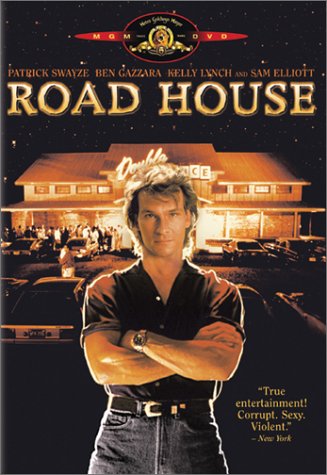
Road House is macaroni and cheese for a lot of movie goers that are over 27 years of age. Released in 1989, the movie chronicles the life of James Dalton (Patrick Swayze, Ghost), a “cooler” at a local bar, who is offered a huge sum of money to help a bar owner named Frank Tilghman (Kevin Tighe, Mumford) get his place called the “Double Deuce” back on its feet. A cooler for lack of a better explanation is a bouncer who helps diffuse situations before they blow up into brawls.

When Dalton gets to the bar, he sees the type of environment he’ll have to deal with. Even though his old friend (and house band singer) is there, he’s got drug dealing waitresses, statutory raping bouncers and money stealing bartenders. And apparently the few legitimate operating businesses in town appear to be owned by Brad Wesley (Ben Gazzara, The Big Lebowski). Brad doesn’t hesitate to break the rules whenever necessary, even if it means that Dalton has to call in his mentor Wade Garrett (Sam Elliott, We Were Soldiers), while he continues romancing Dr. Elizabeth Clay (Kelly Lynch, Charlie’s Angels), who just happened to be Wesley’s woman for a little while.

Synopsis

Mu-ju is trying to adjust to life again after surviving a terrible accident. Life is still hard, as her eldest daughter suffers from something like autism, and she is having trouble landing a permanent position as a teacher at a music school (plus, a former student has it in for her). The aforementioned eldest daughter becomes obsessed with a cello, and a mute housekeeper moves in, and terrible things begin to happen.

If you ask me, what sitcoms need are fewer contrivances and more realistic humor. That's what made Seinfeld so brilliant. As horrible as those people were, the sad truth is that all of us have a little bit of that twisted humor lurking within us. That's just the kind of thing that happens with The Worst Week of My Life. This amazingly funny BBC series lasts just seven episodes, but I guess that should be expected judging from the show's title. The names of the episodes themselves are “Sunday”, “Monday”, “Tuesday” and so on. By the end of the season, viewers have been treated to what is often-times the worst week of many people's lives. The week that should be the happiest of their lives. The week before their wedding.

The show reminds me a bit of Meet The Parents, and a little of Wedding Crashers, but in my opinion it is much funnier than either one of these. The show is shot with a single camera, so it actually has the feel of a mini-series more than that of a half-hour sitcom. The BBC has really come a long way in the last few years. They have hit a run of great shows with Coupling, The Office, MI-5 and now The Worst Week of My Life.

Synopsis

Robert Mitchum shows up twice here, as does Robert Ryan. The two clash in The Racket (1951), where Mitchum is the incorruptible cop, and Ryan is the old-school gangster whose brutally direct methods put him in conflict not only with Mitchum, but with the more sophisticated crime syndicate spreading over the land. The focus of the film is rather split between the two, but is pretty tense, and is further enlivened by a memorably sleazy turn by William Conrad as a VERY corrupt cop.

There is a little more Tracey to go around with Tracey Takes On: The Complete Second Season, so fans of the show shouldn't be disappointed. However, I find her humor quaint and dry in an inescapably British way. No one can deny her talent. But it's hard to like a show when none of the laughs are connecting. Of course, humor - like beauty - is certainly in the eye of the beholder. With that said, I am not one of the lucky ones that can look at this raw oyster of a show and see the pearl. This season, Ullman inc...udes many of the same faces from season one. The humor also continues in the same light with its often irreverent pokes at social norms and behavior. There are a variety of guest stars accompanying Ullman, as was also the case last season. This time, we get Timothy Busfield, Jon Favreau, Julie Kavner, Michael McKean, Ron Perlman, George Segal, John Stamos, and Bradley Whitford; and their only purpose seems to be filling out the camera lens. After all, Ullman can't be everywhere at once, in spite of her talents. And to many of these celebrities, doing Ullman's show is the hip thing to do.

But hip doesn't make for funny, and there's only so much Chic, Hope Finch, and Linda Granger, a sane mind can take. Add in the myriad of quick vignettes in each of the 15 episodes, and you have one stone-faced reviewer doing his best to stay awake through a show that seems much longer than its sitcom-length running time would indicate. I wish we could see more serious acting from Ullman. She is incredible, and I respect her abilities so much. But the humor is flat; the format, tired. The simple fact she can still garner fame and acclaim after all these years of performing material such as this only hints at the even bigger accomplishments she could achieve, if only her mind was set to it. Until then, die-hard fans can cherish yet another collection of her antics; as for me, I'd rather she try something else.

Tristram Shandy is the oddest and most entertaining sort of film. It is a film about the making of the film that you are watching, hosted by the fictional main character. It is sort-of like American Splendor, and sort-of like Spinal Tap. The film is the story of the life of Tristram Shandy, an 18th century Englishman of particularly stately means. The man's life is of note and worthy of such a film because... well, now that I think of it... I don't really know. You see, there are so many interruptions and different takes during the film that the actors are trying to make, that the viewer never really learns anything. Herein lies the genius of the piece. For all of the efforts the cast makes to tell the story, they never really tell us anything at all. Instead, the film is full of false starts, tales told out of order, and tons of disturbingly enjoyable comedy.

When reviewers talk about the desire to find new and interesting films, this is just the kind of thing they are talking about. This is a film that defies explanation, except to say that it is very, very funny. It is a fictional documentary about the filming of an unfilmable book. That in and of itself should sell you on picking up this disc.

Horror films have transformed over the years. We’ve essentially gone from horror films using religion to frighten (The Exorcist, The Omen) to slashers (just about everything in the 80’s), to nothing (the early 90’s void), to post-modern slashers, (Scream, Urban Legends, I Know What You Did Last Summer) to torture (Hostel, The Hills Have Eyes).

With I”ll Always Know What You Did Last Summer, we take a short trip back into the slasher genre. And surprisingly, it still looks and fe...ls pretty good. I’ll Always Know is a direct-to-video sequel to I Know What You Did Last Summer and I Still Know What You Did Last Summer, the Kevin Williamson penned scare-fests that never felt as refreshing as his Scream trilogy, but did their jobs and did them well -- for the most part.

I've said it before, and as long as Warner Brothers keeps putting these classic discs out, I am going to keep on saying it. No studio respects their classic film catalog like Warner's. They have done marvelous things with their special editions of classic films, such as their fantastic 2-disc tin box release of King Kong. They have the largest collection of classic films on the planet, including the entire RKO Pictures catalog, and they are succeeding in introducing an entirely new generation of film fans to the best that cinema has to offer.

In addition to their wonderful single-title releases, they started releasing “Signature Collection” boxed sets of a couple of years ago. These are sets of films featuring a single actor or director, and they are packaged in beautiful boxes, complete with the original artwork for each film. This time around, they are focusing on five films by Ronald Reagan. Included in this box is the 1942 Best Picture nominee King's Row, 1949 film The Hasty Heart, the surprising (and way ahead of its time) drama Storm Warning, the inspirational baseball film The Winning Team and the beloved film Knute Rockne All American, which reminded the world to “win one for the Gipper”.

You would have to either be from another planet, been raised by wolves or be under the age of 15 to not have some sort of a personal history with Full House. The show was a staple of Friday night television for eight seasons, defying all logic and proving that the general public doesn't always know quality when they see it. The story about a non-traditional household was inexplicably popular, despite the fact that it got consistently poor reviews year after year. Even more surprising was how many careers came out of the show. Of course, Bob Saget went on to play a similar role as the host of America's Funniest Home Videos, but John Stamos went on to marry Rebecca Romijn... a match that nobody saw coming or truly understood. And then, of course, there is the multi-million dollar phenomenon that is the Olsen twins.

This particular season falls fight in the middle of the show's run. The big storyline here is the marriage of Uncle Joey and Becky, a plot line that runs from the proposal to the wedding and beyond. Other storylines include Stephanie getting glasses (apparently a major trauma) and one major character getting pregnant. I respect the fact that the show is trying to evolve, but in the end, this is just the same old soft crap that we have already seen for three previous seasons.

I think the fact that Invasion only ran for one season is more of a result of circumstance than anything else. The series starts with a very large hurricane hitting Florida, and the rest of the season dramatizes the aftermath of such a tragic event. Unfortunately, the series made its debut right after the real life hurricane Katrina wiped out much of Louisiana, Alabama and Mississippi. With the 24-hour coverage of the real-life disaster plastered all over the airwaves, audiences just didn't feel much like unwinding with a dramatization of the very same experience.

It's a shame, too, because the hurricane aspect of the story was really just a catalyst to bring on the true story of the series. This was not a show about hurricanes, this was a show about extra-terrestrials. I am always a fan of sci-fi shows that masquerade as traditional dramas, and this one really pulls it off. One of the best things about shows like Alias and Lost is that they spawned other well thought out shows such as this one. It was not long ago that a show would start with a basic idea of characters and place, and the series would evolve over time. Now we are starting to see shows that have an entire couple of seasons planned out before the first episode is even shot (such as 24 and HBO's fantastic Carnivale). The result is a television program that plays more like a detailed mini-series. This is a winning proposition for both networks and fans, as the story builds slowly over time, a personal investment is made in the program.