Synapse

“In a blaze of blood, bones, and body parts, the vivacious young girl was instantly reduced to a tossed human salad... a salad that police are still trying to gather up... a salad that was once named Elizabeth.”

Ah, there is nothing that can bring an exploitation movie alive like the unhinged imagination of Frank Henenlotter. Frankenhooker is another love letter to the seedy side of a New York City from a long-gone era. It is a cult film extraordinaire.

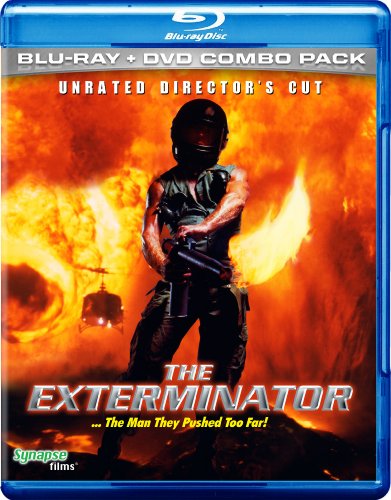
"The punishment's gotta fit the crime."

Believe all of the hype and controversy. In the language of the day The Exterminator was one bad mother. And when I say one bad mother, we're not talking Casey Anthony. The Exterminator came at the tail end of the era of grindhouse, exploitation, and revenge films. So, how do you close out a memorable era like that? You do a movie with all three. You put the violence and the grit out there for all to see, and you don't make any apologies about any of it. That's exactly the attitude that writer/director James Glickenhaus plays it, and the result is... well... one bad mother.

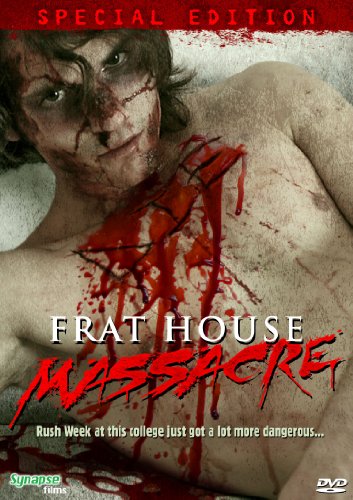
“Rush Week just became Death Week!”

Let me say first off that director Alex Pucci knows something about production values. For a film shot on Super 16mm for a reported budget of around $1 million, Pucci delivered a film that looks and sounds far more expensive. Reportedly attempting to be a homage to the seventies grindhouse slasher/revenge flicks, Pucci’s focus on detail is amazing, even if his seventies period piece comes with a few anachronisms.

By Natasha Samreny

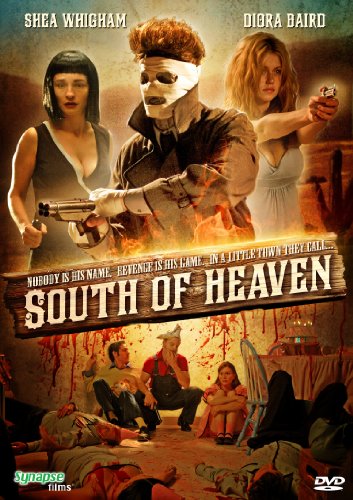
South of Heaven carried far too much violence and gore for me to look past. Maybe enjoy isn't the best word, but I had a hard time stomaching and therefore appreciating the film fully because of its nature. If you're not a fan of such horror movies, even with beautiful design, cinematography and acting elements, don't watch this.

“You have the right to remain silent... forever!”

Maniac Cop is a movie that has all the elements of being a cult classic.

When you want to get the most bang for your buck in a low-budget 1980's slasher film, you could do a lot worse than The Dorm That Dripped Blood. It's an elusive film that has never really enjoyed much of any kind of wide release even in the video market. It was really nothing more than a student film put together as a thesis for UCLA students Stephen Carpenter and Jeffrey Obrow. Like most student films, the piece utilizes locations on the UCLA campus and makes use of local talent both in front of the camera and behind. But this movie doesn't look like any student film you've ever seen before. With almost no budget, the team managed to make a film that was remarkably professional in the way it looked. The cinematography showed style that usually takes years or decades to develop. There's none of the usual amateur mistakes, and you'd be hard pressed to find it not worthy of the rest of the films coming out of that genre and that time. The film went through various name changes and has been seen in many forms over the years. You might know it as The Prank or Death Dorm. Whatever you might call it, I call it one of the best slasher films that you probably never heard of.

The story is simple. There are no complicated set-ups. There's no convoluted back story or supernatural urban legend to kick things off. Don't worry about getting to know the characters very well. It doesn't matter. They're merely killer fodder, and we'll get to know them about as well as we need.

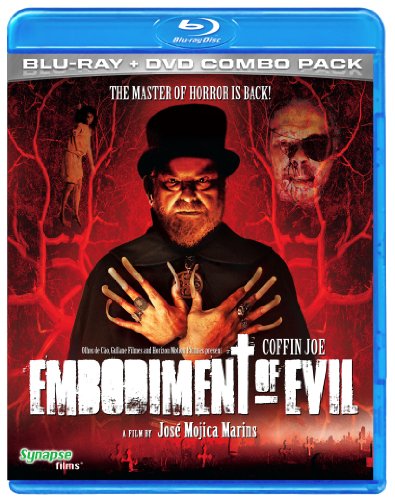
One of the (many) reasons that Scream 3 was such a weak entry is that it tried to riff on the rules of trilogies, when, at the time of its release, there really weren't any horror film trilogies, with notable exception of the Omen series (and the not-so-notable exception of the trio kicked off by Captive Wild Woman in 1943). But the last few years have seen the completion of two horror trilogies, whose third parts were a very long time in coming. Dario Argento wrapped up his Three Mothers trilogy with the disappointing Mother of Tears in 2007. And now, hitting home video, is a primal roar that also happens to be José Mojica Marins' 2008 conclusion to his Coffin Joe saga.

Despite his enormous list of crimes and his total lack of repentance, Coffin Joe (Marins) is released from prison after serving a mere 40 years. Administrative bungling appears to lie behind his freedom – a hint of the vein of mordant humour that runs through the film. Met outside prison by his hunchbacked assistant Bruno (Rui Rezende), Joe is at first thrown by the 21st-Century metropolis he finds himself in, and Marins has some fun with the Gothic and wildly out-of-place Joe and Bruno stumbling along through the traffic. But things take a darker turn very quickly, once Joe is back in the slums, and embarks once more on his quest for the superior woman who will bear his son, and ensure the immortal continuity of his blood.

"And now I wish to present an entertainment which has given pleasure to many of the crowned heads of Europe. Ladies and gentlemen, tonight for your eyes alone..."

In the 1950's and 1960's Hammer picked up where Universal had left off. They became the studio for the very best in horror films. With names like Lugosi, Karloff and Chaney finally reaching the end of their reign, Hammer offered up the likes of Christopher Lee and Peter Cushing. They resurrected all of the famous Universal monsters in their own image. Now we had a new cycle of Dracula, Frankenstein, The Wolf Man and The Mummy. While the films were somewhat low-budget and released mostly through the drive-in circuit, these films made a bloody splash with horror fans all over the world. But by the time the 1970's had begun, the studio was falling behind in the horror genre. Anthony Hinds had left the studio, and with him went some of the passion for the horror films that made Hammer famous. The studio heads became more interested in other kinds of films, and the horror department languished for a time.

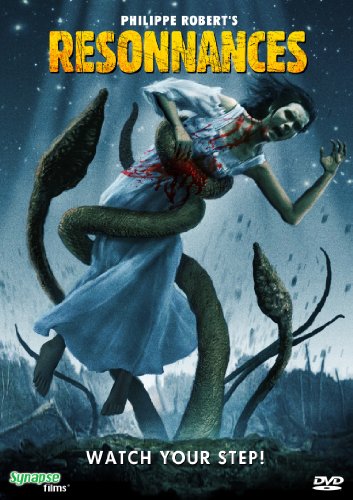
Six young men and women head off in two cars for a weekend trip in rural France. Along the way, the car with the three guys runs out of gas, fortunately within pushing distance of a filling station. There, our boys inadvisedly pick up a hitchhiker, who turns out to be an escaped psychopath. But no sooner have they started to worry about their new passenger when a mysterious fog and a ghostly vision send them careening off a cliff. Wounded and lost, they find that not only do they have a killer to contend with, but there is something monstrous and huge under the ground that is hunting all of them.

Clearly shot on a shoestring, but very ambitious in its special effects (an opening prologue featuring a meteor strike in 17th-Century France, giant tentacles reaching of the ground to grasp a helicopter), this is a film that certainly pulls out the stops. The plot is pretty packed, too, what with a ghost, a killer, AND a monster. But for all that, what the film needs is something quite inexpensive: a stronger script. The characters are set up quite well, but nothing much is done with them, and they wind up playing out in fairly conventional ways (the loser is the hero and vice versa, for instance). And for all the elements that are tossed into the mix, much of the running time still involves racing around to little effect in dark woods. Still and all, there is some fun monster work, and the just how much this little movie attempts to pull off, whether it fully manages to or not, is worthy of admiration.

A mysterious figure or organization going by the name of War on Crime is apparently engaged in just that in the streets of Soweto. Known drug dealers are being gunned down. On the case is Lt. Deel (Nigel Davenport). Caught up in the case is newspaperman Chaka (Ken Gampu), who is contacted by War on Crime and given tips as to when the next attack will take place. Deel and Chaka are friends of long standing, but their friendship is challenged by the fact that the police captain now views Chaka as a possible accomplice in the vigilante killings. The question, too, is whether there is more to these killings than meets the eye.

Now this is an interesting artifact: a South African grindhouse epic from the 70s (and thus the Apartheid era). The case boasts that this is a blaxploitation effort, and while this is only 100% accurate, as a fair amount of screen time is spent with Deel, and ditto a white killer working for War on Crime, it's certainly close enough for government work. The story is a bit meandering, given that there isn't really that much plot (and so we can take time out to watch Chaka eat lunch and feed ducks). But the moments of tedium are made up for by the over-the-top slow-motion violence, not to mention the entertainment value of the hilariously clunky post-synchronization. And the editor, it seems, was having to work while being subjected to random electrical shocks. All in all, a most fascinating oddity.