

Posted in: Disc Reviews by Bob Ross on May 19th, 2011
Precocious teenage girls are movie mainstays for a few reasons. They tend to be cute, for starters. They give young audiences someone to identify with and perhaps envy, because the movie girls get to say and do things that would get their real-life admirers grounded at best, imprisoned at worst. We have our favorites, of course, going all the back to The Bad Seed, The Children’s Hour and the original Lolita. More recently, we’ve been perversely charmed by sexually manipulative antiheroines such as Christina Ricci in The Opposite of Sex, Maggie Gyllenhaal in Happy Endings, Mina Suvari in American Beauty and Ellen Page in Juno. These characters have little in common except that they were captivating on screen and well treated by their screenplays.
As often as not, the genre requires the young woman to be a fish out of water, perhaps relocated from a big town she likes to a small one she despises. Her story, like that of male counterparts in similar youth-market efforts, is designed to put the “coming” in “coming of age.” You know the bit: Sexual awakening is an awkward, confusing process fraught with physical and emotional peril. But there’s a fine line between useful familiarity and plain old cliché. Unfortunately, Daydream Nation can’t decide whether it wants to be radical, routine or ridiculous.
Posted in: Disc Reviews by David Annandale on May 19th, 2011
During the Korean War, a platoon led by Laurence Harvey and Frank Sinatra is captured and sent off to Manchuria. Here the men are brainwashed into believing that Harvey saved them all in an incredible feat of heroism (which he did not) and that he’s a loveable guy (which he isn’t).The unfortunate Harvey is programmed to become a remote-control assassin. Back in the States, Sinatra is plagued by nightmare memories of the experience, and gradually comes to believe that something … really did happen. The question is whether he and Harvey can solve the mystery and discover the target before Harvey is triggered.
The Manchurian Candidate accomplishes a spectacular balancing act. It is simultaneously one of the most intense suspense thrillers ever to emerge from Hollywood, and an absolutely corrosive satire. Said satire is all the more brilliant for savaging both the extreme right and the extreme left of the political spectrum. Also of note is Angela Lansbury’s ferocious performance as Harvey’s gorgon mother. Only 37, and but three years older than the man playing her son, she is utterly convincing, and a villain for the ages. Unquestionably, this is director John Frankenheimer’s masterpiece.
Posted in: Disc Reviews by Gino Sassani on May 17th, 2011
"You unlock this door with the key of imagination. Beyond it is another dimension— a dimension of sound, a dimension of sight, a dimension of mind. You're moving into a land of both shadow and substance, of things and ideas. You've just crossed over into the Twilight Zone."
Posted in: Disc Reviews by Gino Sassani on May 17th, 2011
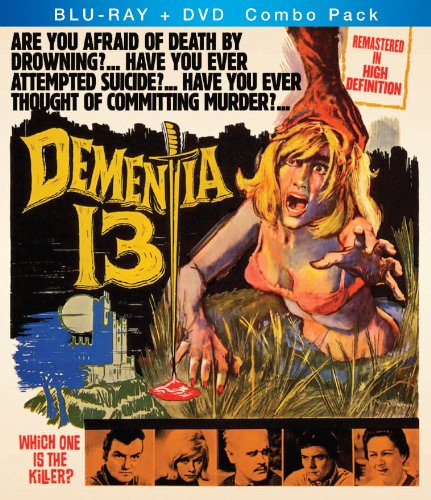
In 1972 he made us an offer we couldn't refuse. A couple of years later he followed it up with one of the finest sequels in Hollywood's history. Of course, I'm talking about Francis Ford Coppola. His movies are often considered epics. When Coppola paints, he tends to paint big. But it wasn't always like that for the once young director. He learned his trade, oddly enough, from the master of the B movie, Roger Corman. It was there that he learned to do more with less. It was there under the tutelage of Corman that Coppola and Jack Hill gave us one of the most atmospheric films to come out of the B movie machine: Dementia 13. It was another one of Corman's attempts to squeeze everything he could out of his resources. Coppola was working, mostly as a sound designer, on Corman's The Wild Racers. He offered Coppola the remaining resources to crank out one of his quick specials. Coppola put together a quick script that was intended to capitalize on the Psycho craze of the time. The result was a creepy film that might have been better than the feature the funds came from, at least horror fans think so.
Louise (Haloran) is arguing with her husband in a row boat when he has an inconvenient heart attack and dies. The inconvenience for him is quite obvious. For Louise it means she won't be getting her hands on any of his family's money when Mother (Dunne) finally kicks the bucket. So Louise develops a quick plan. She dumps hubby in the lake and arranges things so it looks like he had to leave suddenly for business in New York. Meanwhile, she'll stay with his family at their castle and estate in Ireland. But, things don't go as planned. The family is still mourning the death of Kathleen (Dowling) many years ago in a drowning incident. Each year they have a private little ceremony, and the event has shaped their very existence at Castle Haloran. There's also someone with an axe to grind, preferably in the heads of unlucky victims. Good old family Dr. Caleb (Magee) plays detective and has the pond where Kathleen died drained, revealing an even deeper mystery. Who killed Kathleen and now members of the Haloran clan and anyone else unlucky enough to be in the wrong place at the wrong time?
Posted in: Disc Reviews by Gino Sassani on May 11th, 2011
Of all the straight-to-video titles I didn't expect to see, Street Kings 2 would be high on the list. The original film was a predictable film with bad pacing. The box office was no better. That film pulled in about $26 million and quickly faded into obscurity. But here we are two years later and the title has been attached to a direct-to-video release from Fox. None of the original characters or actors are found here. The title merely suggests a similar story, this time in the Motor City, Detroit.
The film opens with a drug bust gone horribly wrong. Detective Marty Kingston (Liotta) is injured in the violence and spends his recovery at a desk and playing a department crime dog mascot at elementary schools. When his partner turns up shot and killed, Kingston injects himself into the investigation led by a green detective Sullivan (Hatosy). At each turn the investigation appears to paint an ugly picture of the deceased detective. He was as dirty as they come and mixed up in all sorts of seedy deals. It seems hard to believe that Kingston wasn't aware of his partner's dirt. Then other cops implicated in the corruption end up killed, and soon we understand Kingston's motives for being a part of the case.
Posted in: Disc Reviews by Gino Sassani on May 5th, 2011
There are a lot of films that I never expected to see on Blu-ray, at least not for many years. With so many blockbusters still not available in high definition, it's not reasonable to expect that some of the gems you've loved for years, but with limited marketability, would soon find their way to your home theater in HD. If you had asked me a short time ago to list some of those treasures, I think that The Terror would have easily made the list. This is one of those times that it feels good to be wrong, and The Terror might end up being the best surprise release of the year.
Lt. Andre Duvalier (Nicholson) has been separated from his regiment in Napoleon's French army. He finds himself somewhere in The Baltics on the coast. He's tired and near exhaustion when he spots an attractive young woman named Helene (Knight). She leads him to fresh water and a chance to rest. But when she leads him into the surf and disappears, the young soldier is nearly killed. He's rescued by an old woman named Katrina (Neumann). When he tells her about the girl, he's admonished that there is no such person in the area. But he sees her again, and once again is nearly led to his death. Finally a servant of Katrina's tells him he will find the girl at the castle of Baron Von Leppe (Karloff).
Posted in: Disc Reviews by Gino Sassani on May 3rd, 2011
"In the beginning there was darkness. And then bang, giving birth to an endless expanding existence of time, space, and matter. Now, see further than we've ever imagined. Beyond the limits of our existence. In a place we call The Universe."
The History series lasted for five seasons. The show used modern space photography, computer-generated images, and demonstrations along with respected scientists to explore the various aspects of our universe. While more time is spent in our own back yard exploring our solar system, the series did take us to the outer reaches of space, going back about 13 billion years. That's as far as we're able to see. The show was narrated by Erik Thompson. Of course, there is plenty of narration by the scientists.
Posted in: Disc Reviews by Gino Sassani on April 30th, 2011
When you want to get the most bang for your buck in a low-budget 1980's slasher film, you could do a lot worse than The Dorm That Dripped Blood. It's an elusive film that has never really enjoyed much of any kind of wide release even in the video market. It was really nothing more than a student film put together as a thesis for UCLA students Stephen Carpenter and Jeffrey Obrow. Like most student films, the piece utilizes locations on the UCLA campus and makes use of local talent both in front of the camera and behind. But this movie doesn't look like any student film you've ever seen before. With almost no budget, the team managed to make a film that was remarkably professional in the way it looked. The cinematography showed style that usually takes years or decades to develop. There's none of the usual amateur mistakes, and you'd be hard pressed to find it not worthy of the rest of the films coming out of that genre and that time. The film went through various name changes and has been seen in many forms over the years. You might know it as The Prank or Death Dorm. Whatever you might call it, I call it one of the best slasher films that you probably never heard of.
The story is simple. There are no complicated set-ups. There's no convoluted back story or supernatural urban legend to kick things off. Don't worry about getting to know the characters very well. It doesn't matter. They're merely killer fodder, and we'll get to know them about as well as we need.
Posted in: Disc Reviews by Gino Sassani on April 27th, 2011
I’ve been a fan of South Park ever since a friend introduced me to the internet Christmas card that started it all. It was Santa versus Jesus and these short potty-mouthed kids that somehow wormed their way under your skin. Pretty soon I was downloading the episodes and watching them on my computer. For some reason I can’t quite explain, I’ve very rarely watched an episode on Comedy Central. By the time things were getting tighter and riskier downloading the shorts, the single disc, 4-episode DVDs began to arrive in stores. So my South Park viewing moved from the PC to the DVD player. In a short time season sets began to arrive, and I looked forward to them with much anticipation, still watching it infrequently on television. After all, who needs the commercials and those silly network bugs that distract you on the screen? The series itself evolved in that time. The show was once achieved through a stop-motion process using construction paper cutouts. The animation was crude. After the Christmas card, the characters were significantly redesigned. They had a very evil look on that short. The first couple of episodes brought us an evolution toward the characters we know and love today. After a while the animation went to a computer process. The look remained the same, but gone were the paper cuts and stop-motion photography. As the show progressed there were less and less bleeps. It’s not that the language got any tamer. Standards got a little looser. Finally the bleeps would disappear from at least the DVD releases. And now South Park has crossed another milestone. Welcome to Blu-ray and high definition, South Park.
I often have trouble believing that South Park has been around for as long as it has. It’s not just the passing of 14 years, but the sheer brilliance in the face of an increasingly politically correct society. It’s like watching old episodes of All In The Family. Who believes that Archie Bunker would have any chance of survival in the 21st century? It’s no wonder that Norman Lear has become involved in the series. It’s the last remaining vestige of a once great freedom to be ridiculous and offend. Eric Cartman’s a lot worse than Archie ever was. We always knew that, in his heart, Archie had a soul. Cartman’s a psychopath without a conscience, and in a civilized society we would be terrified of the existence of such a demon spawn…except he’s just so dang funny. Trey Parker and Matt Stone have been walking a tightrope for over 13 years now, and it just doesn’t get old. One of the reasons the show doesn’t grow stale is their ability to make such a quick turnaround on current events. Because the show takes literally days to write and produce, they are quite often always the first to address an issue. They had an election-night episode on literally the next day in last season. That means the ideas stay as fresh as the headlines. Finally, you have to credit the expanding universe of good characters. The core group of Cartman, Stan, Kyle, and Kenny were great for a lot of years. But, watching this 14th season you have to admire how much Butters has infused himself into that core. We also have such great semi-regulars as Timmy, Jimmy, and Token. These characters allow the stories to expand in ways the core group could not. I’ve honestly come to think of Butters as one of the core now.
Posted in: Disc Reviews by Gino Sassani on April 25th, 2011
Every year when the Academy Awards have been given out, I look over the winners in each category, and more often than not I scratch my head at the ultimate winners. I find myself wondering if they saw the same movie I saw. I start to ponder if there might be an alternate-universe version of these movies that somehow find themselves in the hands of the Academy jury. Sure, once in a while they get it right. Films like The Godfather, Gladiator and Unforgiven manage to fight off the competition and claim their earned statues. Most times, however, I find that a trend of political correctness enters the picture more than the quality of the films or actors themselves. It's the only way I can explain Sean Penn taking a statue over Mickey Rourke a couple years back. Films and actors are rewarded to showing the proper political philosophy. So, when I heard that The King's Speech won the award this year, I began to fear the same circumstances had once again prevailed. I hadn't seen the film, but the subject matter appeared to qualify. I considered it another undeserved Oscar given to an ambitious Hollywood crowd brown nose. Then I saw the film through this Fox Blu-ray release. It might not happen often, at least no more that a dozen times a day, but boy was I wrong about The King's Speech. This really was one of the best films not only of this last year but in quite a long time.
The Duke of York (Firth) has a serious speech impediment. He stammers, which isn't the most confidence-inspiring trait for a member of the royal family to have. In the past the problem likely would not have become an issue. But the invention of radio has made it essential for the members of the royal family to speak to the nation and the world. With the help of his extremely devoted wife Elizabeth (Carter), he has seen all manner of specialists both of sound scientific principle and the whack-job varieties. Nothing works. Elizabeth hears of an unconventional therapist who has a rather impressive track record. When she visits Lionel Logue (Rush) for the first time under an assumed name, she finds him a bit arrogant and unwilling to bend his rules, even for the Duke of York. Still, they decide to give the man a try. At first it appears as though this was merely another in a long string of failed attempts to help the Duke. He leaves as frustrated as he had ever been. It didn't help that the obstinate man insisted on calling him by the too-familiar name of Bertie, reserved only for close family. He treated the Duke like a child. The Duke exited holding a record made of an attempt to speak with blaring music in his ears. He decided he didn't need to hear the recording and suffer the usual humiliation.




![Daydream Nation [Blu-ray] dvd cover art](https://upcomingdiscs.com/ecs_covers/daydream-nation-blu-ray-large.jpg)


![Manchurian Candidate [Blu-ray] dvd cover art](https://upcomingdiscs.com/ecs_covers/manchurian-candidate-blu-ray-large.jpg)


![The Twilight Zone: Season 4 [Blu-ray] dvd cover art](https://upcomingdiscs.com/ecs_covers/the-twilight-zone-season-4-blu-ra-large.jpg)




![Street Kings 2: Motor City (Unrated) [Blu-ray] dvd cover art](https://upcomingdiscs.com/ecs_covers/street-kings-2-motor-city-unrated-large.jpg)

![The Terror [Blu-Ray + DVD Combo Pack] dvd cover art](https://upcomingdiscs.com/ecs_covers/the-terror-blu-ray-dvd-combo-pac-large.jpg)


![The Universe: The Complete Series Megaset [Blu-ray] dvd cover art](https://upcomingdiscs.com/ecs_covers/the-universe-the-complete-series-m-large.jpg)


![The Dorm That Dripped Blood [Blu-ray + DVD Combo Pack] dvd cover art](https://upcomingdiscs.com/ecs_covers/the-dorm-that-dripped-blood-blu-ra-large.jpg)

![South Park: Complete Fourteenth Season [Blu-ray] dvd cover art](https://upcomingdiscs.com/ecs_covers/south-park-complete-fourteenth-sea-large.jpg)

![The King's Speech [Blu-ray] dvd cover art](https://upcomingdiscs.com/ecs_covers/the-kings-speech-blu-ray-large.jpg)
