Posted in: Disc Reviews by Archive Authors on June 12th, 2006
In Failure to Launch, Trip (Matthew McConaughey) is a 35-year-old man who still lives with his parents. His parents simply want him out of the house, which doesn’t seem so harsh considering his age. So what do they do? Why, they simply decide to hire a woman named Paula (Sarah Jessica Parker) to assist them. Paula, you see, is a specialist in helping grown men move out of their parents’ homes. I didn’t even think such a job existed. Well, Paula, we soon learn, has a very simple method that usually guarantees h...r success. First, she looks nice, then she finds out what they like and she pretends to like it too. What a complex job. Paula calls this system “Failure to Launch”.
Trip’s parents, Sue and Al (played by Kathy Bates and Terry Bradshaw) live in a naturally beautiful home that Trip loves to pass off as his own. You see, Trip dates a girl, begins to like her, continues to date her, and then when he gets “the look”, he takes her home passing the home off as his own. It usually isn’t until Al comes into his room that he reveals to the girl that the home is actually his parent’s home. Sue tells Paula this is Trip’s method of breaking up with people. I find it hilarious that Sue takes the amount of care that she does of Trip for a man at his age. She cooks him a big breakfast, packs his launch, does his laundry, etc. I know the whole motherly-love thing is always around, but what kind of mother does this for her 35-year-old son?
Posted in: Disc Reviews by Archive Authors on June 11th, 2006
Synopsis
A group of occultists horsing around with more than they know accidentally open up an evil portal and unleash a terrible force upon the world. Fortunately, there’s an organization of Demon Hunters on the job, determined to send this evil and all if its minions back where they came from.
Posted in: Disc Reviews by Archive Authors on June 11th, 2006
Synopsis
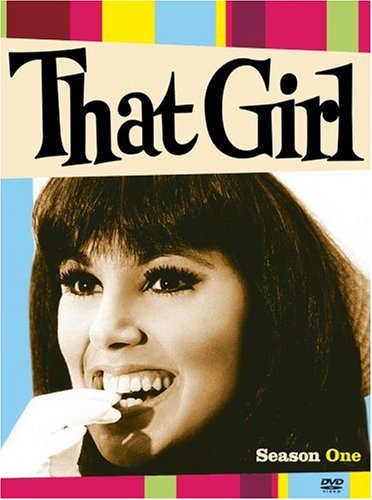
Long before she paired up with Phil Donahue and the two went on to do..who knows what, Marlo Thomas appeared in some smaller TV shows from in the early '60s, until she got a break when she was given a TV show to utilize her talents. That Girl is the story of Ann Marie, who decided to move to New York City to try to find steady work as an actress, and over the course of the show's five year run, Ann Marie's exploits are documented in situation comedy fashion.
Posted in: Disc Reviews by Archive Authors on June 11th, 2006
OK, I hope I'm not diving into a review that may fall into the "film scholar" category, and thus rule me out of being taken seriously. When there's a lull in buying new releases, sometimes my wallet gets cabin fever, and so I went out and picked up the Hitchcock set from Criterion, entitled Wrong Men and Notorious Women: Five Hitchcock Thrillers 1935-1946, and includes the previous Criterion releases from Hitchcock, namely Rebecca, Notorious, Spellbound and The Lady Vanishes. I'm tackling the earliest release of the bunch, entitled The 39 Steps. The story very much resembles another of Hitchcock's later works, North by Northwest, in the aspect that the wrong man is thrown into a spy chase. While Cary Grant is taken through New York, a cornfield, and Mount Rushmore in the later film, in The 39 Steps, Richard Hannay, played by Robert Donat, attends a Music Hall production, meets and takes home a women (Annabella Smith, played by Lucie Mannheim), who he later finds out is a spy who is being chased by two men attempting to kill her. In the middle of the night, Annabella comes into Richard's room, and falls over him, dead of a knife in the back. As the police chase him, looking to detain him for the murder, the two men, assuming that Richard has found out about the secret she held, start to pursue him in order to kill him. And whatever he does, some of Anabella's last words to him are not to trust a man missing the tip of his right pinkie (It sounds strange to write the word "pinkie" in a review of Hitchcock, so I hope it looks out of place as you're reading it).

This was one of Hitchcock's last works before coming over to America to wow us with the movies that have become legend. For all of my DVD collecting, I'm still a bit green when it comes to the older stuff. And after seeing The 39 Steps, I now realize what I've been missing. For its time, it's a pretty suspenseful film, with a lot of shots that are still used in movies today, and even the story has been used in some fashion or another over the years, though clearly not to the same effectiveness that Hitchcock has done. Despite the "Born On" date for this film, it's a very good one, and to see many of the same devices used today, both within the story and within Hitchcock's technical realm, make it an easy recommendation to those who are even casual film fans.
Posted in: Disc Reviews by Archive Authors on June 9th, 2006
Limitations of budget and social conventions of the time prevent Murder, Inc. from being all it can be - still, the performances, and the captivating dynamic between hero (Stuart Whitman) and villain (Peter Falk) result in entertaining fare, so long as this film is allowed to be a movie and not a documentary. Whitman leads a fine cast as the mob lackey, who is constantly manipulated by a tough-talking contract killer. Part of the real life syndicate of hit-men "Murder, Inc.," Falk's baddie steals every ...cene he's in throughout this early career-making performance. He smacks of a young Brando, and comes across as just the type of ice-blooded villain, which gave the 1930's Brownsville mob its infamy. He'll lie, cheat, and steal, to get what he wants - whether it be conning Whitman's assistance to off a stale nightclub comedian (Morey Amsterdam), or brutally raping Whitman's wife (May Britt). And by "brutally," I mean "brutally for the times." The word "rape" is never used, and the explicit nature never goes beyond an aftermath scene, where a disheveled Britt anguishes, "Those filthy hands. Those dirty fingers."
A film like this could be revisited to great effect by a capable director like Scorcese. In fact, stylistically, Murder, Inc. shares many attributes with Scorcese's superior mob epics. It's the kind of film that influences better filmmakers to make better pictures - but I would only use the word "classic" to describe its age, and not its quality. For one, the narration is totally out of place, and - quite obviously - the result of a receding budget. The first bit of narration doesn't come into play until we're past the first act. And when it does finally appear, all we hear is a droll voice with zero personality. We only learn later the narrator is a character in the film - the heroic cop (Henry Morgan), who takes on the entire mob organization. Rather than give the film a documentary effect, the narration serves only to clumsily fill in cracks, where story should be. "Show, don't tell," this isn't. Another weak point is how the best element is often neglected - the Whitman-versus-Falk conflict with Britt caught in between. It seems like every time this story element gets rolling, we cut away to a less interesting sidebar. And when the angle is finally resolved, it happens with such anti-climax that we wonder why we even cared at all.
Posted in: Disc Reviews by Archive Authors on June 9th, 2006
Synopsis
Not having seen the first season, I confess as to floundering somewhat in my encounter with the second. In the interest of keeping things simple and comprehensible, I thus present the synopsis provided by the box itself. The second season “finds Tommy Gavin (Denis Leary) away from his former crew . . . and working in a Staten Island firehouse. He must come to terms with the havoc his drinking has caused and realizes it’s time to get his problems under control. His comrades back at 62 Truck a...en’t faring much better. Chief Reilly struggles with the recent Alzheimer’s diagnosis of his wife and her deteriorating condition. Franco juggles the responsibilities of raising his daughter while trying to return to work. Lt. Shea discovers just how lonely the single life can be and Laura complicates house relations by getting involved with a colleague.”
Posted in: Disc Reviews by Archive Authors on June 9th, 2006
Synopsis
Jeremiah is taken at the age of five from his loving foster parents and turned over to the tender mercies of his white-trash mother, Sarah (Asia Argento, in an absolutely monstrous role). He is dragged down into the abusive nightmare of her life, being raped by her male partners when he is being beaten by them. There is an interlude where he is taken under the care of his fundamentalist grandparents (whicih is a nightmare in itself), but mother reclaims him, ultimately making him up as a gir... and having him turn tricks with her at truck stops.
Posted in: Disc Reviews by Archive Authors on June 9th, 2006
Director Jonathan Mostow is an interesting director to say the least. He directed Kurt Russell is the great Breakdown where a man must fight to save his wife. He director Arnold Schwarzenegger in the third Terminator film where a machine must fight another machine to help save the human race; but before he made Terminator 3, he directed Matthew McConaughey and Bill Paxton in a film where men must fight against their wits to save themselves. Two of the three films are great and are a joy to watch,...while one is enjoyable to watch, but that is about it.
In U-571, Lt. Tyler (Matthew McConaughey) stars as a young man who wants nothing better than to jump into the command line. His commander, Lt. Commander Dahlgren (Bill Paxton) doesn’t see this though. Tyler isn’t experienced enough and isn’t ready to sacrifice the lives of his men for the lives of others or, more importantly, the safety of the mission at hand. This creates some heat between the two, but all that is quickly put aside when they’re called back to the boat. We soon learn that a German U-boat has become disabled in the middle of the Atlantic. On board this U-boat is a secret Enigma machine, which can be used to cipher messages. This exact Enigma machine was used by the Nazi’s to control all of their shipping lanes.
Posted in: Disc Reviews by Archive Authors on June 8th, 2006
Synopsis
Photographer Timothy Greenfield-Sanders decided to do a series of portraits of some 30 porn stars. Two pictures of each, one clothed, one not, the same pose in both pictures. This is his documentary of that shoot. Scenes of the studio process are intercut with interviews with the various stars and talking-head moments from the likes of Karen Finley, Gore Vidal, John Waters and Whitley Streiber (!). We are at the other end of the porn spectrum from Dag Yngvesson’s Rated X – these are t...e top-paid performers, and so the overall experience is less depressing the world shown in Yngvesson’s film. (Though there is some inevitable overlap.) Many of the stars are very articulate (and not just from the expected sources such as porn star/activist Nina Hartley), and there is quite an interesting range of personalities and views presented here. Jenna Jameson is seen, but presumably was too expensive for an actual interview. Instead, she is talked about, and so accrues the semi-divine aura of an all-powerful, all-knowing, enigmatic Mona Lisa. One is left a bit wanting: one doesn’t learn very much about Greenfield-Sanders’ photographic process, and one wishes many of the interviews were longer and more in-depth. That said, a fascinating piece.
Posted in: Disc Reviews by Archive Authors on June 7th, 2006
The Culpepper Cattle Company was a surprise for me, and one that I looked forward to immensely. I love a good western, and I'm particularly fond of anything post-Leone. A western doesn't have to be spaghetti, however, for me to like it. I just feel that, for all Sergio's overblown proportions, he did instill an accurate degree of nastiness in his films, which I'm sure was prevalent in that time of American history. Once Sergio came, westerns grew up, even if they were playing closer to the American style of fi...mmaking. Gone were the days of the fired gun, the clenched chest, and the instant kill. A similar renaissance affected the war film genre with the arrival of Saving Private Ryan, and I feel the recent war-time efforts have been much the better for it. After the glut of Saturday morning western chicanery found in John Wayne's early films and others of that period, it was a relief to see westerns on the silver screen with the right amount of intensity. But unfortunately, all good things must come to an end. And The Culpepper Cattle Company falls somewhere in that descent.
That doesn't mean the film is without merit. I enjoyed parts of it very much. It is, most of the time, an interesting coming-of-age tale, as it follows a young boy with a dream. That dream? He wants to be a cowboy. But as the film progresses, he gets a bitter taste of what it means to fulfill that dream. The boy (Gary Grimes) tags along with a gang of cut-throat cattlemen on a drive to Colorado. As they trek westward, the harsh realities of the prairie - be it man-against-man, or man-against-nature - start to set in. Unfortunately, it doesn't get any more interesting than that. One event after another occurs and forms an episodic monotony instead of a coherent storyline. Still, things do heat up for an exciting and well-arc'd conclusion. Where the character ends up from where he started out is a noble writing effort; but everything it takes to get him there is the dull part. The strongest aspect of the film is the ensemble of veteran character actors, led by Billy Green Bush and Bo Hopkins. These are cowboys from the days when all cowboys were straight, and any suggestion otherwise would get you punched in the teeth faster than you could say "Brokeback Mountain." While they don't seem like very open-minded chaps, they do represent a rugged nature that would have been essential to their way of life.