Posted in: Disc Reviews by David Annandale on July 10th, 2006
Career criminal Ray Milland shows up at the ranch of Korean vet Anthony Quinn, looking for his old flame, Debra Paget. She is now married to Quinn, but she hasn't adapted well to country life, still carries a torch for Milland, and is in the very process of leaving Quinn. She and Milland rekindle their romance, and are planning to leave town with the million dollars Milland has just scored. When Milland runs over a state trooper, he forces Quinn to guide them through the wilderness to the Mexican border. A struggle for both survival and Paget's love ensues.A welcome reminder of when thrillers didn't have to be two-and-a-half hours long, this is a tight, swiftly paced peace of work. Despite the great physical difference between them, Milland comes across as a worthy adversary for Quinn, there's a great cynical anger to the characters, and the violence is pretty brutal for its era. The location settings tend to make the studio exteriors all the more obvious, but this is a minor quibble This is a fine western noir, worthy of rediscovery.
Audio
Posted in: Disc Reviews by Archive Authors on July 10th, 2006
On paper, The Ringer must sound like the most un-PC movie in the history of cinema. After all, Johnny Knoxville from MTV’s Jackass plays a character in need of some cash, so he pretends to be “Jeffy” -- a mentally challenged athlete -- in order to fix the Special Olympics.
However, this movie is produced by the Farrelly Brothers, and as they have done in their past films (There’s Something About Mary, Shallow Hal), the Farrellys treat mentally and physically challenged people with resp...ct -- casting them in large supporting roles -- which allows The Ringer to become an endearing film, rather than the offensive and insulting piece of crap it could have easily become.
Posted in: Disc Reviews by Archive Authors on July 9th, 2006
Something really extraordinary seems to be happening as a side effect of the recent rise in popularity of documentary films. While many films still illuminate problems in our society, some of these films have begin to become agents for change themselves. There is no denying the important role that films like The Untold Story of Emmett Louis Till play in our society, but I am really moved by films like The Boys of Baraka. Show me injustice, and I am outraged. Show me programs that are righting injustices... and I am moved to action myself.
The Boys of Baraka is a very powerful film. Instead of just being another film about the deplorable situations for the youth in our inner cities, this is a film about one program that gives some kids a real chance to get out of the ghetto and break the cycle of poverty. Every year, 20 boys from the projects in Baltimore, MD are given the opportunity to spend two years at a special school in Kenya. Here, the boys not only get a quality education, but they also learn the kinds of valuable life lessons that they could never learn in books.
Posted in: Disc Reviews by Archive Authors on July 7th, 2006
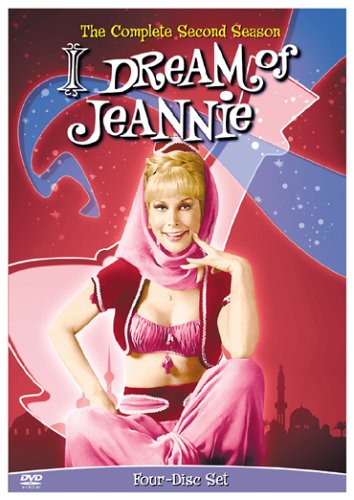
Larry Hagman and Barbara Eden return for more hokiness in the complete second season of I Dream of Jeannie, which features 31 not-so-fantastic episodes with the most juvenile humor and situations. I suppose the possibilities for fun are there, but none are fully realized, perhaps because censors just wouldn't let the series be all it could be. For goodness sake, they wouldn't even allow the display of the lovely Eden's belly button in her mid-riff outfit. Leave it to censors to find sex in the most ludicrous o... places. It makes one wonder what kinds of weird kinkiness goes on behind their closed doors, but that's an avenue I don't care to travel. Truth is: the show is completely harmless, and as with Bewitched, its harmlessness is to its detriment. Fans of the series, however, will have a great time with about 15 hours of Jeannie. And if it's bad entertainment such as this you like, at least there's the lovely Eden's belly button-less frame to make the experience more enjoyable.
The second season begins with the anniversary of Jeannie's discovery at the hands of good-hearted astronaut Tony Nelson. The first episode comes complete with a villain (the Blue Djinn), who was actually responsible for Jeannie's imprisonment. It's an episode that cries out for the main plot of the inevitable movie version of this decrepit-on-ideas series. But it's no more interesting than the other 30 episodes included here. Other highlights for fans of the series: "How to Be a Genie in 10 Lessons," in which Jeannie is forced to torment her aloof master in an effort to "be like other genies." There is the two-part "The Girl Who Never Had a Birthday," in which Captain Nelson and his sometimes rival Roger seek to find out Jeannie's birthday before she wills herself into nothingness. Last and just as least, there is "My Incredible Shrinking Master," which is just like it sounds. In a nutshell, if you've seen one episode, you've seen them all.
Posted in: Disc Reviews by David Annandale on July 7th, 2006
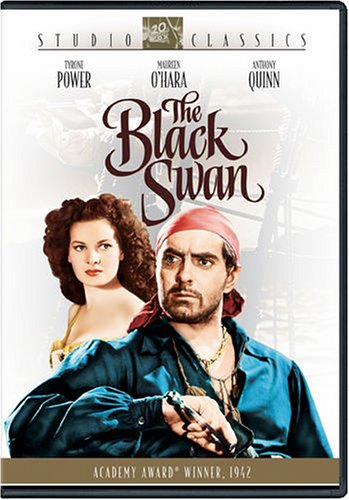
Tyrone Power has been plying his trade as a pirate in the waters near Jamaica. When his former captain becomes the governor of Jamaica, Power goes straight. He has his eye on Maureen O'Hara, who is engaged to a duplicitous aristocrat who is feeding information to unreformed pirate George Sanders (utterly unrecognizable in shaggy red hair and beard). There will be many complications before Power can claim the resisting O'Hara as his own.Compared to the Errol Flynn pirate movies Captain Blood and The Sea Hawk, this one is a bit light on the action, really only getting down to the buckling of swashes in the final act. The romance between Power and O'Hara is a bit difficult to take in this day and age as well, especially in the first part of the film as it dances into rape fantasy territory. But be that as it may, this is still a first-class adventure.
Audio
Posted in: Disc Reviews by Gino Sassani on July 7th, 2006
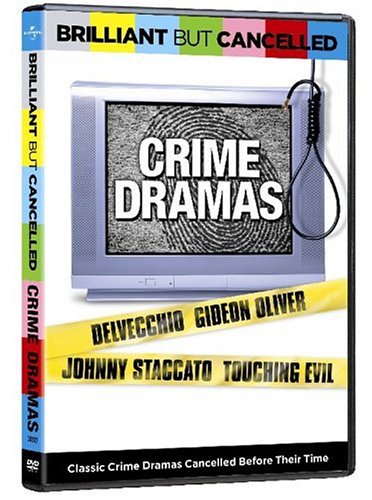
Bravo had an idea. On the surface it was actually a pretty good idea. They realized that of all the well known and critically acclaimed show runners out there with their hugely successful shows, there must have been some flops along the way. After all, no one hits a home run all the time. They also correctly assumed that some of these shows might have been pretty fair efforts that for some reason or another just didn’t last long enough to catch on. Furthermore, it was a rather clever marketing decision that there were folks out there who would like to see some of this stuff again. Even the idea of DVD releases was a smart strategy. The fatal flaw is the way they released this material. The DVD contains but a single episode of four very different programs. For three of the entries, these aren’t even pilots to properly introduce us to the characters and circumstances surrounding each show. Touching Evil is the worst of the lot in this department. From the very beginning, it’s obvious that we’re in the middle of a huge story with rather complicated character interrelationships. We’re left feeling like outsiders. For me that made it almost impossible to fairly evaluate the series. The added “Previously On” was completely inadequate to catch me up. In fact, it actually left me with even more questions.
Johnny Staccato is the shorter of the presentations at about 25 minutes. The series starred the wonderful John Cassavetes as a night club piano player who does a little gumshoe work on the side. The style is very much a 1950’s Sam Spade atmosphere and works quite well. The episode “Tempted” is a pretty nice affair starring Bewitched’s Elizabeth Montgomery as the apparent “damsel in distress”. Many plot twists in a short time move the story along pretty well. This is the only entry in black and white..
Posted in: Disc Reviews by Archive Authors on July 6th, 2006
This is the first Woody Allen film I’ve ever seen.
Something always put me off about the guy. Maybe his infamous personal life plays a part in my not wanting to explore Allen’s cinematic offerings, but I would chalk up my ignorance to Allen’s physical appearance. Shallow, I know. But he’s a little nub of a man who has self-indulgently cast himself as the romantic lead in most of his films. But whatever, he’s a respected filmmaker and the responsibility of being a film buff requires me to keep an open mind -... even when it comes to Woody Allen. In short, I need to shut up and start watching his films.
Posted in: Disc Reviews by Archive Authors on July 6th, 2006
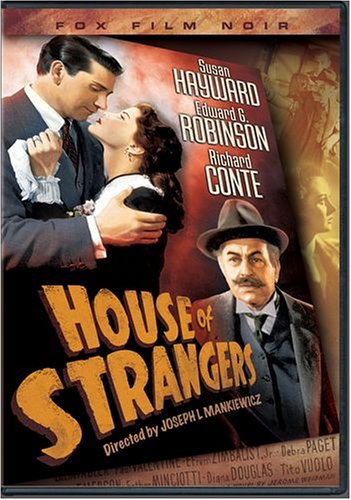
Not having much appreciation for (or just being an aficionado of) the film noir genre, I could probably do one better and say that even if noir was induced on me subliminally, there may be a good chance that I wouldn't even recognize it. So I don't know how cool things like The Blackboard Jungle or some other films are and I can't really rule them out of hand. So when I got House of Strangers to review, I had to give it a try.
Based on a novel by Jerome Weidman (who won a Pulitzer for a Broadway play) and directed by Joseph L. Mankiewicz (who directed a couple of films called Guys and Dolls and Cleopatra), the film centers around several brothers and their father Gino, played by Edward G. Robinson (Soylent Green). Gino's favorite son Max (Richard Conte, The Godfather) is thrown in jail in connection with his father's dealings (he runs a well-known bank in New York). Unbeknownst to Gino, his other sons Pietro (Paul Valentine, Against All Odds), Joe (Luther Adler, Absence of Malice) and Tony (Efrem Zimbalist Jr., Hot Shots!) overthrow Gino in a power play, which leads to Gino's death.
Posted in: Disc Reviews by Archive Authors on July 6th, 2006
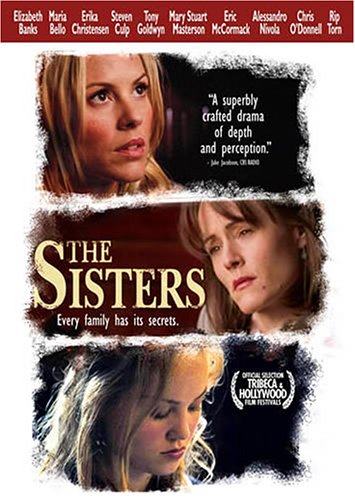
OK, so I've gotta admit that I'm a little bit of an uncultured boob who is not that familiar with the writings of Russian Anton Chekhov. In fact I know a little bit more about Andrei Tarkovsky (Solaris) then anything else, and that Chekhov was (and still is) an influential force in dramatic works today. Well, he has to be if his work "The Three Sisters" gets adapted into a play by Richard Alfieri, then into a film starring a capable and recognizable cast, right?
Directed by Arthur Allan Seidelman, the film chronicles the events of sisters who are living their lives in the shadow of their late, scholarly father. Olga (Mary Stuart Masterson, Fried Green Tomatoes) is the oldest in the family and is in line to be named Chancellor of a University, the middle sister Marcia (Maria Bello, A History of Violence) is a bit of a shattered psyche who lives with her husband Harry (Steven Culp, Desperate Housewives) and they constantly fight, so she seeks the company of Vincent (Tony Goldwyn, The Last Samurai). The youngest sister Irene (Erika Christensen, The Upside of Anger) seems to live a life that her older sisters admire, but she's not without her own demons, despite the thoughts of her fiancée David (Chris O'Donnell, Vertical Limit). There is a brother named Andrew (Alessandro Nivola, Junebug), who the sisters almost seem to subconsciously gang up on, even more so with Andrew's wife, the caustic Nancy (Elizabeth Banks, The 40 Year Old Virgin). There are also some notable supporting character actors in the film also, like the sarcastic Gary (Eric McCormack, Will & Grace) and the creepy but foreign Dr, Chebrin (Rip Torn, Men in Black).
Posted in: Disc Reviews by Gino Sassani on July 6th, 2006
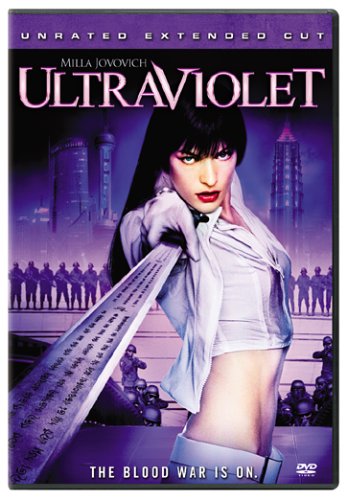
There is no shortage of vampire stories out there. There’s certainly no shortage of kick butt chicks dressed as sparsely as possible running around in depressed future populated worlds. Underworld, without a doubt, does the combination better than anyone. Ultraviolet makes a grand attempt that really ends up being more of a ride than anything else. Now, I can usually follow the most convoluted storylines, but this one gave me some trouble. It seems that while trying to create a super soldier (where is Mulder and Scully when you need them) the government made a big oops and created something akin to a vampire. Those infected with HGV, (I wonder what connection they’re going for there?), possess extraordinary strength. They also develop light sensitivity and a thirst for blood. After realizing these new hybrid beings weren’t going to quite fit in socially, the plan was to round them up and kill them all. That was the plan, anyway, before the likes of Violet. As part of an underground hemophage movement to survive the genocide, Violet finds herself having to protect a child whose blood might contain a cure or a plague. The inevitable chase through a futuristic city serves more to show off some expensive CG f/x than really further any plot.
Ultraviolet makes the fatal flaw of trying to serve too many purposes. There’s nothing wrong with a thrill ride with plenty of eye candy. Still, Ultraviolet is trying to make too many statements. The obvious HIV inferences, combined with the concentration camp mentality of the totalitarian future, overwhelm us most of the time. Another problem is the f/x are often too slick. More often than not the film just doesn’t appear believable. Now I don’t mean “That’s just not possible” unbelievable. I mean, the picture just doesn’t look real. This is what happens when color correction becomes manic. Everything is so smooth and shiny it looks as though it might as well all have been CG. The action is also almost comical. We’re talking Kill Bill on the believability gauge. She just takes on hundreds of enemies at a time. Before long you’re thinking, Who cares? She’s indestructible. Don’t get me wrong, I rather enjoyed it at times. It’s an over-ambitious thrill ride and nothing more. The problem is, it obviously wants to be so much more than that.