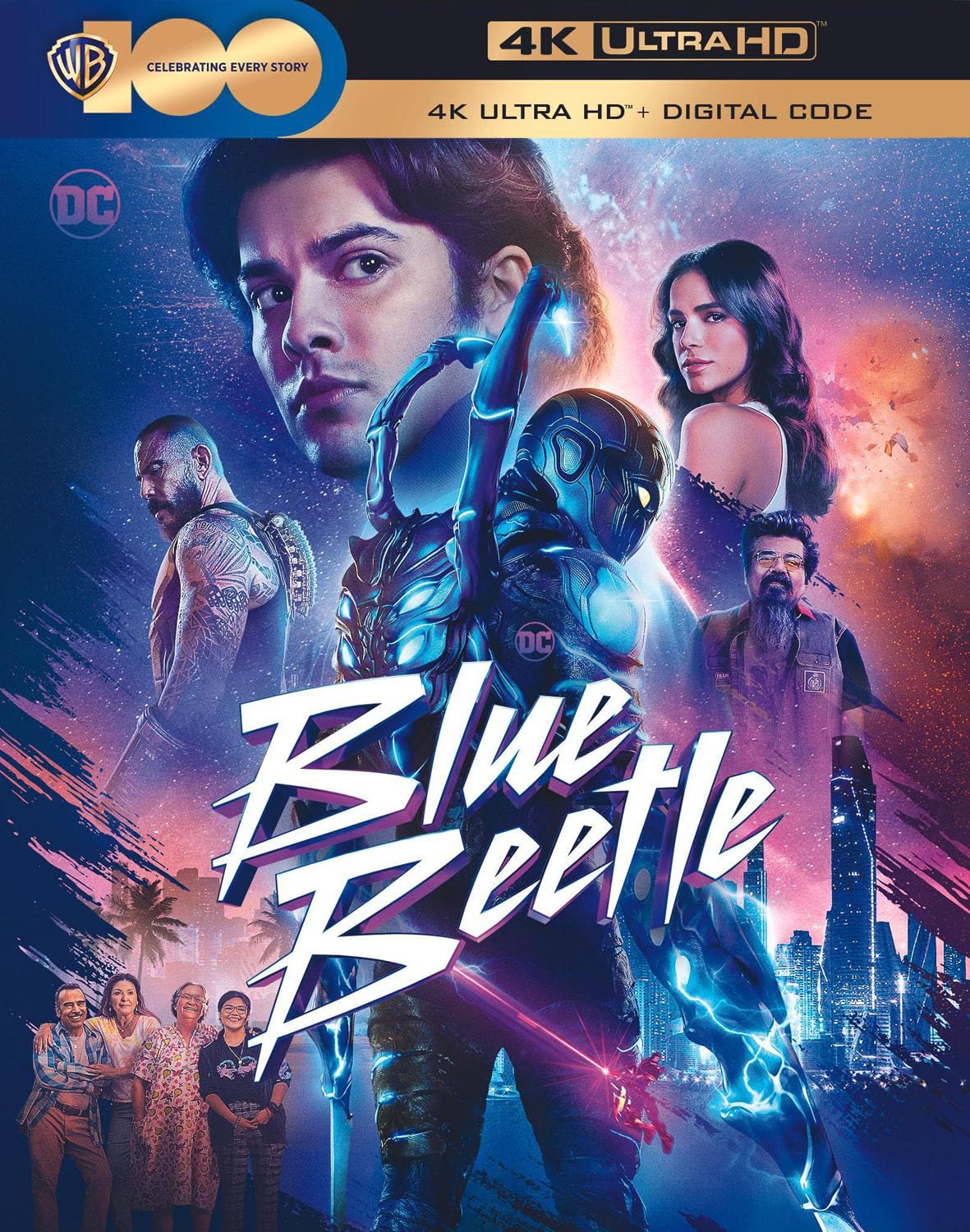
"Do you give people hope? Are you moving through your city like a guardian angel? Do you make a difference? That bolt of lightning chose you. Don't ever forget it."

There's one thing about being the fastest man alive. You get to the end faster than anyone else ... the finish line, if you will. But not so for Barry Allen, best known in the world of comic books as The Flash. When Arrow debuted back in 2012, no one could have foreseen where it was all going to lead. Greg Berlanti and a few others had created what we all thought was just another comic book hero television show. The Green Arrow wasn't one of the better known heroes, but he was part of the Justice League for many years, and he had a rather interesting origin story that could be told over the longer form of a television series.

“You might have saved my life, but you ruined my career, buddy.”

If I’m being honest, it was really difficult not to view this as a parody of buddy cops movies. I know that wasn’t its intention, but if I could make a recommendation; rebranding it as such would bolster its credibility. Between the helicopter vs. airplane shootout, and the dogged, always-get-your-man main character sitting in his empty apartment eating raw steak, I’m not sure how I was supposed to take this film seriously as a buddy-cop film. That said, the film is not without its charms or entertaining moments. I’d even be willing to go as far as to suggest that it worthy of whatever cult status that it has managed to achieve. It may have even became a blueprint for future buddy cop films, or at least a rough outline for them, had it not for another, more popular and realistic buddy cop film that also came out that year. Robert Carradine’s Nick Barzack may have been unpredictable, but Mel Gibson’s Martin Riggs was crazy! Carradine never stood a chance.

Korean horror has picked up in the last twenty years tenfold.  From films like Bedevilled and Thirst, they took on the revenge and vampire themes that a lot of classic horror films are built upon.  But honestly, I've been most impressed with films like The Wailing and Train to Busan.  The latter bred new life into the very tired zombie genre and made a darn watchable film, while The Wailing knew exactly what buttons to push when it comes to religion but then used that to make an interesting and thought-provoking film.  That's why when I saw that we had a copy of Seire, I knew I had to review it, even though I probably would be too scared to write about it for a few days.  I'm so glad I did.

"If we're going to do this, there's a lot I'm going to have to explain to you."

Been waiting on this one for some time, ever since we were introduced to the character in the Justice League movie and it was announced that the film would cover the Flashpoint Paradox storyline, which is one of my favorite comic storylines. My enthusiasm was tempered a bit with the film being delayed and the actor’s subsequent troubles (for the purposes of staying on the topic at hand, that will be my only mention of that situation). However, it is finally here, and after viewing it I can say that it was well done and well received. It is also a bit bittersweet, as it signifies the conclusion of the DCEU as we know it.

I probably could be called a lot of things, some kind and some not so kind.  But the one thing that probably most people would say about me is that I'm loyal.  Loyal to my job, loyal to my wife, loyal to my son.  However, in my life, I have certainly felt the pain of disloyalty, even to the point of infidelity.  Despite what people might say or think, you never quite expect it, and furthermore one can't predict how you might feel or act given the situation.  Today's movie Three into Two Won't Go explores the idea of what happens when a man cheats on his wife with another woman.  However, this woman stays around long after the fact and continues to press into his everyday life until it becomes unbearable.  Let's take a look.

Steve McQueen is one of those actors who will always be an icon of the silver screen and an actor who just personifies cool. The Getaway (1972) is easily my favorite film of McQueen’s. He has several other films one could argue that are “better”, but for me it will always be the Sam Peckinpah classic. Over his career he’s played a variety of roles from being a cowboy, a detective, a race car driver, to a professional thief and so forth, and for the most part I could believe him in all of these roles, but Nevada Smith is the first time I had to put up my hands and just go “are you kidding me?” For some reason they felt the audience would buy that a 35-year-old McQueen could play a 16-year-old half-Native-American character. Now if you can get past that kind of absurd casting and just go into the movie and accept as a western / revenge film, then Nevada Smith is a helluva good time with gunslinging action with beautiful locations and a terrific cast.

When it comes to writing crime, I don’t think anyone has ever done it better than Elmore Leonard.  When you look at his books and you see the number of quality films and TV series that have been adapted from his work, it is pretty impressive. 3:10 to Yuma, Out of Sight, Jackie Brown aka Rum Punch, Justified, Get Shorty … I could keep going, but that’s just a glimpse of what the man is responsible for. I discovered his books in high school, and I have been a fan ever since. When he passed away in 2013, it was a pretty sad day for me. He was an icon and one of my major influences on becoming a writer. So when the chance came along to review the release of the 1986 film 52 Pick-Up, I was more than eager to get my grubby paws on this one. This isn’t my first time watching the film. My first time was back in the 90s when I picked it up on VHS at the local mom & pop video store, but to be fair, I don’t think I’ve seen it again since.

Typically, I avoid World War II period films like the plague.  I literally see the word Nazi or German occupation and usually find a reason not to see the movie.  I have nothing against the pictures; the problem is that so many of these films are surrounded in clichés that it feels like an old hat with nothing new to offer.  However, when I saw The Day and the Hour in my review pile, I was intrigued by the notion of it being in France with a female lead and something of a romance.  Far different from the usual pow pow, war is heck, or a film that's going to have buckets and buckets of tears and worrying about the human condition.  Though from the looks of things, this one might have some waterworks too.  Let's take a look.

Fritz Lang is an iconic Hollywood director who was successful in the silent era and was able to transition and be successful into the “talkie” era. His work in Germany is what he is most known for, Metropolis (1927) and M (1931) but in 1934 he fled Nazi Germany, even after being offered to be the head of the German Cinema Institute and came to America where he signed a contract with MGM studios where his career flourished despite having a reputation for being difficult to work with. He’s a director that if you go to film school you will learn about, and you’ll either appreciate his films or find yourself falling asleep during them.  Despite my appreciation for M and Metropolis, I have to admit I really never explored the filmmaker’s work beyond those films, so when the chance came to check out Human Desire, I was curious to see how it was.

Here is an interesting tidbit of information I uncovered while researching this film. When the film was initially released it was criticized for the lack of accomplished celebrities in its cast. This carries some serious irony given that the film features the likes of Willem Dafoe, William Petersen, John Pankow, Jane Leeves, and John Turturro, all of whom have gone on to become accomplished actors in their own right. All it took was time. Despite not being considered well known at the time, this was still a movie with great portrayals and snappy quips that made me laugh. In fact, the only thing to rival its story is the real-world implications it had afterwards, which we will get into in a bit. Petersen leads the film as Richard Chance, a Secret Service agent with a reputation for reckless, impulsive behavior, and, unbeknownst to his superiors in the Service, also corrupt. Petersen has his sights set on Dafoe’s Eric "Rick" Masters, a ruthless and skilled counterfeiter in Los Angeles.