



“This is a true story. Whenever possible the dialog has been based on official documents.”
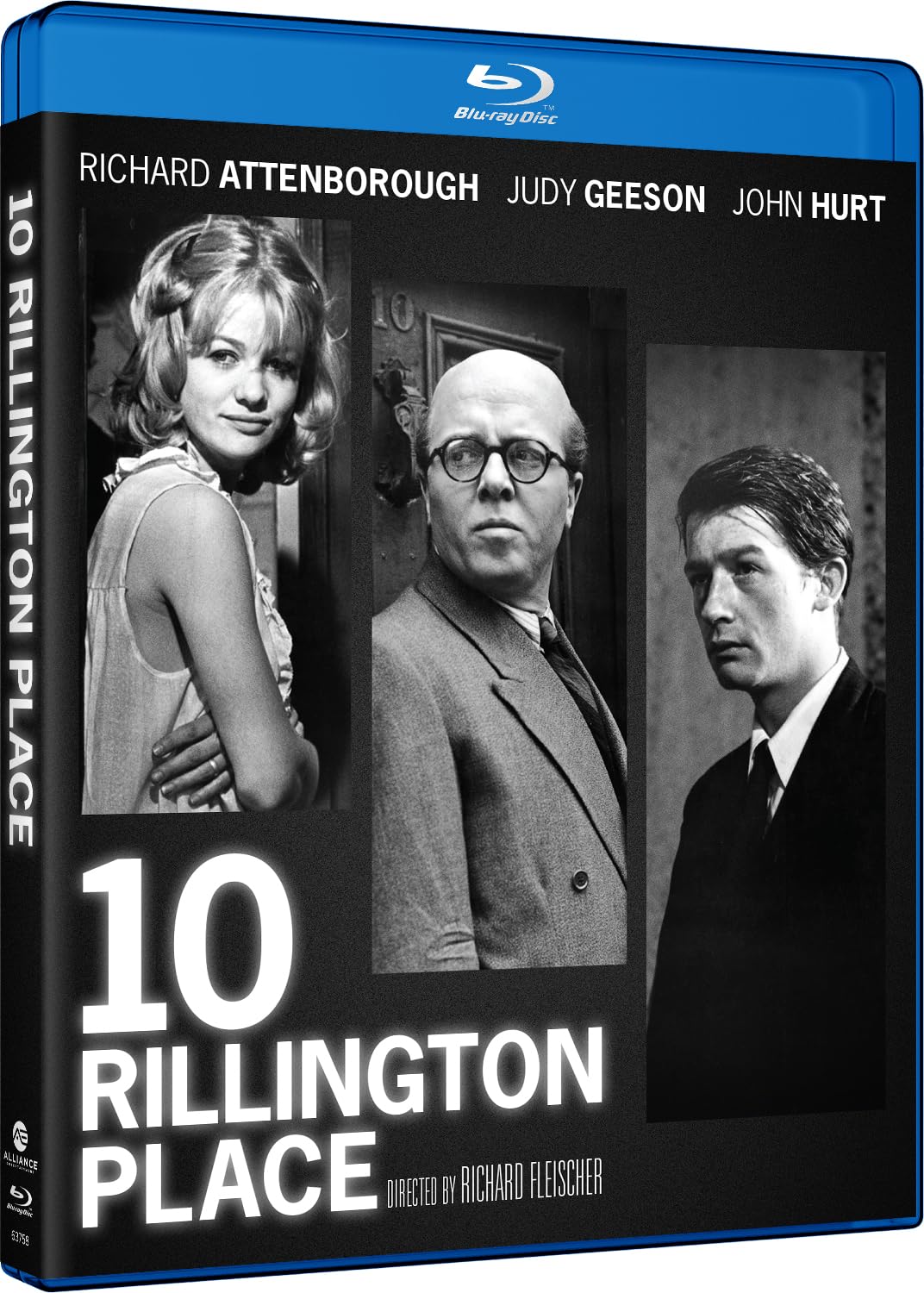
The very idea of a serial killer is very much an American one. Around the globe it’s considered somewhat of an American affectation. While that may be the reputation, of course that’s not true at all. One of the earliest and most documented cases of the serial killer is Jack the Ripper from London’s 19th century. John Christie was also a British serial killer. He never received the kind of notoriety and lasting fame as Jack, but that’s likely because Christie was caught and Jack never was. With Jack we can speculate and contrive all kinds of “truths” because there’s no way to prove or more importantly disprove any of it. In 1971 director Richard Fleischer took on Christie’s story in the thriller 10 Rillington Place. The film gets its name from the book about the case written 10 years earlier by Ludovic Kennedy. Kennedy also made himself available to the film as a technical advisor, as did London’s long-time hangman Albert Pierrepoint, who did Christie’s execution. The film had to wait a bit before it could be made, because English law prohibited films about real-life murders until 50 years after the events actually unfolded. Thanks in part to Kennedy’s book, the death penalty was abolished in England, and the prohibition against such films was also abolished. All of this opened the way for Richard Fleischer to tackle his second film based on a real-life strangler. Fleischer directed The Boston Strangler with Tony Curtis in the titular role just nine years prior. While 10 Rillington Place never gained the same kind of enduring classic status as several of his previous films, it remains one of the more interesting. Now the film is out on Blu-ray, and you have another chance to check out one of the better films you likely didn’t see when it was first released.
The film opens in 1944, and appropriately there is an air-raid siren warning the British population of another attack by Hitler’s famed Luftwaffe Blitzkriegs. Fleischer is using the sirens to warn us of another kind of danger. We meet John Christie, played by Richard Attenborough. He has brought a woman visitor to his home under the pretense of being able to offer some medical relief. Christie’s idea of medical release is a dose of carbon monoxide and a rope around the neck. It’s a brutal attack that serves to set the stage for the kind of man Christie is.
Next it’s five years later, and a couple have arrived to rent an open room in Christie’s building. Timothy Evans is played by John Hurt. He’s a timid man who is out of work and with few prospects because he’s illiterate. There is a young child and his wife Beryl, played by Judy Geeson. Christie is also married to Ethel (Heywood), who so far remains ignorant of her hubby’s hobby. He rents the family the room, but they do not have garden access. Christie likes to plant things there in privacy. The couple struggle and fight. Beryl is expecting yet another child, and they can’t afford to take care of the family they have now. They argue over an abortion, and the fights become quite public. Christie pretends he has medical knowledge and offers to perform the abortion. We all know it’s going to go very wrong, and Beryl becomes just another victim of Christie’s obsession. But he manages to put the blame on Timothy, who hangs for the crime. But Ethel is beginning to understand what’s going on here. Christie decides that’s not a secret he can have walking about, but he’s sloppy and eventually caught.
I love the atmosphere that Fleischer creates. Attenborough is perfectly cast and delivers such an understated and subtle delivery. There are echoes of Hanibal Lecter here, and Christie’s mannerism and brutality are absolutely chilling. It was actually a bit hard for me because, like many of you I’m sure, he’s the old rich guy who builds Jurassic Park and dotes on his grandkids. The film gives me a new appreciation for the man’s skills. He delivers a master class in this film, and it’s a character you won’t soon forget. John Hurt also delivers as the ignorant Timothy Evans, but Attenborough steals every second of the film.
There are two absolutely brutal scenes, but most of the film is rather calm and works through atmosphere. Unlike most killer films, we don’t get treated to a litany of the actual murders. The first pretty much sets the stage, but the murder of Beryl is hard to watch and once seen impossible to forget. When it’s done, you’ll realize most of this was character interaction and a bit of Timothy’s murder trial and execution. As I mentioned earlier, these scenes were guided by the man who executed both.
Since Christie was caught and executed, Timothy Evans received an official exoneration, and his body was removed from the Old Baily and allowed to be reburied in consecrated ground. The book’s depiction of these events changed English law. This was a powerful movie that never really got a very wide release and so remains relatively unknown. This was my first time with the film, and I won’t soon forget it. My only regret is that there are no bonus features to be found here.
Fleischer gave us quite a few classics over his career that included Charlton Heston in Soylent Green, Tora! Tora! Tora!, Fantastic Voyage where he shrunk Rachel Welch small enough to go swimming in a guy’s blood vessels, and Disney’s classic 20,000 Leagues Under The Sea. It seems his films always have moments that are simply unforgettable. Who can forget Charton Heston running around telling us that “Soylent Green is people!” or that giant squid attack on the Nautilus long before the days of computer-generated f/x? His stuff all seems to stand up and leave us with at least one moment we remember for the rest of our lives. 10 Rillington Place is just such a film, and you have a chance to catch it now, because it belongs up on the same video shelf with those other Fleischer classics. The late Richard Fleischer didn’t film every classic ever made, but trust me, “Never mind what he’d never do, it’s what he’s done.”
