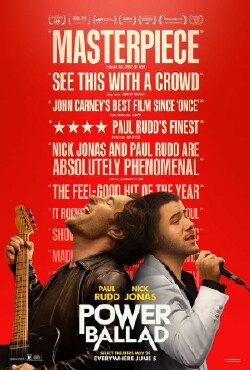
“We’re not rock stars. We’re human jukeboxes.”
A little bit of quick background. I’m a recording artist with eight albums under my belt, so I likely approached this film a little differently than most folks. I wasn’t really all that enthused about seeing the film. You see, I tend to hate when songwriters write songs about writing songs. I think it’s pretentious. So what have I done? Written at least a handful of songs about writing songs, so I don’t do a lot of practicing what I preach. That’s the mindset I had going into the screening. It turned out maybe I do like songs about songwriting and just haven’t had the guts to admit it. There aren’t any maybes about one thing. I can tell you for certain that Power Ballad turned out to be one of the best films I’ve seen in the first half of 2026. Who knew? I think that director/writer John Carney knew. It’s possible that Paul Rudd and Nick Jonas did. Now I know, and in a minute, so will you.
“It’s what a good song can do. Mean many different things to different people.”
Paul Rudd plays Rick. He’s a frustrated songwriter who wants to play his original songs instead of covers, but they are a wedding band, and covers are what they want. It causes friction both in the band and at home. His luck appears to change when the band does a wedding and a close friend of the bride’s happens to be Danny Wilson. Nick Jonas is practically playing himself. Danny was once a boy band sensation, but his career is in the dumps. His manager threatens to dump him, and he’s not getting a lot of love from his record label. But he was once a star. and the bride asks the band to let Danny sing a song. At first it frustrates Rick. but Danny invites him to sing along, and they appear to bond on the stage. After the show they stay up all night together drinking and playing songs for each other. One of the songs Rick shares is a song he wrote for his daughter Aja (Fallon) called How To Write A Song. It’s actually a pretty good song, and when Danny gets more pressure from his manager and label, he presents the song as his own. You can likely predict that the song becomes a monster hit, and Danny doesn’t credit Rick, who insists that it’s his song. No one believes him, and the frustration even turns a bit violent. His attempts to reach out to Danny are ignored, and he plans to confront the star with his complaint. The problem is he can’t prove it. None of the demos on his computer have it, and he never played it live, so even his bandmates and family never heard it before. How it all ends up isn’t really the point of the film.
It’s truly every songwriter’s nightmare. Someone steals maybe the best thing you ever wrote. Most of us spend the insane money on copyrights, and today you video all of your performances so there’s a living and breathing record about what you’ve done. We spend money both at the studio and elsewhere to have digital tags embedded in the recordings. Sometimes you end up trusting a fellow musician because you want to test drive it before you protect it. We’ve all taken that chance, and so I could really relate to Paul Rudd’s character here.
I’m sure this was intentional. There was a film staring Frank Sinatra as, what else, a singer, called Meet Danny Wilson. That was Sinatra’s character. In the 90’s there was a band who had one semi-hit, and they called themselves Danny Wilson. Coincidentally I actually also know a musician named Danny Wilson. So I figure there an homage in there somewhere. During a bar scene if you listen for it you’ll hear the juke playing Mary’s Prayer, which was the hit Meet Danny Wilson had in the 90’s. It’s a nice little Easter egg for fans of the song. It’s been on my mp3 playlists for decades.
The entire film rises or falls on Paul Rudd’s performance. He balances the line from comedic frustration and lashing out enough so that we still feel like we can root for him. That’s not an easy task, and it was a tightrope for sure. Credit Carney for getting out of the way and letting the performance be as organic and natural as it is. So we root for Rick no matter how close to that line he ever gets. Of course, Jonas is good here too because he’s a bit of a likeable villain. Jonas allows his own pangs of guilt to show through, and we keep hoping that he comes clean. I won’t tell you if he does, but the nuance doesn’t go unrewarded here.
Then there’s the song everyone is going crazy about. It’s tough in a film when you try to present a song as a smash hit. If any of us knew exactly what that was, we’d be writing them all day, every day. Often these presentations fall flat on me, and remember I write them as well. So it’s got to pass the nose test, and this one actually does. I like the song … a lot … and that’s key, because if the song doesn’t have the kind of appeal it’s supposed to have, the entire premise is gone and these great performances don’t mean squat. Now you do hear it maybe more than is good for the song. I think Carney tended to overplay the song a bit, but that’s authentic as well. I recall summers in the 70’s when I would like a song I hear on the radio, but by the time summer ends, I’m feeling more “make it stop”. Carney crosses that line just a smidge here. In fact, the film itself is a bit overlong by about 10 minutes.
You might hate the song by the time you leave, and that might have been true a little for me. But it’s a good song, and a couple of days later I was really liking it again. I think it was brave of Nick Jonas to take the part. He’s done this for real, and it must be truly hard to play a guy who would steal another guy’s song like this. No matter how much his conscience might bother him, it’s a bad look for a musician, and it was brave for Jonas to take that leap. What about you? Should you take the leap and give up a couple hours of your life on the film? “Of course you should.”