“Tell me, O Muse, of that ingenious hero who travelled far and wide after he did sack the famous town of Troy. Many cities did he visit, and many were the nations with whose manners and customs he was acquainted. Moreover he suffered much by sea while trying to save his own life and bring his men safely to their homes; but do what he might he could not save his men, for they perished through their own sheer folly in eating the cattle of the Sun-god Hyperion; so the god prevented them from ever reaching home. Tell me, too, about all of these things, oh daughter of Zeus, from whatsoever source you may know them.” – Homer c750 B.C.
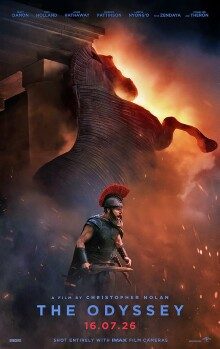
Christopher Nolan has a tell, and he exposes it almost every time he makes a film. He’s not a one-source kind of a guy, and he’s not above creating composite characters or adding a flourish here and there in order to tell a good story. Like Homer before him, he knows how to tell a good story, and while the film is called The Odyssey, it borrows rather heavily from other ancient sources, most notably Virgil’s Aeneid. I’m actually quite on board with the approach, because that’s what Homer beseeches us at the very beginning of his epic poem, The Odyssey. Nolan himself becomes the bard, the teacher … the storyteller. I’m not on board with everything he’s done here, and the problem is this is too ambitious of a story to tell in 10 hours, let alone three. But the telling of this classic tale could not have been made by anyone but Christopher Nolan. His choice to shoot on 70mm actual film ensures a film that is organic. It lives and breathes just as the old Greek stories still live and breathe in any of us who have read the original work. So allow me to tell you the story … about the telling of the story.
Nolan does not tell the story in the same mostly linear fashion in which Homer told it. He used the various epic moments and atmosphere to try to spin an even wider tale, and in this I think we find what flaw there is to find. There have been controversial moments over casting and the like, but all of that is just noise. These performers all tell their stories, and with Nolan’s guidance they each tell them well. I have no issue with the casting. I do take some issue with how briefly episodic many of these moments have been presented.
Again, this is not an easy story to tell in a 3-hour film, so I’m not finding fault as much as questioning some of the decisions. The story takes place after Troy has been sacked and the war won. If you want to get into all that happened in the war, that’s actually a different story. Homer’s first “chapter”, if you will, is The Iliad. It’s also told from several other sources. Briefly, Paris of Troy kidnapped Helen, the Queen of Sparta. He took her back to Troy, while King Agamenon pulled together a vast Greek navy to give chase. Hence the well-known line that Helen was the face that launched a thousand ships. But the Trojan walls were not so easy to penetrate, and the Greeks stayed for nearly a decade hoping to lure their enemy out of the protected city. There were skirmishes, and here you’ll find the stories of Hector and Achilles. Strangely, you will not find reference to the mythic horse. Those references do happen in The Odyssey, but quite fleetingly. The fuller story of that infamous horse is mostly taken from Virgil’s Aeneid. As our story here begins, the Greeks have now set off for their homes. For Odysseus, played by Matt Damon, it was prophesied to him that he would take a long way back home, nearly a decade making his absence 20 long years. During that time he is presumed dead, and in Ithica his wife Penelope, played by Anne Hathaway, is being pressured to choose from the number of rich and important suitors who have gathered at her home, eating and consuming the resources of the estate. His son Telemachus, played by Tom Holland, is forced to watch the estate that he hopes to inherit if indeed his father is dead disappear. They plot against him to try to remove his own claim to the estate and more importantly the long-empty throne of Ithaca.
On the sea, Odysseus and his men fall into all manners of traps and dangers. They find themselves cornered in the home of a cyclops, who is also a shepherd. They eat the forbidden cattle of Hyperion even though warned not to. Each time Odysseus attempts to guide them from trouble, but trouble was meant to be. The magical Circe, played by Samantha Morton, turns them into pigs, and the lovely but isolated and lonely Calypso addicts him to the lotus flower and keeps him for herself for nearly eight years, finally relenting and guiding him home. It sounds rather ridiculous to describe these epic events with so little description, and sadly Nolan is forced to do the same thing. In the epic poem there are tons of details Nolan simply could not include, but the failure to do so makes these encounters less than they should have been. He has no time to tell the entire story, and there are huge chunks he must abandon completely, leaving the uneducated viewer to feel they’ve been short-shifted with each adventure. I think Nolan did the best he could do, and my argument isn’t what he should have kept, but rather can you honestly tell this story in this format? The answer just might be that you really can’t.
There are entire stops that are skipped, and there are important subplots that involve the giving and the taking of gifts according to Zeus’s law that are only alluded to once when he asks his son if he had such gifts. But these gifts were essential to a story where there was just no time to include them.
Nolan gives us a huge canvas, and he captures the epic and atmospheric quite well. Someone asked how can you deliver claustrophobia in the Cyclops cave on such a wide palette? Nolan delivered. Can’t exactly tell you how, but he delivered something that captivates you and never gives you a chance to feel those three hours going by. So when I make the criticism, I’m making it’s not to call out Nolan. This is a masterpiece film in as much as it ever could be. But it’s incomplete. Maybe putting this in more than one film like the Lord Of The Rings and Dune films have done might have been the better choice. But how long can you tie up such an important cast?
My real complaint comes at the end of the film. Odysseus has a huge pang of regret about the trick he used to win the war. Homer makes no regrets in his own telling, and neither does Virgil. It’s the requisite anti-war message delivered by a career warrior. There’s also a story that involves Pattison’s character, who buys a young boy off to take his place in the war. It also adds to Odysseus’s pangs of guilt because he was forced to give the boy a duty almost certain to result in his death. These are the pangs of command, and Homer avoids them for the most part. I was happy to see the ending remained much as it should have been. Odysseus, disguised by Athena as an old man, performs a feat only Odysseus could have accomplished. I am disappointed that his relationship with Athena, played by Zendaya, was so short. In the actual story she appears often and helps him. She also pleads his case with the other gods and begs for mercy for him. All of that is missing, and while a good casting choice, she’s more implied in the story than actually present.
I had one really bad complaint when I saw the trailer for the first time months ago. Nolan had made the sirens bird-women, not mermaids, and I’m happy to say I must not have been the only negative voice here. We never see them at all. We hear them, of course, and we get a misty view of manatees, who are named for the siren in their Latin name. Thank you for sparing me those birds. By the way, Nolan, you’re an incredible filmmaker, but you still haven’t mastered sound. As per Nolan usual, the dialog is often hard to hear. It’s almost like he doesn’t want you to hear it. What’s up with that, Chris? May I call you Chris?
Look, I could write all day about the film, and I’ll never be able to describe this journey to you. This is one you should ignore anything I have to say and experience it. It will be an experience you will remember for a long time. Read the books. I took it upon myself to prepare by re-reading both Homer books during the last holiday season. I’m glad I did, because I was able to fill in those blanks I keep talking about. The Iliad and The Odyssey are two of the oldest stories in recorded history. They aren’t quite the oldest, but they are the oldest of this epic style to survive the days of the ancients. If this film pushes you to read them, then that’s the greatest thing a movie like this can do. And beware those non-bird sirens, because, “These are the mighty singers, whose voice will make a man forget all else. And at last will steal his life away.”