“I’ll drink to that.”
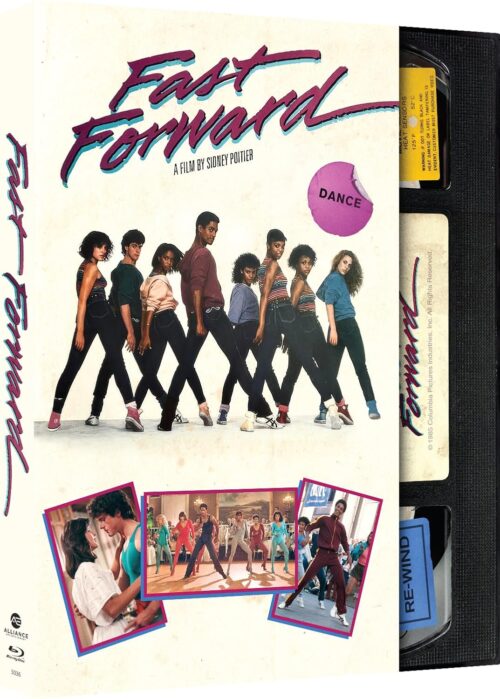
Directed by the legendary Sidney Poitier, Fast Forward was part of a cycle of mid-late 1980s dance movies which included Fame, Flashdance, Footloose, Dirty Dancing, Breakin’ aka Breakdance, Electric Boogaloo: Breakdance 2, Salsa, Beat Street, Heavenly Bodies, Rappin.’ In this addition to the mid-1980s dance movie craze, a tight-knit group of eight high school students from a small town in Ohio form a dance troupe called “The Adventurers”. Driven by pure ambition, they pack their bags and head to New York City to chase their big break. The film served as the debut theatrical feature film for most of the cast members, though there were a few recognizable faces. Such as Debra Varnado (All the Right Moves), who played Debbie Hughes, and Don Franklin, who played Michael, who I recognize for a host of tv show appearances. The movie wasn’t really the breakout film it was hoped to be, particularly given the stiff competition during its era. And unfortunately, while I did find it intriguing at times, I’m skeptical that the film will find new life amongst this newer generation.
Led by Matt (John Scott Clough), Michael (Franklin), and June (Tamara Mark), the cast delivers raw, earnest energy. What they lack in refined acting chops, they more than make up for in sheer athletic capability and charm. Upon their arrival, reality hits them hard, as the group quickly discovers that their rehearsed choreography are dated and the local street dancers aren’t welcoming to outsiders, and their money is rapidly running out. The plot follows their struggles to survive on the streets, make industry connections, and prepare for a high-stakes talent competition that will ultimately decide their future.
The first dance battle reflects the adversity the group must overcome, which serves as a source of irony given my earlier statement regarding the unlikelihood of the film finding new life with a modern audience. While I can appreciate the context of the time period and can acknowledge that it is well choregraphed, it is difficult to ignore the pointed toes and synchronized jazz hands, Given the era, I was expecting more gritty, authentic breakdancing. I did enjoy the group’s money-making endeavors, such as when Matt came up with a plan to eat steak that night: dancing for tips in a fancy restaurant. I also enjoyed the “I’ll drink to that” commentary of the girls’ late night out drinking. So, for me, this story was more about the lengths the group went to in order to pursue their dream.
There was also a bit of character development, particularly for Clough’s Matt, who found himself compromising his morales and integrity in the latter half of the film. This was another intriguing subplot that helped guide the latter half of the film. While this film served as Sidney Poitier penultimate film in the director’s chair, he is not the only legend associated with this film. Quincy Jones served as the executive music producer. Amongst the soundtrack was modest hit “Do You Want it Right Now” by Siedah Garrett, which reached #3 on the US Hot Dance Music/Club Play and #63 on the US R&B Charts.
So, while I don’t believe that this film is likely to stand the test of time in this modern era, it is not without its enjoyable parts. I attribute this to the cast that Poitier assembled with the utmost care, reportedly spending four months in search of young, formally trained ballet dancers. From the thousands of applicants versed in ballet, jazz, modern and contemporary technique, Poitier chose eight talented and versatile leading cast members. This resulted in several high-energy sequences such as the restaurant flashmob that relied on the tight spaces between tables, chairs, and surprised diners, as well as the “Clock” Routine at the film’s climax that depended on the dancers used synchronized arm and body movements to mimic gears and ticking hands. There is no deny the dedication that went into making the film, especially the choreography that was only possible thanks to the use of elite, trained dancers. Unfortunately, it just doesn’t work in a modern setting, but the film does get points for inadvertently incorporating that idea into its plot.