
“Congratulations. You are now equipped to make a comprehensive assessment of where the value is in your surroundings. Go out and identify the dead weight in your life. Cut yourself free from it . Protect yourself and thrive. Now plan, execute, and master the conditions of your life.”
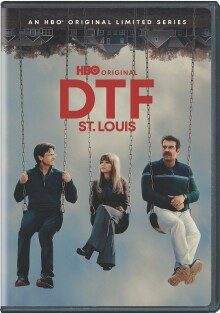
Let me begin by saying I had no idea what DTF stood for. I guess I’m getting old, and many of these abbreviations to help the text generation send a coherent message with the attention span of a goldfish have come and gone without my being aware of most of them. So I found out what it means, and I’m not going to tell you. Look it up like I had to. What I will tell you is don’t bother, because it actually doesn’t appear to have anything to do with DTF St. Louis, now out on DVD from HBO+. In fact I think this particular series might be meant for those among you who don’t know what a lot of things mean. Things like quality and entertainment. Steven Conrad is kind of a one-man band here, and that likely explains a lot of what I don’t really like here. It’s always good to have at least one other person in the creative process. One tends to go off the rails, and of course it makes sense to you, but the rest of us? Not so much. This is one of those reviews where I’ll get emails telling me that I just don’t get it. Fine. I don’t get it. But whose fault is that? This is also the second series I’ve reviewed this month where one of the main characters dies in the first episode, but continues to be a lead throughout the series’ 7-episode run.
I’m talking about David Harbour, who plays Floyd. Floyd is one of those kind of guys who is always thinking positive. You know the type, yeah? You just want to beat them with a baseball bat just to see if you can get them to frown. He just cares too dang much. His family kind of feels the same way, and Floyd is feeling the distance growing from his attending affirming therapy with his son Richard (Ruf), and his wife has become rather cold and aloof. Carol (Cardellini) works for the pet food company Purina and moonlights as an umpire for organized baseball games. Floyd is starting to have trouble in their love life, because every time he tries he pictures her in this over-the-top cartoon umpire outfit. It’s obvious they stopped communicating with each other, and both are looking for a little affirmation for themselves.
For Floyd it comes on his first day on the job at a local television station. He does sign language for the weather forecast. The popular weatherman Clark Forrest is pretty well known. He’s on billboards all over town. On their first day together they are covering a storm and cyclone, and Floyd saves Clark’s life. They bond and both become great best friends. The families start getting together, and now Floyd has something positive in his life. Unfortunately, so does Carol, who ends up in an affair with Clark. Floyd finds out by hiding in the bedroom closet while they do their thing. Even that doesn’t upset Floyd. He tells Clark he’s not mad and completely understands. This is the kind of guy who needs to be strapped to a chair with eyes wide open ala A Clockwork Orange and watch Bambi’s mom get killed over and over again. He’s just that unreal. Clark isn’t much better. He wears his “sunshine” billboard smile almost everywhere he goes. You can kind of see why these guys get along. It’s all smiles and hugs.
At the end of the first episode Floyd is found dead at the closed-for-the-season community pool house. There are a few zany clues, and the case is taken on by County Sheriff Homer, played by Six Feet Under’s ever present dead dad, Richard Jenkins. He is no-nonsense and wants to be in charge. There’s an unlikely pair-up with police Detective Jodie Plumb, played by Joy Sunday. The two of them make Jack Webb look animated. They investigate with a stoic kind of blundering that’s a cross between Maxwell Smart and Inspector Clouseau. It has to be intentional that these robot portrayals are intentional and perhaps thought to be funny. I don’t know Joy Sunday’s work, but I do know Jenkins’ work, and this is not his typical performance.
Of course, Clark becomes the main subject, and a great deal of the show’s narrative is taken from his interrogation by our robocops, without the cool weapons. At times it is intended to mirror that first season of True Detective. We jump about in time based on Clark’s narrative. It takes him a while to realize he’s the prime suspect, and the reality of it all appears to be trapped somewhere in a cloud where most of our thoughts must go these days.
I love David Harbour and know what he can do. I recently binge-watched Stranger Things on 4K and looking forward to another Violent Night Christmas. The show really gets bogged down in the repetitive conversations the leads have about life and the universe and everything. If only the answer were a simple number here. It’s not. The final answer kind of comes from nowhere, and that blew the last bit of enjoyment I might have been having here. Sure, it’s unique, even clever at times, but what a waste of talent. I expect more from the folks who brought us The Sopranos and The Wire. The best I can say is the show is “Unconventional.“.