“Take your voltage, coming in the main power station in Canoga Park. Now, the electric company will tell you that it’s running smooth and steady. That’s a lie. I mean, you put that thing under a magnifying scope, that smooth, steady line starts to look like King Kong’s EKG. Ninety-volt drop-offs, 130 volt spikes. Pulses, they’re called.”
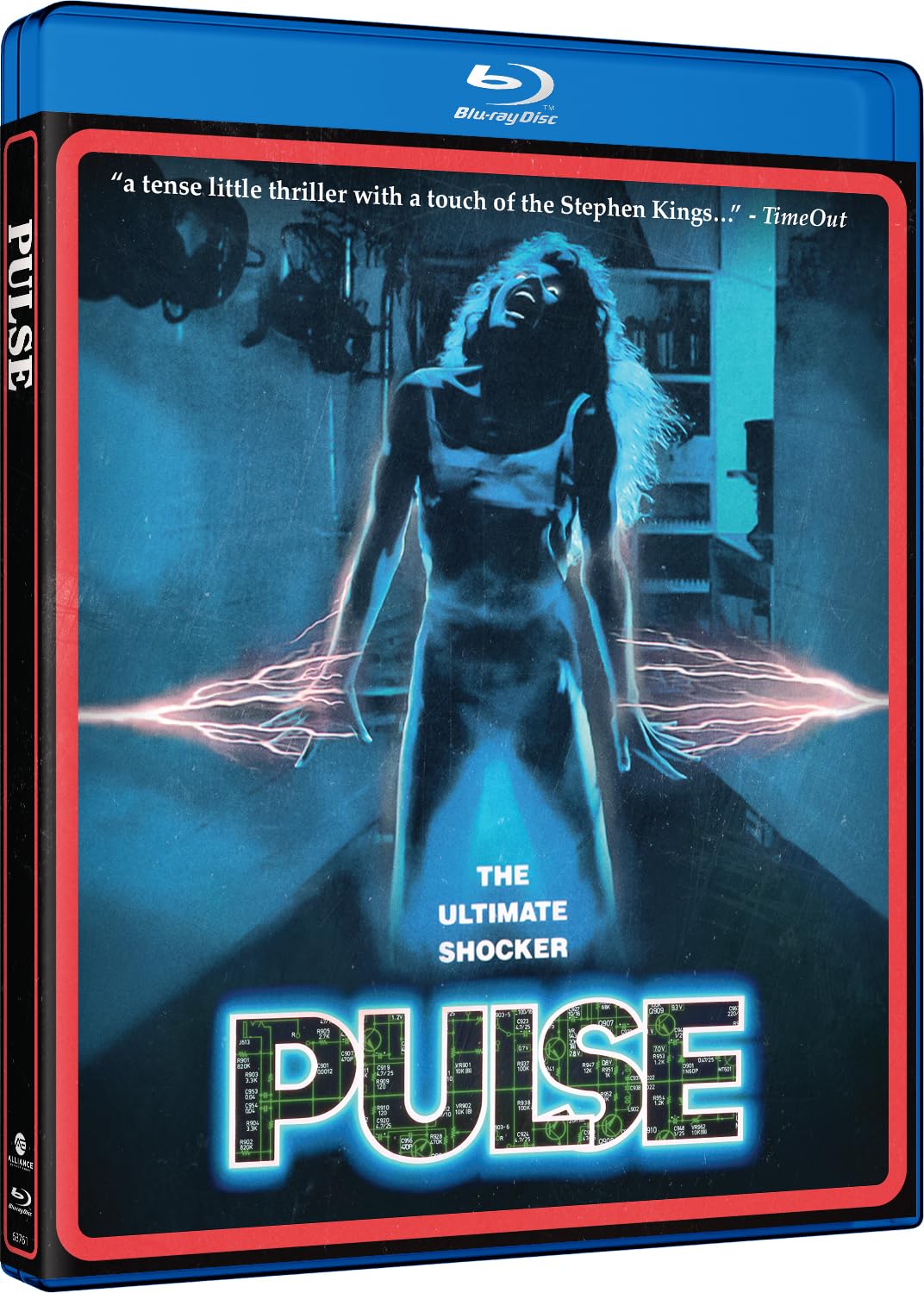
I’m old enough to have known relatives who were born before Thomas Edison started to wire America with his great new electric generators. In less than three generations we are completely dependent on that sweet 120-volt juice coming through our lines. When it’s not there, we panic and complain about having to deal with things like darkness and uncomfortable temperatures, not to mention how the heck are we going to cook dinner? We need it. We want more of it, because we keep buying more things that require it. We not only let it into our homes, but we demand it stays on. Now what if that electric current we feed on like it’s mother’s milk, what if it were an evil force trying to kill us off? That’s the premise behind director Paul Golding’s 1988 thriller Pulse. It’s now out on Blu-ray, so if you managed to miss this one, you have a chance to add it to your collection. Of course, you’re going to need a steady supply of that current in order to watch it. On second thought …
Pulse should not be confused with the horror franchise that started with a Japanese film and has had several incarnations of English versions over the years. This has nothing to do with that ghost franchise, and you’ll be really disappointed if you pick this one up with the wrong expectation.
David (Lawrence) is a young boy who is a victim of a broken family. He ends up with Mom, and she moves from California to Colorado. David still has hopes of the family reuniting, and his visit to Bill (De Young) his dad and his girlfriend Ellen (Hart) is his chance to bond with his estranged father. But Dad has business to do and doesn’t appear to have time for the son he hasn’t seen in quite a while. Dad abandons him the first night and leaves David home alone (that’s a different franchise, too) to watch the Dodgers play baseball on television. But the power goes a little wonky, and he finds the house is experiencing some power issues. The next day he meets local kid Stevie, played the actor’s real-life brother Mathew Lawrence. Stevie tells him of the guy across the street who went crazy an killed his wife and tore his house apart in what appeared to be a fit of madness. But David thinks there’s more to all of this, and he explores the abandoned home only to be scared by a Crazy Ralph (Friday The 13th) lookalike who also has some “out there” ideas about what happened.
Now David is starting to put it together, and, of course, no one believes him, and the power creature starts to attack him. Let’s face it. The kid knows too much. It all cascades from there, and the beast in the wires takes a crack at the whole family. Dad’s starting to look and act like the crazy guy across the street, but by now we get it, and we don’t think he’s crazy at all.
The film has a lot to do with very little to show us. You see, or the problem is you don’t see the monster, because he’s in the wires causing things to happen. The attacks remind me a lot of the way the later Final Destination films deal with attacks. Water starts to pool while wires inch closer to the pool. Gas pipes crack, releasing deadly gas. We see these “attacks” through the stages that cause the danger. There appears to be some cool stop-motion work with some of these things, and we get super micro-views of electronics as transistors fuse, and that’s really our only way of following the “progress” of the “creature” here. Some of the work is quite good, but it’s not enough to keep Pulse from becoming a very average film that hasn’t really had a lot of staying power over the last 40 years. There’s not a lot of chemistry here, and the characters are written badly enough leaving the actors with the burden of trying to put as much life as they can into the performances, and it mostly falls flat. By the climax Cliff De Young does get to emote more as the determined father trying to protect his son, and it’s the only real emotional stuff in the film. The pacing hurts the film, because the story just couldn’t find something to move it along. It’s worth seeing for historical reasons and to satisfy the few fans the film might have had.
Writer/director Paul Golding didn’t end up with much of a film career. He only had a handful of writing or directing credits before the film, and he pretty much completely disappeared after Pulse was released. There wasn’t a lot of studio confidence here, and the film only had a limited opening of a few hundred screens. It’s the kind of film that sometimes catches on in the home video resurrection releases and becomes somewhat of a cult favorite, but that never really happened to Pulse. There are no extras included here, so this is a pretty much bargain-basement release. I’m sure the film has some fans, and that appears to be the expectation here: to give it’s core fandom something that looks and sounds pretty good so that they can revisit the film from time to time. The ideas might have been ahead of their time. Final Destination made out pretty well with these kinds of presentations, and maybe a better budget would have helped. Who knows? If it had been released more recently it might have found better footing. “Spooky, isn’t it?”