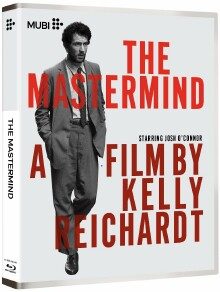
Been seeing a lot of Josh O’Connor lately, and I’m glad to see it. Prior to his performance in Challengers, I had only a mild awareness of him, but since then, it’s been impossible to escape his presence. Speaking of presence, I feel like O’Connor brings something different with every role. In the case of The Mastermind, O’Connor deadpans comedic irony, quiet domestic desperation, and a deeply flawed, delusional masculinity. Given how the situation works out for his character, the title is more than a bit ironic. I’d go so far as to consider this an anti-heist movie if it weren’t for the fact that bumbling thieves managed to accomplish the task. The heart of the film resides in the aftermath of the heist and the hijinks that transpire. Rounding out of the cast were Hope Davis, Bill Camp, Alana Haim (One Battle After Another), and John Magaro (The Bride!). The film is a bit of a slow burn, but the character performances are the driving force of the film, as the plots debunks the idea of a smooth-talking American criminal in favor of an everyman, or better yet, an amateur trying to head up an art theft.
Set in a sedate Massachusetts suburb in 1970, the film follows O’Connor’s James Blaine “J.B.” Mooney, an unemployed family man and failed architect who concocts a plan to rob a local art museum. Alongside a couple of amateur accomplices, he manages to successfully steal four Arthur Dove paintings. Rather than lingering on the suspense of the theft, film director Kelly Reichardt sped through the heist itself and focused primarily on the fallout. As previously mentioned, the ironic title becomes clear as J.B. proves to be anything but a mastermind; he is an inept, privileged oaf who spends his time floundering on the run, hiding canvases in barns, and testing the patience of those around him.
Electing to focus on the aftermath came as a surprise, as I anticipated that the bulk of the film would show O’Connor’s character as he struggled in his assigned role, but through luck and an eleventh-hour stroke of genius, would accomplish his goal. However, what transpires is actually the polar opposite of that, which I found to be very intriguing, as it bucked the traditional blueprint for a movie of this kind. Not only did this turn of events take me by surprise, but it also added to my enjoyment of the film because it added to the film’s unpredictability.
The film is loosely inspired by true events, specifically the 1972 art heist at the Worcester Art Museum in Massachusetts. Director Kelly Reichardt reportedly adapted the story from the real-life snatch-and-grab — where thieves stole modernist paintings — revising events to have her fictionalized amateur protagonist target the works of American painter Arthur Dove, rather than the two Gauguins, a Picasso, and a Rembrandt taken in the original crime. Interestingly enough, during the filming of the art heist scenes, an actual art heist occurred at Bard College, the college director Kelly Reichardt teaches at, in which a Bard College student allegedly broke into the campus’s Blithewood building — which houses the Levy Economics Institute — and stole two historic paintings shipped out of Austria in 1939. The paintings have since been recovered. Talk about life imitating art.
The film also included a solid supporting cast, most notably Haim and Magaro as J.B.’s wife and an unwitting accomplice respectively. Haim does feel a bit underutilized, but makes the most of her time on screen, particularly through sharp, non-verbal expressions of resentment that relied on quiet, simmering aggravation and ultimately exhaustion. This paired well with O’Connor’s character’s delusions of grandeur. Magaro’s character, on the other hand, served as contemporary to how the rest of the characters treat J.B. Magaro’s character looks upon J.B. with reverence and starry-eyed enthusiasm, which merely feeds into the titular character’s ego.
The film provides a very fitting conclusion for O’Connor’s character, capitalizing on the ineptitude that he displayed throughout the film and adding further irony to the title. It served as a fitting punchline to his comedy of errors, leaving him thoroughly erased by a system he thought he could out-game.