1080p

“Ride into this world all alone. God takes your soul. You're on your own.
The crow flies straight, a perfect line on the devil's back until you die.
Gotta look this life in the eye”.

When these guys send a message, they don’t use Western Union. Not only will they blow up your warehouse, but they’ll catch one of your guys and plant a stick of dynamite in his butt cheeks to set off the explosion. That’s the world of the motorcycle club, the Sons Of Anarchy. In the wake of The Shield, FX stays true to form with the latest from that show’s alumni Kurt Sutter. Sons Of Anarchy has a familiar tone and quality to it for fans of that now-gone cop drama. There’s a lot of handheld camera stuff, and you have very similar themes.

Imagine a time when Joel and Ethan Coen weren't household names. The two have become something of Hollywood legends with films like No Country For Old Men and the superior remake of True Grit. But every legend has to have a beginning, and the story of the Coen Brothers goes back to 1984 and a quirky little film called Blood Simple. The film had only a limited release and pulled in a mere couple of million bucks in its initial release. Even the cast with the notable exception of M Emmett Walsh was pretty much unknown at the time. The movie came and went without very much fanfare. It would be about three years later with Raising Arizona that the Coen Brothers would finally arrive in our collective consciousness where they have continued to have a strong impact through the present day.

Blood Simple is not a great film by any standards. The pace is quite slow, and it fails to fully realize the film noir nature that it so strongly emulates. In truth, it deserves to be overshadowed by the many Coen Brothers films that have come since. That doesn't mean it's a particularly bad film either. MGM has released the bare-bones Blu-ray more for an eye toward the historical value that the movie offers. It was not directed by both of the brothers. In those days they still functioned less as a whole. Only Joel is credited with directing the film, but if you believe that then I have some prime swamp property here in Florida I'd love for you to take a look at. They collaborated on the script and the film is a wonderful peek at their developing style. Already many of the trademark Coen Brothers style points are clearly on display. It all started here from the intense close-ups of trivial objects to the odd angles and rather dark lighting. It's all on display in a movie that no fan of the duo should not see at least once.

"Where life had no value, death sometimes had its price. That is why the bounty killers appeared."

If you had asked Clint Eastwood about the chances of Fistful Of Dollars being at all successful, he admits he hadn't given it much of a chance. The film took a lot of chances with what was already a tired genre. Add to that the fact that it was a low-budget European effort and there really was no chance that the movie would be remembered a year later. But the film did pretty good money and made a ton of international noise. The men involved ended up with more than a fistful of dollars in their banking accounts. Who could blame them for wanting A Few Dollars More?

“They're right. All those people who say it's our job to just sit and watch people die. They're right.”

A starving, war savaged toddler girl squats, burying her face in the sun baked earth of the Sudan. She remains motionless, near death and locked in catatonic despair. A few feet behind her a vulture, nearly as big as the child, eyes her hungrily and patiently waits for her to grow too weak to fight it off. A photographer quietly circles the scene, snapping away and looking for the best angle. He finds it, gets the shot and leaves. The photo wins a Pulitzer Prize. The little girl presumably gets eaten by the vulture.

"Everybody here has become very rich, or else they are dead."

In 1964 things were very different from the way they are now. The Hollywood western movie was winding down. The genre had pretty much played itself out and was struggling to maintain even on television. Few people knew who Clint Eastwood was. He had a pretty sweet gig on the television series Rawhide but wasn't anywhere near a household name. Sergio Leone was a name almost no one had heard of. And there was no such thing as a Spaghetti Western. With the release of one very low budget film, all of those things changed practically overnight.

"You unlock this door with the key of imagination. Beyond it is another dimension -- a dimension of sound, a dimension of sight, a dimension of mind. You're moving into a land of both shadow and substance, of things and ideas. You've just crossed over into the Twilight Zone."

“How would you like to use that gun belt for something more than just holding up your pants?”

Although the title of the blu-ray is Return of the Magnificent Seven, the original film’s title sequence just calls it Return of the Seven, and for good reason. There is nothing vaguely magnificent in this movie. This is the type of sequel that gives sequels a bad name.

"This is a picture of Walter Black, a hopelessly depressed individual who becomes The Beaver, who becomes a phenomenon."

When I first heard about this film, it was hard to keep the Mel Gibson story out of my mind. It almost seemed as if his casting was related to his off-screen situation. After all, this is a story of redemption, and there isn't anyone in Hollywood searching for that more than Mel Gibson. But as I watched the film, it became surprisingly easy to let go of that baggage and direct all of my attention to the performances and character delivered by the film. And while a lot of credit goes to Jodie Foster and her exceptional job of directing the film, the real credit belongs to Mel Gibson himself who creates a compelling character who you just can't take your eyes away from. It might be the best performance of his career, and it doesn't appear that very many people will ever see it. The film was never given a wide release. It never appeared on more than 200 screens for any given weekend and made less than $1 million at the box office. Unfortunately, I don't see it doing any better on video, and that's a bit of a shame, I think.

Baby here again, and I'm not exactly a happy German Shepherd/Chow mix puppy right now. Do you wanna know what's put the growl in my scowl this time? The other day I heard Gino say that somebody was in the doghouse. That sure sounded like fun, but it turns out the dude got fired and that being in the doghouse turns out to be not such a good thing. Now I understand if they said that UPS was in this dog's house. That would be bad for the UPS guy. And that spells O U C H. But why is it that humans say that when someone is in trouble. Heck, I spent most of my life in a doghouse, and I was havin' a good time. I never got fired or yelled at. Okay, I made that last part up. Yeah, I get yelled at all of the time, but it's never exactly my fault, you understand. How 'bout you guys start saying cathouse when someone's in trouble, although I think I heard someone use that word to describe something else. Never mind.

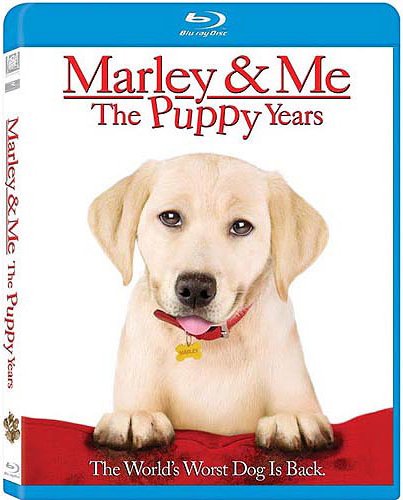
You know what else puts me in a snarlin' mood? It's when a studio takes a really good movie and decides to put out a new movie with the same name, 'cept they really don't have anything to do with each other. Somebody's just looking to get a bowlful of treats without working too hard. Me, I work for my treats, which reminds me... Anyway, that's exactly what you get with Marley & Me: The Puppy Years.

“We deal in lead, friend.”

In the fall of 1956, Anthony Quinn watched a special screening of Akira Kurosawa’s The Seven Samurai and had an epiphany; this Japanese masterpiece, inspired by the great American westerns of John Ford, would, itself, make a great American western. Quinn acquired the rights and contacted his then close friend Yul Brynner and pitched the idea of him playing the bad guy and Brynner the good guy. Brynner screened Kurosawa’s film and called in producer Walter Mirisch, who in turn contacted director John Sturges (Bad Day at Black Rock, Gunfight at the OK Corral, The Great Escape). Sturges loved the concept and immediately set about acquiring the rights, ultimately forcing Quinn out of the picture. Quinn sued, but lost.