1080p

Growing up in life came a little later for me than most people. Most people seem to hit maturity right around their later teen years and early twenties. Honestly, I didn’t really grow up until I hit my mid twenties. But what would happen if one was forced to grow up sooner, say around their seventeenth birthday? Well then, you might be like Jenny Mellor from An Education who had to grow up a lot sooner than she probably expected to.

It’s 1961 in England. Jenny Mellor (played by Carey Mulligan) is 16 and entering her last year of school. She studies literature, plays the cello and is certain to ace her A-levels and be accepted to Oxford University. Her weakness is currently Latin but she promises to bring up that grade as soon as possible. Or else her father, Jack (played by Alfred Molina) says that she won’t make Oxford.

"We're back..."

The Chipmunks began life oddly enough as a singing group, of sorts. They were the brainchild of struggling songwriter Ross Bagdasarian and were named after the three chief executives at Liberty records. His own alter ego David Seville’s name came from his World War II Army station in Spain. The Chipmunks first appeared in a 1958 record called The Witch Doctor, but wouldn’t officially become The Chipmunks until later that year when The Chipmunks Christmas Song was released. It is for that Christmas music that I most remember the group. They first appeared as puppets on The Ed Sullivan Show. Alvin and the boys got their own television show in 1961. When Ross died in 1972, the Chipmunks would continue on under the guidance of his son. In 1983 The Chipmunks had yet another popular cartoon show and had appeared in countless specials and films. Today they are pretty much a hallmark at the holidays, and a Christmas song collection just wouldn’t be complete without them.

One might have to legitimately ask about the thinking behind this particular children- targeted release. I have to admit that I was a little uncomfortable with the idea of reviewing this film at this particular time. I have two issues that are just unavoidable here:

They both deal with the film's two central stars here. Bindi Irwin is the daughter of famed Crocodile Hunter Steve Irwin. You all remember Steve. He used to approach some of the most dangerous animals on the planet and quite casually tell us just how deadly they were while tempting them to tag him. We all suspected that Steve might one day get a little careless and get himself killed. The truth is that didn't exactly happen. It wasn't a particularly dangerous animal or any carelessness on Irwin's part that led to his rather unexpected death a few years ago. It was a usually harmless stingray that sent a barb through his heart in what can only be described as an unfortunate freak accident. Now, even before his death, the family had been preparing their very young daughter to follow in Daddy's rather unusual footsteps. Bindi's done several documentary films, including her own television show in the wake of her father's death. Here I can't help getting the feeling that the appearance is somewhat exploitive of the whole business. When I look at Bindi's mom in the extra features, I can't shake the feeling that she's cashing in here. I don't know these guys, so I'm not trying to claim that I know their hearts and minds. I can only report the feeling it leaves me with, and it's not a good one.

"It's New Year's Eve on the Poseidon. Partying voyagers toast the future. The future comes in a rush; a 150 foot rogue wave flips the cruise ship over. And a struggle to survive begins."

Poseidon doesn’t waste any time getting to the action, so I won’t waste any time with an introduction to this review. Yes, it’s a remake of the 1972 film, The Poseidon Adventure. Yes, it is chock full of convenient cardboard characters (a former Navy man, a fireman, a nurse, etc…). But we don’t watch movies like Poseidon for character exposition, do we?


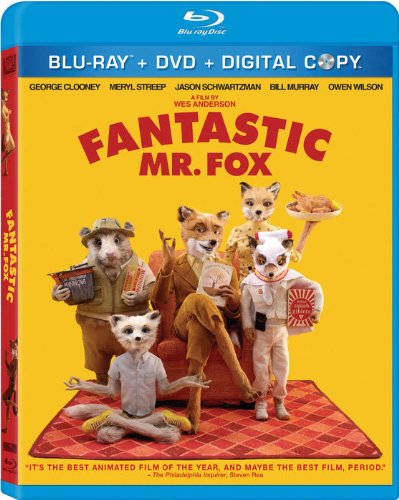
"Boggis, and Bunce and Bean. One fat, one short, and one lean. These horrible crooks, so different in looks, were none the less equally mean."

Roald Dahl was one of the more eccentric writers to come upon the scene. While he often wrote for children, his work is most decidedly dark and often quite sinister. He's most known for such tales as Charlie And The Chocolate Factory. His work has not been adapted to film as often as you might suspect given his popularity. The most famous was certainly Gene Wilder's Willy Wonka And The Chocolate Factory, which was far brighter and more cheerful than the original work. It took Tim Burton and his trademark brand of darkness to create the story Dahl intended in a more recent film which used the correct title of the work. This is not the first stop motion film to be adapted from his stories. Quite a few years ago we were given James And The Giant Peach, which enjoyed little box office acclaim. Wes Anderson is obviously a Dahl fan and immersed himself in the author's world as he prepared his screenplay for Fantastic Mr. Fox. The effort shows in the way Anderson captures Dahl’s pointed wit and social sarcasm. I think that if you're looking for something Dahl himself might have created, this is your movie.

"The year is 208 AD. After 30 years of civil war, a deathly calm has fallen over northern China. One by one the rebel warlords have met their end under the sword of Prime Minister Cao Cao. Now even the Emperor bows before his power. Yet, from the south a challenge is heard. Two leaders rise against Cao Cao's tyranny. The aging Liu Bei and the inexperienced Sun Quam. So Cao Cao petitions the Emperor to brand these men as traitors and declare a new war against the peaceful southlands."

And so the stage is set for John Woo's enormous epic Red Cliff. The scale of this film is simply one that must been experienced to quite understand. It has the grandeur of any of the largest films in Hollywood's history. But this film is not a product of Hollywood. Woo filmed his massive triumph in his native China. You won't find a bigger story told with more elaborate sets or with such a legion of actors, required to bring these historic battles to life. Gladiator. Kingdom Of Heaven. The Ten Commandments. Red Cliff deserves to stand with the best of them, and it will.

"More of this is true than you would believe."

What was intended as a somewhat thought-provoking quirky comedy looks a lot like something you would expect to see on a late night rerun of The X-Files. All of the subject matter has been covered there, just not quite in this way. It all started with a non-fiction book written by Jon Ronson. He claimed to have researched various government studies in human behavior that entered into the world of the paranormal. It was part of an ideology of waging non-lethal war. It was a strange combination of 1980's new age mysticism and actual studies that showed that soldiers in World War II were, in fact, quite reluctant to kill or even harm the enemy. The study claimed that almost 80% of the soldiers deliberately looked for excuses not to fire or merely aimed inaccurately to avoid killing. The study went further and claimed that of the minority that did shoot with deadly results, most of them suffered terrible guilt over the experience, often making them unable to remain effective soldiers. The study regards the remainder of the study group, the ones who did fire accurately and did not suffer guilt as psychopaths. In short, the book gathered a lot of speculative ideas and put them into a rather oddball collection of "facts".

In the long run what was more important to Pixar and its relationship with Disney wasn't the milestone that Toy Story provided being the first computer animated feature. Movies are, as much as we'd like to think otherwise, a business. In the end, a film has to make some money. Toy Story was like a private printing press for the two companies bringing in nearly $200 million at the box office. Add another nearly $200 million in foreign receipts, and this prototype of a movie pulled in nearly a half billion dollars before the first DVD was released. That's huge for what was basically a children's cartoon. The second Pixar film would be A Bug's Life, and it would bring in nearly the same kind of jingle. The cry was too loud to ignore. The people wanted to see more of Buzz, Woody, and the rest of Andy's toys. The edict came down from on high, and what once took them 4 years to do, Pixar was asked to do in about 18 months. Now we would find out if Pixar was a viable company that could produce films reliably and on a faster turnaround. Would the studio compromise on quality just to answer the gate call of millions of dollars waiting to be plucked from the pockets of eager moviegoers? Several films later we know the answer to that question, but it was very much an answer in doubt in 1999. But another $485 million later in worldwide box office settled the question once and for all. Pixar didn't just start the computer animation business. They didn't just define the industry. They would continue to lead it for the next decade ... and apparently, beyond.

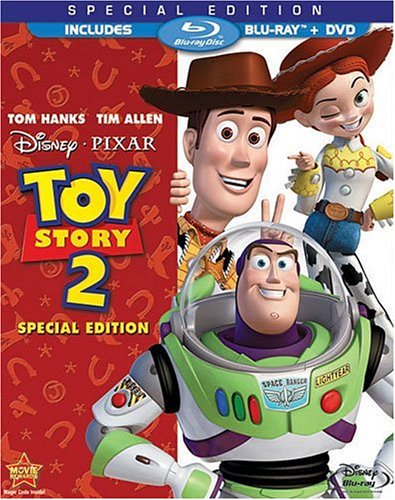
All of your favorite toys came back with their original voice cast. This time Woody (Hanks) attempts to rescue Wheezy The Penguin (Ranft) from the 25 cent box at Andy's mom's garage sale. The rescue brings him to the attention of Al (Knight) from Big Al's Toy Barn. Unfortunately for Woody and his friends, Big Al has the largest collection of Woody's Roundup collectibles on the planet. He's been trying to close a deal with a big Japanese firm who want to buy the collection for huge bucks. But Big Al has been missing only one piece in the collection, the most important piece, however ... Woody himself. The Japanese won't buy any of it without Woody. So Al steals Woody and brings him back to complete the collection. There Woody learns about his roots and the television show that he was based upon. He meets Jessie, The Yodeling Cowgirl (Cusack), Stinky Pete, the hapless old prospector (Grammer), and Woody's trusty horse Bullseye. While Woody's friends stage a rescue lead by his now best buddy Buzz Lightyear (Allen), Woody begins to feel sorry for his new companions. They've been kept in dusty old storage for years waiting for that final piece so they can be put on display at a museum and be admired by generations of new kids. When his friends finally arrive to save the day, Woody must decide between his old friends and his television comrades.

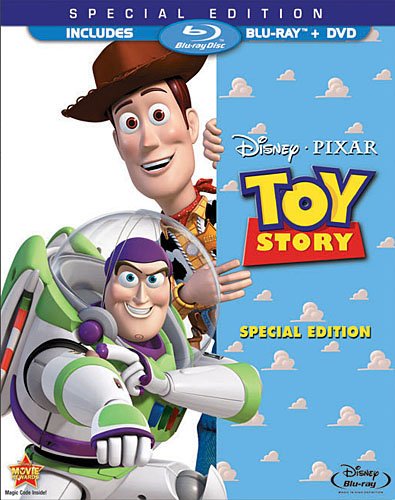
It's hard to believe it, but Toy Story was the very first computer generated animated feature film. CG graphics had already appeared as parts of films starting with the "Genesis proposition video" from Star Trek II: The Wrath Of Khan. It was a rather fitting movie for this Hollywood and technological first to occur. The piece was rather short and not as breathtaking as we've come to expect today, but, it did herald the beginning of a new era in filmmaking, to be sure. What better place for such an historical technological breakthrough than in Star Trek?

Pixar had already been making short subject computer animation. If you ever have the opportunity to check out their collection of shorts, you can't help but be impressed with the evolution of the process as evidenced in these short films. The awards were rolling in for the upstart company, and it was only logical that sooner rather than later they would be the ones to attempt a full length feature film. Of course they were quite a small company at the time with no distribution network in place to launch a major motion picture. There wasn't much of a promotional arm to the company to create the kind of buzz, pun intended, a full length film would require. The truth was that Pixar's small size, which was so much of a creative asset, just wasn't up to the kind of task they were taking on. The first step would have to be to find a partner with the name recognition and resources to back up such an ambitious project. They would likely be betting the future of the company on this one effort. The choice was obvious. They would tie their fortunes together with the same company that took the very same risk 70 years ago. Walt Disney had created the very first animated feature film with Snow White And The Seven Dwarfs. The result started an entire industry and put that one-time fledgling company on the map. Would Pixar be able to make the same impact on the industry that Disney had so many decades before? Anyone who has had the pleasure of seeing Toy Story knows the answer to that question. Lightning did indeed strike twice, and Toy Story would open the floodgates to an entire new industry of computer animated features.

Around Thanksgiving of last year, I started to see trailers of a particular movie that quite literally made me laugh out loud. The reason behind it is because I knew with the title of the movie and the obvious plot, there was no way I was not going to review it when it came to dvd & blu-ray. I have a reputation for certain movies, I guess you could say. That movie was Ninja Assassin. Several months later, I am reviewing it for a mass audience. Funny how that works.

An old man and master of tattoos (played by Randall Duk Kim) is filling in an elaborate tattoo on a young gangster named Hollywood (played by Sung Kang)’s back. A henchman brings Hollywood a sealed envelope. The envelope is opened and out spills black sand. The old man is startled. He starts to spin a tale about ninjas and how he saw an envelope just like that before everybody around him was assassinated.