Posted in: Disc Reviews by Gino Sassani on May 10th, 2010
A short time ago I had the unexpected pleasure of watching and then reviewing Tyler Perry's I Can Do Bad All By Myself. I say unexpected, because I was looking for the typical Madea antics and ended up drawn into a compelling gospel musical that was inspirational and entertaining without ever feeling like I was sitting in mass listening to a long homily. Now I've just had the opportunity to see Stan Foster's The Preacher's Kid. There's no doubt that Foster has been inspired by the Black Theater productions of guys like Perry. There appear to be a couple of inside swipes at Perry in the film. I call them swipes, but it's more likely they are loving jabs. I get the impression that Foster is a fan of Perry's and, unfortunately, has tried hard to imitate his style. The result is certainly not a terrible film at all. It's just not a very good one, either.
The plot is based on the biblical parable of The Prodigal Son. In this case it's the Prodigal Daughter. Bishop King (Williams) is a hard taskmaster for the Lord. He has a thriving community congregation that features one of the nation's best gospel choirs. Of course, the choir stars his own daughter Angie (Luckett) as the soloist. They are on their way to a huge competition in New York City, and everyone expects that Angie's going to lead them to the promised land, so to speak. But Angie is getting restless. She has dreams of a recording contract and fame and fortune. She's tired of giving up so much for the Lord and longs for a little Angie time. Her rigorous schedule doesn't even allow time to catch a movie from time to time. She and close friend Marcia (Kelly) sneak away to a club where a has-been recording artist Devlin (Tank) is partying. The girls make his acquaintance, and he is taken with Angie. He invites them to attend a performance of his gospel play called Daddy, Can I Come Home. Angie loves the production and is invited to a diner to eat with the cast and crew, where she loudly declares that she absolutely must be a part of the production. An impromptu audition wins her the part of understudy to the lead. It's her father, the Bishop, who she can't convince. She leaves even after he warns her that he wants nothing to do with her, should she go. Not very Christian, for a Bishop that constantly asks everyone around him: What would Jesus do? Certainly, he wouldn't disown his kin. So Angie goes on the road with the production. She is seduced by player Devlin and quickly falls into the temptations of the road. Before very long, she's drinking, taking drugs, and sleeping with the abusive star. Meanwhile, her church must prepare for the competition without their star singer. Angie soon discovers that the life she coveted isn't all that she hoped it would be. She must endure betrayal and abuse from Devlin while finding her dream of one day singing the lead doesn't look very promising at all. And, like The Prodigal Son of the Bible, Angie wants to go back home.
Posted in: Disc Reviews by Gino Sassani on May 4th, 2010
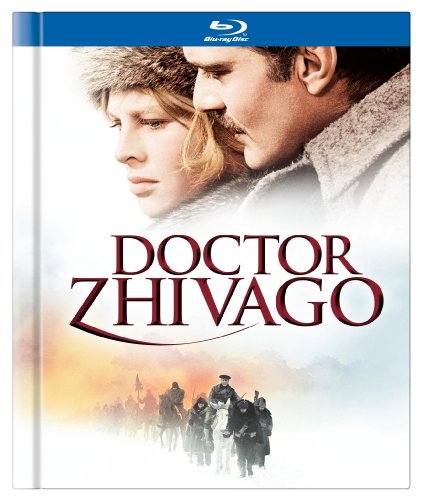
In many ways the epic story and film Doctor Zhivago echoes the real-life story of Boris Pasternak, who penned the original novel. Pasternak was a firsthand witness to the events that led to and became the Russian Revolution. He collected 50 years of memories that began with the early days before the revolution and ended with his own confrontations with the USSR government. Like Zhivago in the story, Pasternak's work was banned in his own country. The manuscript had to be smuggled out of Russia and found its way first to Italy, where it was finally published for the first time. But it didn't stop there. The book quickly found its way to countries all over the globe. It was translated into several languages in a very short time. In 1957 Pasternak was honored with the Nobel Peace Prize for literature. Alas, that was not meant to be. He was confronted with the Party Government and warned he would not be permitted to return home should he go to Sweden to accept the prestigious award. And while that might not have appeared to have been much of a threat when you consider Pasternak's harsh observations, this was his homeland, and he did have family there who would have most assuredly paid a price for his actions. He declined the award, begging the committee to not "judge him too harshly". It would be Pasternak's last stand. He would never see the complete success of the novel or the impact it made on the world stage. He died just three years after turning down the award. He was never to see David Lean's epic interpretation of his work. He never saw the film Doctor Zhivago.
I must confess that I too had never seen the movie. I had certainly seen many clips of the film. It was impossible to follow films, in general and not be aware of the film and its impact. Of course, I had heard much of the music. The Love Theme, also called Lara's Theme, has become one of the most recognizable movie themes in the history of the industry. The movie was quite popular, but circumstances just never presented themselves for me to have the opportunity to see this movie, at least in a manner worthy of its reputation. Certainly, there were television showings, but I could never bring myself to experience such an iconic film in a cut-up fashion with likely an inferior print. Even DVD kept me at a distance. Did I really want to watch this movie with a 3-4 mbps bit rate? Certainly not. I suspect there is perhaps an entire generation of film fans out there that found themselves in the same situation. We've been asking ourselves: will there ever be any chance of seeing the movie in a format that preserves its splendor? I guess I was holding out for a nostalgic screening at a local at house theatre. And then came Blu-ray, with its limitless possibilities, and finally a copy of Doctor Zhivago would arrive on my doorstop. My dog barked ceaselessly at the UPS man who delivers these goodies on an almost daily basis. This time there was an extra snarl in that growl, I was sure of it. Could she have known that this particular delivery was going to find me and my wife locked away for nearly 4 hours (in my case more like 6) in our, closed to dogs, little theater? She knew. She knew.
Posted in: Disc Reviews by Gino Sassani on May 4th, 2010
These last couple of years have seen a resurgence of a particular kind of character study. For me I think it started with The Wrestler. For Mickey Rourke, it was a powerful comeback and led to an example of grand theft at that year's Oscar celebration. Now, I wouldn't exactly say that Jeff Bridges was in any particular need of a comeback. He's had some pretty steady work over the years. Still, you just can't watch Crazy Heart and not be reminded of The Wrestler. These characters could not be more different in a lot of ways. But they are also cut from the same cloth. Both have already seen their glory days behind them. They've each indulged in some pretty self-destructive behavior. In The Wrestler, it could be argued that the abuse he put on his body was a necessary part of the life he chose. With Crazy Heart, we're talking alcoholism, pure and simple. Still, any of those old cowboys might make the argument that booze is as much a part of the life they choose as the drugs and physical punishment are for a wrestler. It's a pretty good point. Both characters are looking for some kind of redemption with a past child. In this case it's a son. Both are attempting to find healthy relationships, perhaps for the first time in their lives, with single moms who have had some bad luck in the romance department. Finally, both characters are looking for a comeback. Here is where the stories truly diverge. For Mickey Rourke's Ram, he returns because it's the only thing he knows. His job defined him. His comeback will likely mean the end of his life. For Bad Blake, the new career in music could well be his salvation and a chance at a longer life. Whatever the comparisons, both are strong character-driven pieces.
Bad Blake (Bridges) was once on the top of the country charts. But that was a long time ago. Today, he's driving around in his Suburban from gig to gig with about 10 bucks to his name. He's gone from great arenas to bowling allies and small-town dives. He still has a small core group of fans that make even this life possible. The trouble is that Bad chain smokes and drinks his health away. He can barely stand for one gig. His old guitar player Tommy Sweet (Farrell) has offered him the chance to open for his act. More important, Sweet wants him to write some new songs for him, and is willing to pay well for them.
Posted in: Disc Reviews by Gino Sassani on April 28th, 2010
"Every town has a story... Tombstone has a legend."
Posted in: Disc Reviews by Gino Sassani on April 28th, 2010
Cocoon was based on a somewhat obscure novel by David Saperstein. It was also an unlikely film for beginning director Ron Howard. He had made it known since his career began that he had little respect for the science fiction genre. In an interview provided on this very release, he condemns the genre as not being about character or story. I'd say that Ron Howard just hasn't watched the right science fiction. I beg to differ with his assessment. Science fiction has been a remarkable tool to discuss some of the most important issues facing our society. When issues can be couched in aliens and other worlds, the censors and those who avoid socially conscious messages tend to make certain allowances, which has made it a very powerful genre over the decades. Still, that's not the way Howard sees things, and that's why he was likely a bad fit for Cocoon.
The movie has a lot of great actors and some very memorable characters. But Howard left the story somewhere else. Was it the cutting room floor? I don't know, but it never really appears on the screen. What we end up with is a movie with a ton of emotion and charming characters and moments, but it never quite comes together in a memorable film. It did well in 1985, pulling in a respectable $76 million at the box office and earning itself the number 6 spot for the year. There were Oscar nominations, and even a win. These are all impressive accomplishments. Still, Cocoon very swiftly passed out of interest and revealed itself as more a fad than an enduring film. To show just how far and how quickly the film fell, you need look no further than the 1988 sequel. While Ron Howard was not a part of Cocoon: The Return, most of the exceptional cast was back. The film bombed, pulling in just about $18 million, not enough to cover its budget.
Posted in: Disc Reviews by Gino Sassani on April 27th, 2010
"This is the Earth at a time when dinosaurs roamed a lush and fertile planet. A piece of rock just six miles wide changed all of that. It hit with the force of 10,000 nuclear weapons. A trillion tons of dirt and rock hurtled into the atmosphere, creating a suffocating blanket of dust that the sun was powerless to penetrate for a thousand years. It happened before. It will happen again. It's just a question of when."
When was 1998 with the summertime blockbuster movie Armageddon. This film was the poster child for summer tent pole movies. It had everything to combat any of those summertime blues. There was adrenaline-pumping action and adventure. We got to witness groundbreaking, for the time, special effects. Who can beat the threat of global devastation and a ragtag team of unlikely heroes sent to save the day? There's space travel and plenty of explosions. The movie sported an all-star cast. There's even a classic red or blue wire moment. And, of course, there were computer generated lifelike dinosaurs munching on the panicked citizenry. Okay, so I made that last part up. There were no dinosaurs. But, who would dare to deny this was a film loaded for box office bucks? It was often hounded by the critics for being somewhat unbelievable. There were also the usual complaints of a thin plot covered over by a huge spectacle. And every one of those accusations is dead on true. Who cares? This was an imaginative amusement park ride from beginning to end. It was never intended to do anything more than entertain. And entertain it did in the summer of 1998. And, entertain it continues to do today on a sweet Blu-ray high definition release. The theatergoers agreed with me then to the tune of $201 million at the box office and $350 million worldwide. Consider that this reviewer accounted for about 8 bucks of that money. If I hadn't gotten an advance copy of the Blu-ray, I would have been in line to relive the fun in glorious high definition. Since I already have mine, it means I saved you a place in line. Don't blow it.
Posted in: Disc Reviews by Michael Durr on April 26th, 2010
The first District 13 movie was considered a modern day cult classic. It featured a number of meticulous and daring stunt scenes that were worked without the use of wires or computer generated effects. It was written and produced by Luc Besson famous for Fifth Element & Leon. But would the sequel set in the future 3 years later be able to hold the same interest?
It is France in the year 2013. Gang overlord, Taha Bemamud has been dead for three years leaving chaos in the streets and at the political level. Five territorial gangs are fighting for control and none are willing to back down to usurp control. The government is working on establishing peace and harmony to the troubled sector stationed firmly in the heart of Paris but is having considerable difficulty with the 2 million plus people stationed there.
Posted in: Disc Reviews by Gino Sassani on April 26th, 2010
"You're not in Kansas any more. You're on Pandora, ladies and gentlemen. Respect that fact every second of every day. If there is a Hell, you might want to go there for some R&R after a tour on Pandora. Out there beyond that fence, every living thing that crawls, flies, or squats in the mud wants to kill you and eat your eyes for Jujubes..."
I don't really have to tell you what Avatar is. If you haven't heard of it by now, I have only one question to ask of you: How was that coma? Ever since he cleaned up at the box office with Titanic, James Cameron has been planning this movie. The only trouble was that the technology to make it did not exist. Most filmmakers would have either tried anyway, or simply waited until the hardware caught up with their imaginations. Not James Cameron. He decided to invent the equipment himself. The result is a new 3D filming process that allows for the most realistic images you likely have ever seen on a movie screen. He combined the new process and equipment with new state-of-the-art computer-generated technology. The result is a movie that is truly the first of its kind. It was a huge risk for Cameron. A lot of money went into not only making the film but the technology development. In many ways Avatar was really an audition film. Cameron wants to make his equipment the stuff other filmmakers use to create their own silver screen dreams. It was a gamble. Judging by the box office take, it paid off big time. With a box office return of nearly $3 billion worldwide, James Cameron now has the number one and number two top-grossing movies in the history of the industry. If you're keeping count, it's a total box office take of just under $5 billion for two movies.

Posted in: Disc Reviews by Michael Durr on April 22nd, 2010
Despite its rather crass and offensive material, Drawn Together lasted three seasons and thirty six episodes before Comedy Central pulled the plug in March 2008. The show featured parodies of popular cartoon characters or archetypes and brought that together in a very funny style that delighted fans who were partial to shows such as Family Guy or Robot Chicken. So it was only natural that when the episodes ended, they would look to other production avenues, like direct to dvd.
*Warning. This review does have a little bit of salty language or describes risque situations. If you are a child, please do the right thing. Clear your browser history and cookies after you read this review. You have been warned, thank you.*
Posted in: Disc Reviews by Michael Durr on April 19th, 2010
One of the first books I read about the restaurant business was a title called Kitchen Confidential by Anthony Bourdain. He describes the people who work at restaurants to be a band of misfits, those who are probably only there because of an irrational dedication to cooking. That would certainly describe the people who work at the Slammin Salmon, the latest comedy from Broken Lizard group.
Rich Ferente (played by Kevin Heffernan) is a down on his luck waiter. After a bout with some very disrespectful customers, he comes to the back with a tuna patty forcefully stuck in his mouth. He gets yelled at by the floor manager Carl (played by Nat Faxon) which causes Rich to quit on the spot. However Rich has to tell the Champ that he has quit and you know what happened to the last guy who did that? Ultimately Rich chickens out and runs away. Fast forward a year.