Dolby Digital 2.0 (Cantonese)

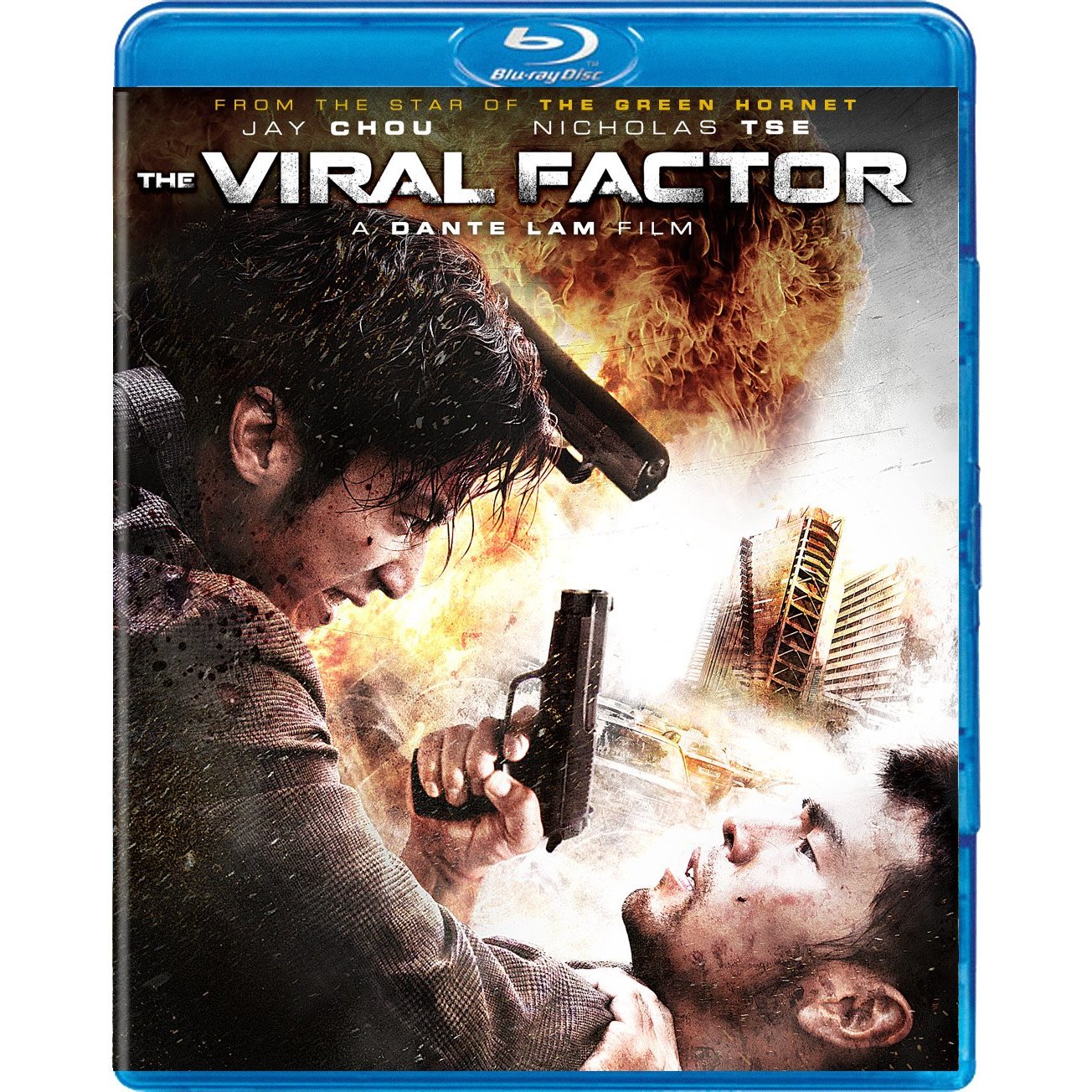
The Blu-ray case for The Viral Factor — an impressive, preposterous Hong Kong action offering available Aug. 28 — proudly boasts that the film comes "From the star of The Green Hornet", possibly marking the first and last time anyone has bragged about their involvement with The Green Hornet. (Don't look at me: I'm one of the few people who really enjoyed it.) Nevertheless, you shouldn't shy away from this one just because it may somewhat be selling itself short.

While escorting a criminal scientist from Jordan to Norway, International Security Affairs agent Jon (Jay Chou, Kato in The Green Hornet) and his team are ambushed. Unfortunately, a member of Jon's team is a traitor who puts a bullet in Jon's head, kidnaps the scientist, and threatens to unleash a deadly virus on the world. Doctors inform Jon that the bullet is lodged in his brain and he only has a few weeks until it causes complete paralysis. So far, I'm thinking we've got the ingredients for a pretty solid action flick. Jon has to race against time to get revenge against his traitorous colleague Sean (Andy Tien) and save the world before his body breaks down, right? Well, not exactly.

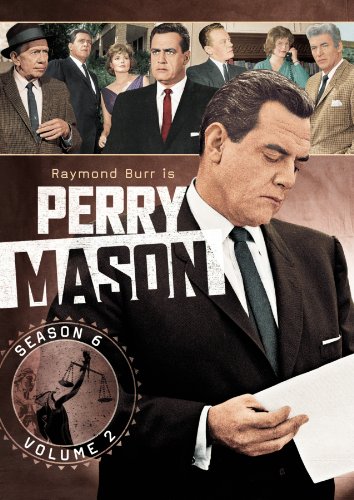
Erle Stanley Gardner wrote crime fiction, and while many of his 100 or so works are unknown to most of us, he created a character that has become as identified with criminal lawyers as any other in fiction. It was in these crime novels that Perry Mason first faced a courtroom. He developed a style where he would investigate these terrible crimes his clients were on trial for. He would find the real killer, and in what has become a Hollywood cliché, reveal his findings in a crucial moment during the trial. While we may not remember the novels, we all remember the man in the persona of Raymond Burr.  Burr had a commanding presence on our screens and enjoyed a well deserved 11-year run as the clever lawyer. What makes this run so amazing is that the show followed pretty much the same pattern the entire time. We always know what’s going to happen, but we wait eagerly for that gotcha moment when Perry faces the witness on the stand. We know when he’s got the guy squarely in his sights, and we can’t sit still waiting for him to pull the trigger. OK, so maybe that’s a little over the top, but so was Perry Mason. From the moment you heard that distinctive theme, the stage was set. To say that Perry Mason defined the lawyer show for decades would be an understatement. Folks like Matlock and shows like The Practice are strikingly similar to Perry Mason. If you haven’t checked this show out, this is your chance. See where it all began.

Raymond Burr did not carry the show on his own. There was a very fine cast of supporting characters. The most famous has to be his faithful secretary Della Street, played by Barbara Hale. The two were inseparable. Perry had the help of a good private investigator in the Raymond Chandler style. William Hopper played the tough-as-nails Paul Drake. One of Orson Welles’ famous Mercury Theater Players took on the part of Police Lt. Tragg. Ray Collins starred in Citizen Kane as the political party boss Gettys. He was a fine example of top talent working in television.  Mason was often pitted against prosecutor Hamilton Burger, whose name too often reminded me of hamburgers. There wasn’t anything funny about Burger, however. He was a worthy opponent who drew the short straw most of the time because he was up against Perry Mason. The task was accomplished with a lot of style by William Talman, a one-time evangelistic preacher.

The more I get into this review writing gig (I say this like I just started writing movie reviews last week when it’s been half a dozen years), the more I appreciate foreign films. I am no longer afraid of subtitles, culturally sensitive sub-plots, or the use of specific foreign mythological creatures as supporting characters. I am not even sure what I just said. Anyway, we have an interesting foreign film to review today entitled “Sin Yan” or more commonly known by the American title as Stool Pigeon.

We are in Hong Kong, manufacturing side of town. A couple of vans pull up along with a Jeep. Inside the Jeep is Inspector Don Lee (played by Nick Cheung) awaiting to make an arrest. Meanwhile, in a nearby warehouse we lay witness to a drug deal masterminded by mob boss Marco (played by Vincent Wan Yeung-Ming). Lee’s informant, Jabber (played by Liu Kai-chi) is on the inside and waits patiently for the police to make their move.

There are usually two schools of thought when it comes to judging sequels. One tends to be very harsh on the proceedings expecting it to surpass the original (which it hardly ever does) in all aspects of film-making. The other still expects a good film but realizes that this sort of thing is usually financially driven and just hopes for something that can favorable stand against the original. I happen to be in the later crowd. But, I certainly found myself inching towards the former when I received the blu-ray package to review Ip Man 2, Legend of the Grandmaster. Let's go inside, shall we?

Ip Man (played Donnie Yen)has escaped from Foshan and has made way with his family to the Hong Kong of the 1950's. His wife, Cheung Wing-Sing (played by Lynn Hung) is pregnant with her second child. However, the family is barely making ends meet. Cheung can't work much and Ip Man's martial arts school isn't going as well as planned. They can hardly cover rent and school fees for their son, Ip Chun (played by Li Chak).

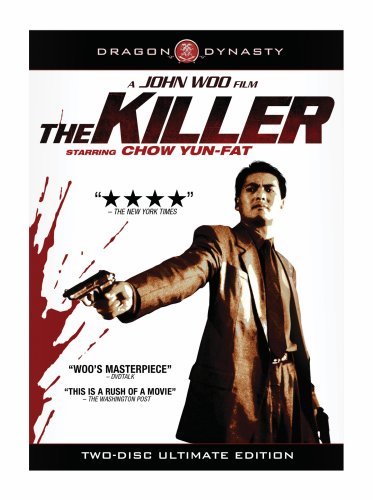
Having accidentally blinded a singer during a contract killing, hit man extraordinaire Chow Yun-Fat, consumed with guilt, becomes the woman's protector, and seeks redemption by finding some way to restore her sight. Meanwhile, Danny Lee is the plays-by-his-own-rules cop on his trail, and inevitably the two men will find themselves as unlikely allies in gigantically operatic gunfights.


I can remember when John Woo was still a name whispered with reverence by cult film fans, and his films were only available on grey market VHS or import laser disc. In fact, I first saw The Killer on one such disc, in Cantonese with Mandarin subtitles, reading a transcription of a translation, desperately trying to grasp the gist of the action. It was worth the effort, though, for I had never seen action sequences like these. Today, of course, the situation is very different. Woo's films are readily available, Hard-Boiled's sequel is a video game (Stranglehold), and his stylistic characteristics have become clichés. The passage of time and over-familiarity have arguably robbed the film of some of its power, while making the OTT sentimentality harder to take, but the fact remains that this is still a seminal moment in action filmmaking.

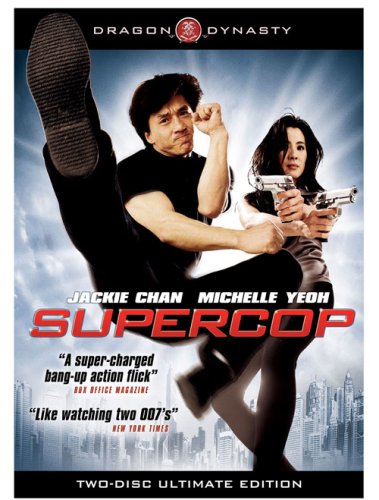
Supercop is really just the American title for the third entry in Jackie Chan’s very popular Police Story series in Hong Kong. For the first time in the franchise, Chan decided to go with an outside director, and he made a wise choice with newcomer Stanley Tong. Tong might have been a green director, but he had a natural feel for the abilities and strengths of his mega-star. The two would go on to collaborate on several more films after this rather remarkable first time pairing. It didn’t hurt that Tong not only had Jackie Chan to draw upon for the film, but he also had Chan’s Hong Kong film female equivalent with the talented Michelle Yeoh. Both stars are accomplished martial artists and perform nearly all of their stunts without the use of doubles. Tong’s task here was to allow his stars to “do their thing”, yet bring something new and fresh to the formula of Police Story, and to a certain degree all of the Jackie Chan films. He succeeded on all accounts, and Supercop is easily the best of the Chan Police Story films. The two would also team up for one of Chan’s most popular films, Rumble In The Bronx. While I’ve not seen anywhere near all of Chan’s Hong Kong outings, this is high and away the best that I’ve seen from that market.

Jackie Chan once again stars as police inspector Chan. When he overhears his superiors talking about a dangerous mission in need of a “supercop”, Chan volunteers for the task. Of course, he has to convince his girl that the month long job is going to be easy and safe, all the while giving her his life insurance policy and bank book records. Chan’s job is to pretend to break the infamous Panther (Wah) out of State custody and infiltrate the organization. He is briefed and trained by INTERPOL Inspector Jessica Yang (Yeoh). Once he’s ready the breakout commences, but the military guarding the prisoner aren’t in on the gag. After dodging bullets and missiles, Chan gets Panther safely away. Now the gang wants to meet with their contact in a local town that just so happens to be Chan’s cover story hometown. This is where his family is supposed to be. The only trouble is that Chan’s never been there before. INTERPOL sets up a fake group of family and friends, and it’s amusing to watch Chan try and fake his way about knowing these people when he’s not even sure who they are each even playing. Chan has a particular problem when he’s introduced to his “sister” played by Yang. The two follow the gang through various government operations to recapture him. Finally they’re in it for the meet and payoff, but Chan’s cover gets blown by a chance meeting with his girl, May (Cheung). Now it’s as much a matter of survival as of bringing down the bad guys.

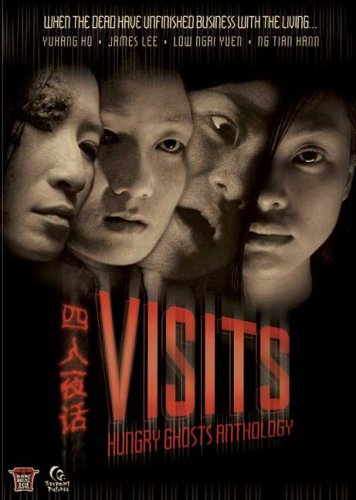
Visits – “an anthology of bone-chilling horror”? Well, it has its moments, I will say that. The most effective scenes are the ones that don’t call attention to the scare elements. Scenes that involve one or two little things out of the ordinary that don’t smack you in the face, but actually force a double-take in considering what it was you just saw – that’s when this quartet of horror tales is at its peak. Too many hack horror movies nowadays come pre-packaged for disaster, placing all their little synthetic jumps in the same places they’ve always put them, signifying to the audience, “It’s okay to be scared now.” What happened to films like Bob Clark’s original Black Christmas, where the director lays it all out and lets the audience use its brain to decide what is (and isn’t) scary?

I blame Carpenter’s Halloween, with its simple, creepy musical score, and its stunning musical “stabs.” Grant it, Halloween did this effectively. But that’s because Carpenter knew what the hell he was doing. Unfortunately, the imitators that came after did not.

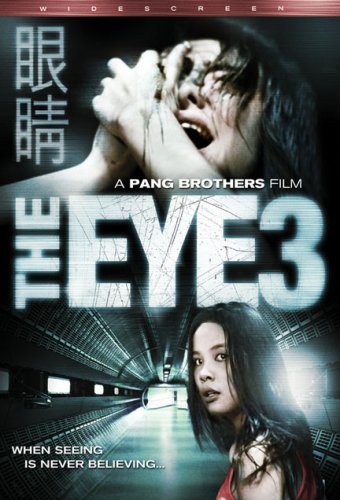
The Pang brothers return with one more instalment to their series of ghost tales. This one also goes under the title of The Eye 10 (and The Eye: Infinity), which is actually the more accurate nomenclature, given the sheer number of hauntings that are present here. A group of friends on vacation in Thailand regale each other with ghost stories. Their host then produces a book that lists the ten ways of seeing ghosts. The group, whose instinct for self-preservation could do with some strengthening, proceed to put the book to the test. They get far more than they bargained for.

In the making-of featurettes that accompany the film, the Pangs talk about how they had too many ideas to fit into the first two instalments of the franchise. So here they have a structure that allows them to pack in a cornucopia of summonings and hauntings. Some of the manifestations are undeniably effective, and there are some pretty decent jolts. On the other hand, the Pangs recycle some of their greatest hits, sometimes to deliberately humorous effect. The tone generally is much lighter than before, but the humour has a tendency to disrupt scenes that are building up a good head of terror. The film is thus a frustrating mixed bag, where flashes of the Pang brilliance are present, but there are also plenty of moments where the brothers seem to be just going through the motions, when they aren't taking the piss entirely.

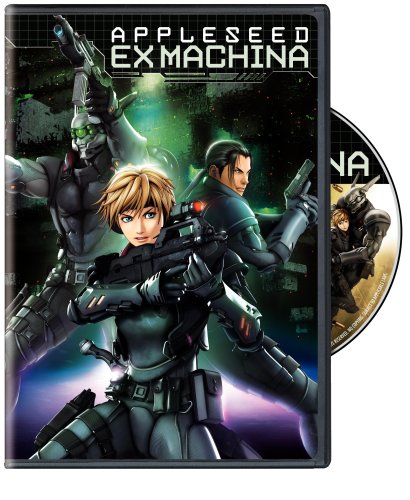
A question to ponder before we head into this review. What do you get when you mix anime or japanese animation with a healthy dose of John Woo? Besides a ton of falling gun shell casing and cute characters performing acrobatics in the air while taking down a dozen bad guys? You get a movie that goes full speed for over a hundred minutes and makes you realize that this is truly the perfect avenue for John Woo and style of films. However, just don't expect there to be a completely solid story behind it.

In the future, the world is annihilated by itself. However, out of the dust & debris, Olympus rises as a utopian society. The new society has a group of soldiers called the ESWAT (wasn't this a game for Sega Genesis? sorry, *turns off video game knowledge*). These warriors protect the peace and serve in the utopian society's best interest. The warriors consist of cyborgs and humans. Bioroids or genetically engineered humans serve as diplomatic leaders over ESWAT due to their calm and collective nature.