Posted in: Disc Reviews by Gino Sassani on April 28th, 2006
This is another one of those films that is best suited for the international film festival crowd. I’m not sure, however, if even that group will get this one. Jennifer Van Dyck gives one of the silliest and most wooden performances I’ve ever seen as a woman suddenly constrained by normal life. Under the influence of a messed up play director, she is encouraged to experience life through other eyes. Her use of profanity, sleep deprivation, and depravity are just not interesting to observe. I’ve had bouts of sleep de...rivation, and trust me, it’s not the sense-stimulating experience she writes about. It plays out like a poor art film student’s work. Not to be taken seriously at all. It won’t likely even show up at the local video chains . “You ain’t missing nothing.”
Video
Posted in: Disc Reviews by Gino Sassani on April 28th, 2006
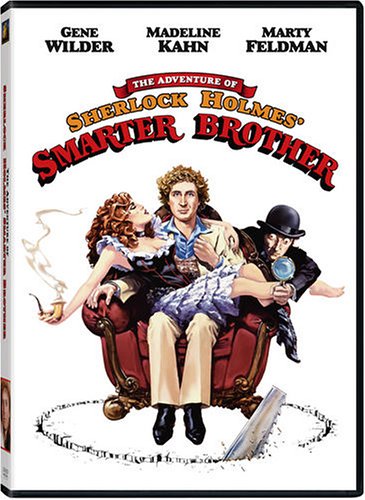
The Adventure of Sherlock Holmes’ Smarter Brother has everything that Young Frankenstein had except Mel Brooks (although he does make a very brief vocal cameo). With the combined comedic genius of Gene Wilder, Madeline Kahn, and Marty Feldman, how could this film go wrong? Like Young Frankenstein, Sir Arthur Conan Doyle’s Sherlock Holmes offers a rich classical mythology to mine for material. A wonderful supporting cast featuring the likes of Dom Deluise can’t miss, right? No so elementary, my dear Watson. Focus. ...hat’s the rub. I’m not referring to the work of the cameramen here. Gene Wilder appeared so sure of his own brilliance that he forgot to bring the story.
The game’s afoot, and it smells like it, too. Never before has so much talent been squandered on so little substance. I understand this is a farce, and I’m fully prepared for the absurd. I’m just not prepared to go nowhere. I was extremely disappointed at every turn. Toilet humor replaces wit. There are also no straight men. What’s Costello without Abbott? Everyone is so into trying to be funny no one offers to be the foil. Simply uninspired. The entire film makes one feel they are witness to one large in joke and we’re on the outside of the punch line. The musical numbers make the film all that much more intolerable.
Posted in: Disc Reviews by Gino Sassani on April 26th, 2006
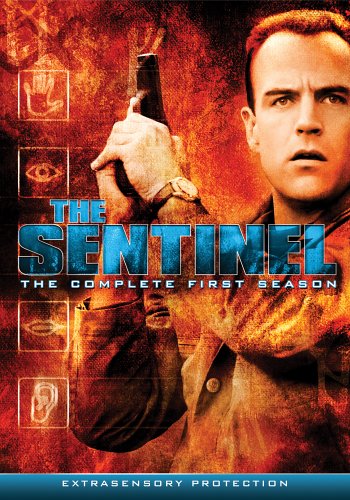
I must first admit that I never saw The Sentinel when it originally aired in the 90’s. I guess this one never made my radar. It’s basically a cop show with a somewhat sci-fi or maybe paranormal twist. It seems that Jim Ellison’s (Burgi)plane went down in the jungles of South America. While the crash killed his crew, he not only survived, but somehow obtained strange super powers. The idea is that this ancient jungle tribe develops a “sentinel” to be their guardian. For years Ellison protected the village before his...eventual rescue. Now he’s a cop with a certain advantage. Ellison has heightened hearing and vision. The rub is he can’t really control when or where it kicks in. As I watch the series, predictably the powers always kick in at just the right time. His other senses are also super-active, but sight and sound make for the most used power. Of course there has to be a team. Blair Sandburg (Maggart) is an anthropologist who studies Ellison. Captain Banks (Young) also contributes to the team This was an early UPN show. It should be noted that this series has nothing at all to do with the upcoming film with the same title.
Video
Posted in: Disc Reviews by David Annandale on April 26th, 2006
Synopsis
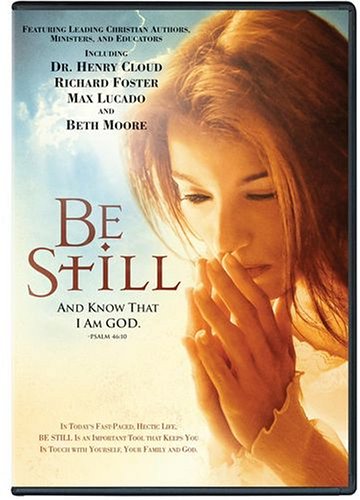
Not much to is. This is one larger film and a series of shorter ones (though they are all of a piece) extolling the virtues of contemplative prayer, which, it appears, consists in sitting quietly and listening to God, rather than speaking yourself. The whole thing drips in every “inspirational” cliché you can imagine (lots of shots of parks, clouds, sunsets, gentle spring rains, and so forth). Oddly, for a piece that’s supposed to help viewers practice being quiet, some of the speakers here ...re hardly advertisements for that fact. Priscilla Shirer, in particular, speaks in a Camille Paglia-style torrent of words, making one extremely doubtful that she has ever had a quiet moment in her life. But whatever. Those who like this sort of thing will surely like this sort of thing. Obviously, I’m utterly outside the demographic for this thing. For a chuckle, check out the consumer review on Amazon to see how this bit of flotsam can generate hugely polarized viewpoints. Hilarious.
Posted in: Disc Reviews by Gino Sassani on April 25th, 2006
Battle For The Planet Of The Apes was the last of the original Apes films. It has been far too frequently maligned. While I will admit that some of the high concepts are a little too undisguised, there was still some life left in the franchise. Of course, the novelty had worn off by now. It didn’t help that the films’ budgets kept falling as Fox was looking for cheaper ways to sell the same ideas. “Battle” was a violent film, but it was really a film about peace and the violent rite of passage often necessary to ac...ieve any long-term tranquility.
Roddy McDowell was, in fact, Planet Of The Apes. He appeared in four of the original films as well as the short-lived television series. The series was a victim not of its viewership, but rather a strong anti-violence movement aimed at the television industry at the time. While it was no more violent than most shows, it seemed to draw the most fire. Whether playing Cornelius in the first film, Caesar in the final two, or Galen in the series, McDowell had an uncanny ability to bring emotion and strength of character to the Apes make-up. He brought a realistic animation to a risky business. The Apes films might have easily become farces with laughable characters that no one took seriously enough to listen to the social commentary being offered. With the help of brilliant makeup artist Chambers, these characters were real. Paul Williams was a surprising cast choice. Better known for writing syrupy love songs, the singer did a fine job as the cynical brain trust, Virgil. Claude Akins brings the gruffness of gorilla Aldo exactly what it needs. The cast is pretty solid.
Posted in: Disc Reviews by Archive Authors on April 25th, 2006
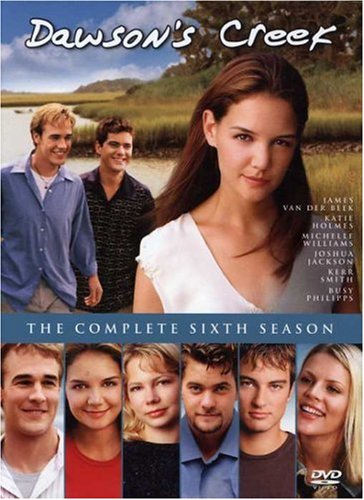
Dawson’s Creek follows the lives of Dawson Leery (James Van Der Beek) and his friends, as they struggle through their formative years and – in this final season – search for their places in the adult world. The first episode pulls a cruel tease in finally putting Joey (Katie Holmes) and Dawson together before the rug is pulled out from under their love affair the very next episode. Some might say it’s a decision from which the season never recovers – I say the show never had its footing to begin with. Plagued ...y writer and executive producer Kevin Williamson’s penchant for overwriting every single character, the two-hour finale has more laughable life affirmations that in no way resemble the ways that actual people talk than you can shake a stick at. His dialogue – and that attributed to other series scribes – revels in its own verbosity. No matter what the character’s intellectual playing field, he or she has something profound, deep, and flowery, to say; and such speech is usually followed by a self-congratulatory retort from another character – as if the writers are throwing out a line they think sounds terrific, and they’re so pleased with themselves, they must have the other conversational participant pat them on the back for thinking of it. I can’t tell you how many times you’ll hear things like, “So true”; “Well-put”; “I never thought of it that way”; “I couldn’t have said it better myself”; blah, blah, blah…
The final decisions for the two-hour finale are also terribly clichéd and can be seen coming from a mile away. Williamson drives one major character’s death into the ground so much that by the time he/she actually goes, you’ve lost all emotional attachment to the character, and are just thankful you don’t have to listen to one more weeping goodbye. On an unrelated note, the show heavily promotes the gay lifestyle. What your feelings are with regards to this are your own business, and as a free citizen, you have every right to them, but what Dawson’s Creek is guilty of is its refusal – along with the rest of popular entertainment – to feature positive characters opposed to the lifestyle. In this case, the show skirts the issue all together, with the exception of a moment where Jack (the primary gay character) refers to such thinking as living in “the Stone Age” – a relatively small potshot, but still a potshot. I’m not suggesting the gay characters be portrayed in a negative light – but it would be nice if the writers had a large enough understanding of the human race not to paint the opposition in such broad, generic strokes. Of course, if these writers had such ability, they wouldn’t be the pompous lit-class rejects they come across as in this show.
Posted in: Disc Reviews by Archive Authors on April 24th, 2006
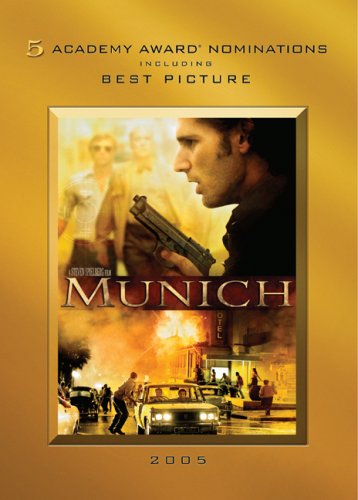
Steven Spielberg has always been a surefire type of director to go to if you want a high quality film. I was first introduced to Spielberg’s work via his groundbreaking film Jaws. Since then, Spielberg has continued to churn out hit after hit from 1993’s Schindler’s List which was awarded a Best Picture Oscar to his most recent film 2005’s Munich. Both of these particular films have gained numerous political and critical praise for the messages and raw power they both contained via the film’s int...nse imagery and story. I’ve always viewed Schindler’s List as my favorite film simply because of the impact the film had on me. After watching Spielberg’s latest masterpiece Munich, I can now say that the film is high up on my list nearly dethroning Schindler’s List.
Munich opens with the 1972 events that took place at the Munich Olympics where terrorists took hostages and killed them for the simple goal of wanting peace for their homeland. The event is re-enacted in near heart-stopping moments due the raw silent scenery that Spielberg creates. We then move to a room where we meet Israeli Prime Minister Golda Meir (Lynn Cohen) sitting with her cabinet. She utters the line “Forget peace for now.” We learn that Meir has decided to establish a secret Israeli revenge squad. What’s the goal of this squad? Why simply to kill the men who were responsible for these heinous attacks. The question that was eventually raised, long after the events in the film, was why kill these men? Men who will simply be replaced by more and more powerful and intense men who will want to do even more harm.
Posted in: Disc Reviews by Archive Authors on April 24th, 2006
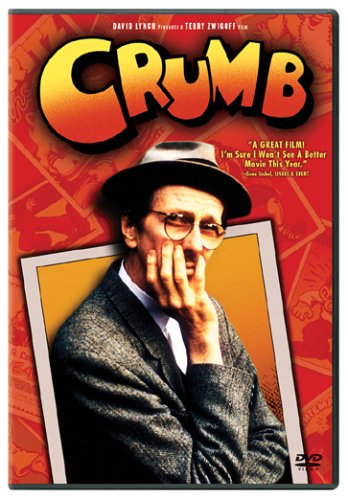
Say what you want about Robert Crumb, and his controversial cartoon funnies, but at least he’s found a healthy way of expressing not-so-healthy ideas – more than what can be said for his brothers, Maxon and Charles. Sony’s classic documentary Crumb (directed by Terry Zwigoff) demonstrates this in a beautifully ugly piece of filmmaking, now available in a new special edition to celebrate (albeit, a bit late) the film’s tenth anniversary. Maxon is the “molester” of the Crumb kids, and I say that hoping it’s an e...aggeration, but knowing somehow, deep-down, he’s probably been on his share of sex offender lists. Charles, if not for his appearance in this documentary (and role in Robert’s life), might as well not exist. He sits at home and bathes sporadically (but never often enough – you can almost smell the guy as he sits there with a pompous grin and green teeth), and he never leaves the house to get a job, seek out a slice of personal happiness, or add any value to society. The brothers of Robert Crumb are, indeed, losers, and the only things preventing Robert from sharing their fate is his talent for drawing, and for using said talent to carve out a better niche in life. Still, he, too, is guilty of hypocrisy, not necessarily in his work, but in his personal thoughts and opinions. He bemoans the commercial aspects of our society. He makes rushes to judgment about large groups of people, based solely on the kind of clothes they wear, yet his own views do little else besides espousing hostility towards women and presenting other races in unflattering lights (even if that isn’t his intended purpose). He can lay claim to all the liberal social ideas he wants, but if an African-American read his strip “Angelfood,” and had immediate access to Crumb’s throat, he or she would be ringing it emphatically (and would be just in so doing).
I am unsure of Zwigoff’s intentions in his presentation of Crumb – is this guy supposed to be a visionary artistic hero, or a mealy-mouthed little pervert with better ways of expressing it than Max? What I managed to draw from Crumb is that the case can be made for both. Make no mistake – I did not like this man. I’m more inclined to believe the pervert aspect of him than the hero. Still, I find his artistic style pleasing to the eye, and I enjoyed this examination of his work very much. He may not be a model citizen, and his move to France, which takes center stage in the final act, can only mean good things for our country, but he’s an interesting chap, and he makes for interesting viewing during the solid two-hour running time. I also found the extensive discussions among the three brothers very fitting to the film’s overall purpose – to dissect a legendary artist and his work. See, the brothers play such a huge part in shaping what this central figure becomes that, without them, there is no film – and subsequently, no Robert Crumb. Overall, this is a great piece of documentary filmmaking, which represents the difference between those that dream, and those that make their dreams come true. But the more obvious message – at least, to me – through the dichotomy of the Crumb siblings’ personalities, is how a degenerate doesn’t have to be a human slug, too. And that’s how Robert differs from his brothers.
Posted in: Disc Reviews by Archive Authors on April 22nd, 2006
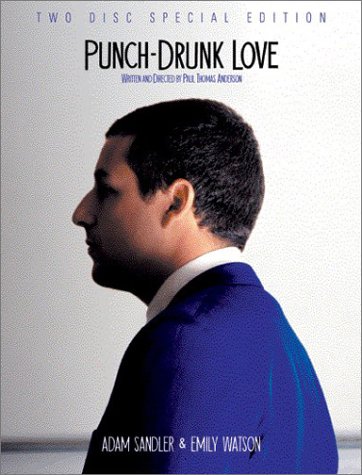
A critically acclaimed Adam Sandler film? I’d never would I have thought I’d see the day. I guess if The Truman Show is one of Jim Carrey’s dramatic stabs, then the star of Big Daddy can give a romantic comedy a try. Written and directed by Paul Thomas Anderson (Magnolia), using a story from the “Strange But True” category, combined with adding a touching tenderness to his characters, wrapped up with Sandler, playing a quiet, soft spoken man prone to fits of blind rage.
Sander is Barry ...gan, a novelty toilet plunger salesman with 7 sisters, who don’t hesitate in bullying him at every opportunity. Barry has times where he has periods of anger that cause him to destroy things, such as a sliding glass door at one of his sister’s houses. One morning, while at work, Barry discovers a harmonium that is left abandoned outside of the warehouse where he works. The harmonium becomes a metaphor for Barry’s pursuit to reclaim his life, as he periodically tries to play it through the film. Barry soon meets Lena (Emily Watson, Breaking the Waves) who drops her car off at the mechanic next to Barry’s office, but her intent is to meet him. Barry is attracted to Lena, and his awkwardness around her is cute to see, as if he’s a 13 year old trying to figure out what to do and say. Barry’s conflict in the movie is when he calls a phone sex company. He’s very awkward, and even confused, when talking with the girl on the other line. She decides to extort money from him, and enlists the help of Dean (Philip Seymour Hoffman, Capote), the owner of the company, and 3 crazed brothers.Through this, Barry is inspired by Lena, and when he finds out about a business trip she has to take to Hawaii, he takes advantage of a loophole in a Healthy Choice Promotional Campaign, which allows him to collect over 1 million frequent flyer miles from pudding purchases. He’s unable to redeem the miles in time, but he goes to meet her anyway.
Posted in: Disc Reviews by David Annandale on April 20th, 2006
Synopsis
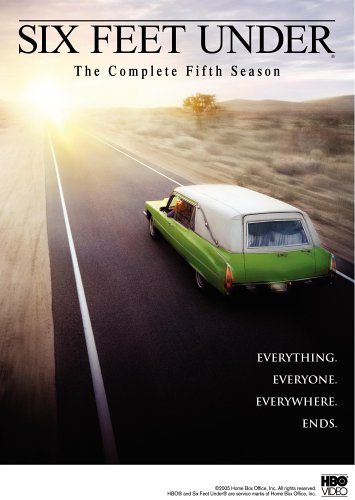
I’m late coming to this series about a fractious family and the funeral home they run. These are the first episodes I’ve ever seen, so I’m not going to pretend I have the faintest idea what’s going on here. All the various plot lines are clearly working to a conclusion, and for the benefit of those who know these characters, some of the things that are dealt with are James Cromwell’s depression and the difficulty in treating it, and the imminent arrival of a baby (which sets up the final epi...ode’s variation on the opening: instead of starting the show off with a death, it begins with a birth).