Dolby Digital 2.0 (English)

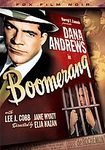
Small town Connecticut. A beloved priest is gunned down in the middle of a busy street, and the pressure is on for the police to find the killer. The new regime at city hall needs a conviction, and doesn't care too much about the niceties. When a suspect (Arthur Kennedy) is at last found, police chief Lee J. Cobb isn't entirely happy with the case, but he passes it on to DA Dana Andrews, who is under even more political pressure. At first pleased with the case, Andrews becomes uncertain the more he looks into it, and startles everyone (not least the defence attorney) by entering a plea of innocent at the beginning of the trial. Politicians and lynch mobs are soon baying at his door.

Elia Kazan's 1947 thriller is, as commentators Alain Silver and James Ursini point out, very much in the vein of the docu-noir. There is lots of procedural action going on here, and the voice-of-god narrator is frequently on hand to explain things to us. What is perhaps most interesting about the film, though, is that the case itself becomes of secondary importance to the political machinations. This isn't so much about the possible conviction of an innocent man, so much as it is about the mechanisms that make such a thing possible in the first place. Given what the future would hold for Kazan and his involvement with the HUAC hearings, the witch hunt scenes here take on additional, troubling, resonance.

James West (Conrad) was a Union Army vet. He’s the kind of act first think about it later kind of guy. Artemus Gordon (Ross) was a typical con man. He could create the most convincing disguises and was also a master of sleight of hand. Together they worked for the Secret Service in the days of the western frontier. The two of them were the prototype of the future spy. They would use incredible inventions and Bond-like gadgets, along with their own skills at trickery, to investigate major Federal crimes, often plots against the United States. Think of James Bond in the Wild West.


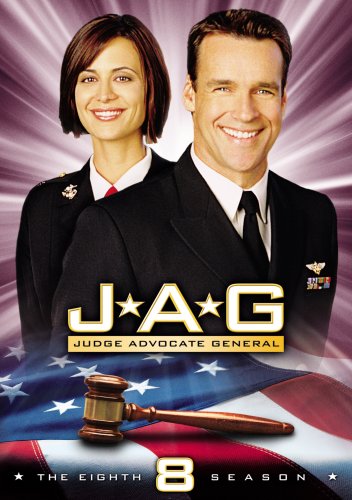
After 7 years JAG had pretty much settled in. It’s usually at this time that a show has to shake things up a bit or become somewhat stagnant. I think that JAG took the latter course. I have to believe that much of the creative talent was already working on the NCIS spin-off that was now 2 years away. The characters don’t appear to be taking any risks, and there is a little more of a return to the soap opera elements that began to fade away, making it a better show for some time.


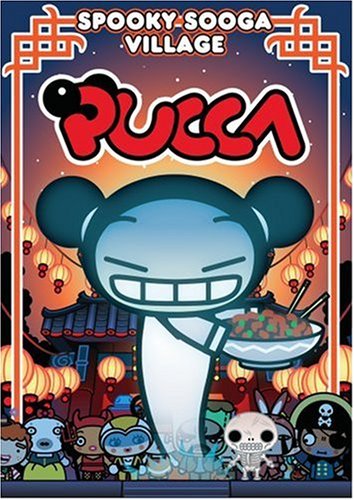
As I get older, I still find myself watching a lot of cartoons. New ones, blue ones, ones that I have no idea how they got made in the first place. So, with this practice I often run into cartoons that I have never seen but feel the need to give them a chance and see if they have any draw whether to kids, parents or me the cartoon nerd who enjoys such things. In my review pile, I stumbled upon one such cartoon and that was Pucca. From a critical eye, one might dismiss the odd characters and strange style rather quickly. However, to the careful eye one might find something a little more entertaining.


Pucca lives in Sooga Village. She is consumed by one thing and one thing only, the pursuit of love. Or more importantly the love of a silent ninja named Garu. Garu might run from her kisses but he can not deny the constant trappings of the kung fu queen. They each have a best friend. Pucca has Ching, a very cute and very happy girl who looks like a reject off the Powder Puff squad. The best friend of Garu is a Bruce Lee look-a-like named Abyo who manages to rip off his shirt every episode at the earliest convenience. Together they fight in a series of eleven episodes against various forces including Tobe, the deadly ninja who is trying to beat Garu at his own art.

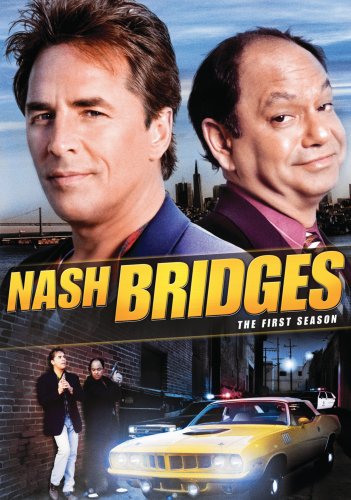
When Miami Vice finally left the air in 1989, Don Johnson was a very hot commodity indeed. He decided to try and parlay that success into a film career that never really brought him the breakout roles and fortunes he envisioned. Not too proud to return to his roots, he signed a deal with CBS that gave him pretty much a blank check to star in whatever kind of television series he wanted. It was a rare deal that forced CBS to air, or at least pay for, whatever Johnson came up with. Many of us were expecting pretty much a Miami Vice clone when it was announced he would once again be playing a cop. It was all sounding pretty familiar. Bridges was a super cool cop, this time from San Francisco with a rather tattered personal life. He was going to be teamed up with a partner, who wasn’t going to be a cop, but an investigator whose cases would cross paths with Bridges’. It was rumored that the partner might not survive the pilot, thereby killing the buddy cop routine that was beginning to sound very much like Johnson’s previous show. It appeared doomed to failure, and even CBS was at first looking to back out of the deal. They tried to buy Johnson off, but he was by now very excited about the new show and insisted he get his episodes. But how could this new show not be compared to the old? How could anyone have the kind of chemistry with Johnson that John Diehl had? On March 29, 1996 everyone held their collective breaths as Nash Bridges appeared on the scene. Cheech Marin ended up with tons more chemistry with Johnson, helped by the fact the two had been friends for over 25 years previous. In short order Nash Bridges had arrived, and television audiences everywhere found themselves saying: “Miami Who?”


My personal bias may be leaning through but I fully enjoy the Transformers. More than meets the eye, robots in disguise, Starscream for President! Well, he can’t be any worse than the two turkeys we got running right now. Anyhow, after the Generation 1 cartoon series came and gone, we got a slew of off-shoots and attempts at re-creating the cartoon hit that was the Transformers. In the middle of 2005, a series produced by a partnership between Hasbro and Takara came to the fold. It was a sequel to Transformers: Armada & Transformers: Energon. It was called Transformers: Cybertron. Fifty two episodes later, the series ended. Was it any good or did it just get sucked into a black hole?

The destruction of Unicron takes place in the Transformers universe and has resulted in the formation of a massive blackhole. This blackhole engulfs planets and Cybertron is the next inhabited planet in its path. Optimus Prime and his crew of Autobots decide to evacuate to Earth as they consider how to keep Cybertron safe. Landmine is the first Autobot to make it to Earth as he finds his way through a portal.

Standup comedians live interesting lives. The typical stand-up comic performs for fifteen to thirty minutes, two or three times a week. For many their sole purpose in life is to make people laugh. Many often suffer from depression when their acts bomb or they go through dry spells where they can’t get gigs or write new material. However, the best ones make their own breaks and find their way into their audience’s heart. Sometimes that can be accomplished through a MC. This MC or master of ceremonies can often take a grand event such as a tour that lasts 30 days & 30 nights and turn four men into superstars.

Vince Vaughn had a great idea. He would take four comics and tour thirty cities in thirty days from the Music Box Theater in Hollywood to the heartland of the United States. The four comedians would each be allowed their set. Among the four comics chosen was Ahmed Ahmed, a Middle Eastern comic who often uses his heritage to draw material for this act. He acted as the cornerstone for the other three comics.

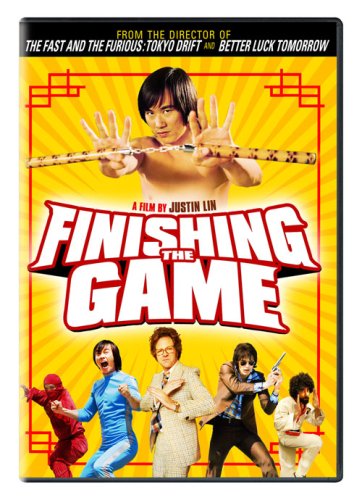
The day that Bruce Lee left us was truly a tragedy. The Game of Death was Lee’s pet project, the one where he could truly show off his skills for the world to see. He never finished it. Even though there was ninety minutes of footage, it was never completely restored to make a complete film. Instead, a mere eleven minutes and seven seconds was used in a 1978 movie called Game of Death. The plot was revised and every camera & stand-in trick was used in the book to finish the movie. The rest of the footage was either lost or found its way into the documentary, Bruce Lee: A Warrior’s Journey. One has to often wonder what the casting process behind casting a body double & stand-ins were like for somebody as unique as Bruce Lee. One also has to wonder how easy it would be to make fun of it.

On July 20th, 1973, Bruce Lee died suddenly at the age 32, leaving behind 12 minutes of footage intended for his dream project THE GAME OF DEATH. Director Ronney Kurtainbaum (played by Jake Sandvig) and casting director Eloise Gazdag (played by Meredith Scott Lynn) are on a mission to find the next Bruce Lee for the project or at least a reasonable facsimile. There are some strong candidates as well as many questionable ones for the film.

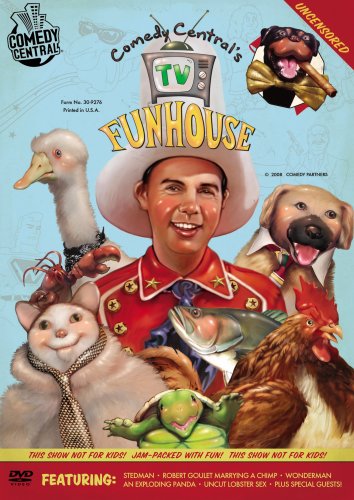
One doesn’t usually admit they love puppets. There are many vehicles for this love all over the entertainment world. On one hand, you have those who perform standup with puppets like Jeff Dunham. Then you have those crazy puppets who live down in Fraggle Rock. But one can not forget the fairly recent invention of one Triumph, the Insult Comic Dog. A dog, sporting a cigar who likes to insult & poop on things. The idea of Triumph did not come from the Conan O’Brien show so much but instead came from the mind of Robert Smigel. Comedy Central’s TV Funhouse was that show that gave the real inspiration or birth to the character. At least I know now who to drag into the street and shoot.

In the year 2000, a show premiered on Comedy Central called TV Funhouse. The show was created by Robert Smigel & Dino Stamatopoulos with Doug Dale as the host. Doug played host to the viewers at home with the atmosphere of Pee Wee’s Playhouse complete with an assortment of puppets. These puppets ranged from dogs & roosters to turtles & cats (and more). Every week had a theme from Western Day to Safari Day where Doug would try to present the show in that format until the animals turned into something far worse. The show lasted only eight episodes. Low ratings and disturbing content led to a pre-emptive exit.

Jim Phelps (Graves) led his team in a fourth season of Mission Impossible starting in 1969. The show continued its trademark traditions. Jim would receive a mission from the “self destructing” tape and would gather his IMF (Impossible Mission Force) team. The team was necessarily eclectic in nature, and it changed significantly in the fourth season. Still in the team we had Barney Collier, the gadget man, played by Greg Morris. The muscle was still supplied by Willy Armitage, played by brute Peter Lupus. Leonard Nimoy joined the team in season four as Paris, who also had a skill for disguise. He was a magician, so his sleight of hand skills came in … well, handy. Together they took on missions that the government could not be officially a part of. They were always admonished that should they be caught “the secretary would disavow any knowledge” of them.  Usually they were sent somewhere to put some evil mastermind out of business. Their tactics ranged from scams to outright theft. Sometimes they were a rescue team, while other times they would infiltrate a group of bad guys. There were certainly cold war elements to the whole thing. Each week the team concocted some convoluted con to play on their mark, walking away at the end of each episode often without getting any credit or congratulations.