Posted in: Disc Reviews by Gino Sassani on February 12th, 2009
"When you give up your dream, you die."
Posted in: Disc Reviews by Gino Sassani on December 31st, 2008
There are a ton of parallels between the Chris Farley/David Spade comedy team and that of John Belushi/Dan Aykroyd. Both teams began in the Saturday Night Live arena. It was that physical big/little guy combination that has its roots with Laurel and Hardy, and Abbott and Costello. Both teams were at the height of their careers when a drug overdose would claim the wilder member of the team. Both of the deceased comedians left behind at least one successful brother to carry on the name in show business. Tommy Boy was by far the best of the films this duo made before Farley’s tragic overdose in 1997.
Tommy Boy Callahan has been a screwup since he was a kid. It wasn’t looking much better as he matured into adulthood. After 7 years Tommy finally graduated college with a celebrated D+ grade. Now his father, Big Tom (Dennehy) wants Tommy Boy to come and take his place as the heir apparent in their auto parts manufacturing plant. Tommy’s best friend since childhood is Richard (Spade) who has been Big Tom’s right hand man all along. He feels cheated but is tasked with getting Tommy Boy ready to eventually run the company. Big Tom is also getting ready to marry a hot babe 20 years his junior, Beverly (Derek). At the wedding Big Tom suddenly dies, and now a group of con artists are trying to take control of his plant so that they can sell it to their biggest rival, Zalinksky (Aykroyd). Now it’s up to Tommy Boy and Richard to hit the road and sell a half million worth of brake pads to keep the company from defaulting to the bank, and falling into the hands of the con artists, who are working to place roadblocks in their way. Can they save the plant?
Posted in: Disc Reviews by Michael Durr on December 18th, 2008
Comedy movies can often bring together two or more separate groups of people. This can be groups among the races, culture, and even nations that have been feuding for years. It brings these groups a chance to laugh together, a chance to perhaps look over stereotypes and realize that people aren’t so different at all. You Don’t Mess With the Zohan while not meant to be taken seriously does bring together Israelis and Arabs into one picture. A picture where they can have a good time and hopefully everybody regardless of their race or creed can laugh right along with them.
Zohan Dvir (played by Adam Sandler) is loved in his nation of Israel. He is on vacation in Tel Aviv and is the attraction of every man and woman whether he is showing his Hacky Sack poweress or his bulging biceps. However, Zohan has a very important job, he is the top Mossad agent. His vacation is cut short when Israeli helicopters arrive and whisk away Zohan back to the base.
Posted in: Disc Reviews by Gino Sassani on November 18th, 2008
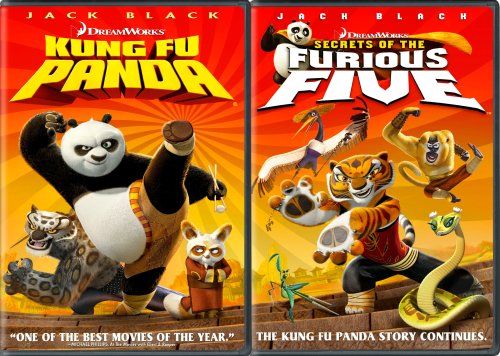
Jack Black stars as a Panda named Po who works in his family’s noodle shop. His dreams, however, aren’t of noodles and broth, but of Kung Fu. He fantasizes of hanging out with the famous furious five, the living legends of Kung Fu. The five are made up of the actual animal poses in Kung Fu. You have Tigress (Jolie), Crane (Cross), Monkey (Chan), Mantis (Rogen), and Viper (Liu). Together they have been training with the Master Shifu (Hoffman). Under the guidance of Grand Master Oogway (Duk Kim) they are preparing for one of them to take on the mantle of Dragon Warrior. Then they will inherit the sacred Dragon Scroll and be the great protector of Peace Valley. When Po learns that the time has come to select the Dragon Warrior, he just can’t miss being witness to such an awesome event. The palace is high on a great mountain, and Po tries all silly means of getting to the event. Finally, strapped to a fireworks propelled chair, he makes a grand entrance and finds himself selected as the Dragon Warrior. Much to the dismay of all gathered, Master Oogway insists that Po will become the great warrior needed to protect the Valley. Shifu must overcome his own doubts and work fast, because the imprisoned Tai Lung (McShane) has escaped from the world’s most secure prison. “One way in. One way out. One thousand guards and just one prisoner”Tai Lung. Tai Lung wants the dragon scroll for himself, and not even the Furious Five are able to stop him. Po must learn the “secret ingredient” that will give him the strength and courage to face up to this most ferocious of enemies.
The CG animation craze has no shortage of lovable and cute animals these days. It seems that the animal kingdom has become the greatest fodder for these family animated blockbuster films. Dreamworks might be in the lead with these kinds of efforts. They’ve given us bears, penguins, and lions among others. Now they deliver perhaps one of their better ideas in a lovable Kung Fu Panda. As much as anything else, you really have to give most of the credit for the film’s success to Jack Black and the wonderful voice cast that support him here. Honestly, the script is pretty simple, and like most children’s films it tends to be oversimplified and rather silly throughout. But give a cast like this an even average script and you can pretty much sit back and watch them go. Okay, maybe sit back and hear them go.
Posted in: Disc Reviews by David Annandale on September 5th, 2008
Denys Arcand’s conclusion to the loose trilogy whose first two parts were The Decline of the American Empire and The Barbarian Invasions takes place in a near-future Quebec of soulless bureaucracy and nonexistent human relations. Our hero (Marck Labrèche) is a civil servant with a wife whose job leaves no time for him, two iPod-dependent teenage daughters, and a giant suburban house that is not a home. He retreats from his dead-end life into a series of fantasies which see him as hero, shiek, rock star, celebrated novelist, and so on, always with women rushing to have sex with him.
There is sour diversion here, but this is not deep satire. The jokes are hardly fresh (smokers hiding from guards and dogs). Then there’s the attitude towards women. While one might argue that the fantasy figures are precisely that, and meant to reflect the character’s problems, not the director’s, the fact that the women in the real world of the film are a clutch of castrating harpies makes one suspect that the filmmaker is rather too sympathetic to his protagonist’s worldview. Of course, there is an absolutely terrific film dealing with a weak civil servant escaping into fantasy while labouring in a future society of absurd, Kafkaesque totalitarian bureaucracy. But it’s called Brazil.
Posted in: Disc Reviews by Michael Durr on August 20th, 2008
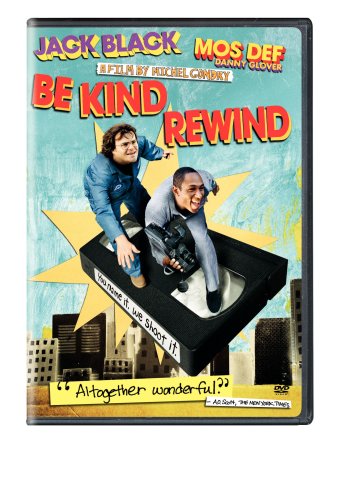
My earliest recollection of VCR’s was when I was just a little boy and my parents went down to the local TV shop and purchased a Zenith for about $600. At the time, it was a wondrous machine and I can still remember fondly my copies of Ghostbusters or Die Hard and how many times I would watch them. I didn’t care whether the tapes had a case or which edition of the tape I had. As long as it was the original movie and the tape wasn’t beat to heck I was a happy camper. Times change. I don’t think I own a single VHS tape that isn’t exercise related and my dvds, more than 400 of them are cataloged and cared for to the utmost degree. In truth, I sometimes miss the VHS days when things were simpler & films sold on the film alone, not on how many extras the dvd has or how fantastic the Dolby Digital 5.1 sound is. Be Kind Rewind goes back to that simpler time and gives a movie that is more about substance than the tiny snap case it comes contained in.
Fletcher (played by Danny Glover) owns a VHS rental store called Be Kind Rewind on a corner lot in Passaic, New Jersey. The place has history claiming that legendary jazz musician, Fats Waller was born in the very store. But business has been in decline and now town officials wish to demolish the building and replace it with a new complex. However, they give Fletcher the chance to bring the place up to code. Fletcher decides to research a more successful DVD store and see what makes it tick. He leaves the store in the hands of his best (and only) employee Mike (played by Mos Def). On the train, Fletcher leaves Mike one last note scribbled backwards on the glass that reads “Keep Jerry Out”. Mike can’t decipher the message as the train speeds away.
Posted in: Disc Reviews by Archive Authors on July 14th, 2008
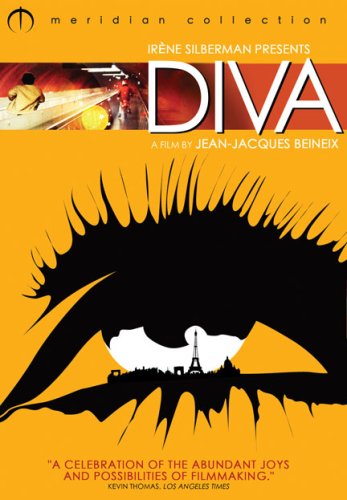
I don’t remember that much about Diva growing up; it was a film that I heard about as a kid, and a lot of people liked it, but that was the first time I can honestly say I was exposed to the arthouse film, and that it was something that I wanted to find out more about. Through the years, I’ve seen many a foreign or independent film, however the one that started all of it off for me I hadn’t seen, until now.
Diva was adapted from the Daniel Odier novel by Jean-Jacques Beineix, who previously directed a documentary version of The Diving Bell and the Butterfly long before Julian Schnabel put together a dramatic version of Jean-Dominique Bauby’s life. The story of Diva is a little complicated, but I’ll give it a go; a young messenger attends the concert of an opera singer, and creates a recording of the performance, which is a rarity for the singer, who normally frowns on recording her work. A line is said in the film along the lines of “art shapes itself around business, when business should actually shape itself around art.” A woman is murdered and drops a separate recording that is criminally linked to the police, and the tape winds up with the messenger. When the messenger, named Jules, is spotted recording the singer’s concert, they threaten him and demand to obtain the tape, so that it can be sold to the highest bidder. Unbeknownst to Jules, the participants of the other tape include a crooked police chief, who wants to try and get the other tape by any means necessary.
Posted in: Disc Reviews by Archive Authors on July 14th, 2008
It’s not that these fantasy-epic films that feature a young child in the starring roles bore me, it goes to the larger notion that Hollywood will remake every child’s fantasy novel into some sort of cinematic product, so a buck or two can be made. For every Harry Potter, there’s a Golden Compass or even Spiderwick Chronicles. The well is rapidly running dry, and you needn’t look much further than The Seeker: The Dark is Rising, a film about a young lonely boy who finds himself in circumstances and an adventure beyond what he might initially suspect. Wait, doesn’t that sound like EVERY children’s movie lately?
The novel was written by Susan Cooper and edited by John Hodge, who did Trainspotting, of all films, and was directed by David Cunningham (To End All Wars). In this, Will (Alexander Ludwig, Race to Witch Mountain) plays the youngest in a family of six Americans who have moved to London for their father’s job. He soon finds out about his real roots, continuing a lineage of warriors, protected by the old ones in Miss Greythorne (Frances Conroy, Six Feet Under) and Merriman Lyon (Ian McShane, Deadwood). No other performers from HBO television series were involved in the making of the production.
Posted in: Disc Reviews by Archive Authors on June 13th, 2008
Come on, admit it, you want to say that Hayden Christensen was the worst part if the latest trilogy of Star Wars films, and yeah, the guy did bring the suck, to be sure, but he wasn’t really that bad, right? Well yeah, he was, but he’s not the only thing wrong when it comes to Jumper, the latest film from writers David S. Goyer (The Dark Knight) and Jim Uhls (Fight Club), who adapted the Steven C. Gould novel. Directed by Doug Liman (The Bourne Identity), Jumper features Christensen as David Rice, a man who grows up with a genetic gift, the ability to ”jump” from place to place, Christensen’s performance was his first major role since transforming Darth Vader from an ominous, silently rueful and dominating presence, to a dude who thought his girl was cheating on him, so he started hanging out with a creepy old guy as a result.

David is unsure about his ability when he first discovers it but then starts to use it to his advantage, going to places ‘round the world, walking in and out of banks unnoticed, pretty much getting a chance to do whatever he wants. He leaves his Dad (Michael Rooker, Mallrats) early on in his life, and his mother (Diane Lane, Untraceable) had long since abandoned him, so the world is pretty much his oyster, right? Wrong. There’s a guy out there who captures and kills “jumpers,” a guy named Roland, played by Samuel L. Jackson with a grey wig, which, if I may, pretty much tells you it’s going to be a bad movie. Honestly, outside of a Quentin Tarantino movie, have you seen a really good movie that he’s in where he’s wearing some stupid hair prosthesis? Thank you. Soon, David finds someone else that can jump, a British guy named Griffin (Jamie Bell, King Kong), who, aside from telling David he’s not completely unique, also tells him that Roland is part of a group who hordes and kills jumpers named “Talismans,” so he’s generally got to watch his butt around them.
Posted in: Disc Reviews by Michael Durr on April 30th, 2008
A question to ponder before we head into this review. What do you get when you mix anime or japanese animation with a healthy dose of John Woo? Besides a ton of falling gun shell casing and cute characters performing acrobatics in the air while taking down a dozen bad guys? You get a movie that goes full speed for over a hundred minutes and makes you realize that this is truly the perfect avenue for John Woo and style of films. However, just don't expect there to be a completely solid story behind it.
In the future, the world is annihilated by itself. However, out of the dust & debris, Olympus rises as a utopian society. The new society has a group of soldiers called the ESWAT (wasn't this a game for Sega Genesis? sorry, *turns off video game knowledge*). These warriors protect the peace and serve in the utopian society's best interest. The warriors consist of cyborgs and humans. Bioroids or genetically engineered humans serve as diplomatic leaders over ESWAT due to their calm and collective nature.