Dolby Digital 5.1 (Cantonese)

Back around the time I was born, and Tom Cruise had an ounce of sanity, a little movie called Top Gun swept across the globe raking in over $350,000,000 worldwide, as well as sparking an interest in the US Navy and everything Tomcat, Skyhawk, and MiG related. Ever since its original release Top Gun has kept a hold on its audience, being played almost weekly, and now it makes its way into the world of high definition with its release on HD DVD.

For the few of you out there who don't know, Tom Cruise (Mission Impossible) plays Pete Mitchell better known to the rest of us as Maverick. He's young, cocky, and he pilots an F-14 Tomcat. His wingman Goose (Anthony Edwards, Zodiac) keeps him in check with a cool head, and is the more cautious of the two. After another pilot turns in his wings the two are given the opportunity to join the Top Gun fighter pilot school in which only the top 1% of fighter pilots are invited. Upon getting into the school Maverick believes himself to be the best there and borders on the line of being reckless, creating an enemy of fellow pilot Iceman (Val Kilmer, Heat). As the movie plays out Maverick falls in love, contemplates his lifestyle, looses people close to him, and faces death well trying to make it through the training. The movie pretty much wraps up in typical Hollywood style with a bow on it, but still manages to be a good watch.

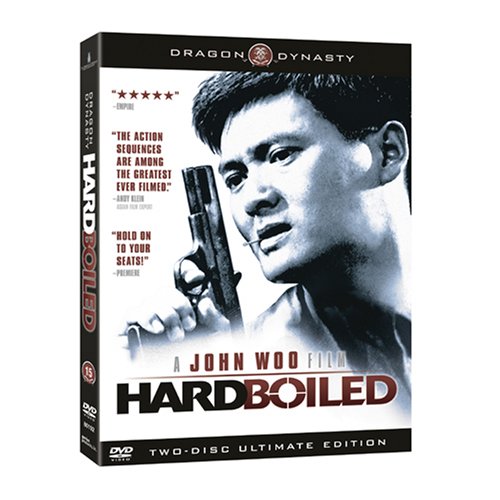
In the United States, we tend to take for granted; influences. In the case of movies, we take certain film styles for granted. We just figure that they always existed. Doesn't really matter where they came from, we just know we like that style of movie; over and over and over again. Enter Hard Boiled, a 1992 film directed by John Woo. This featured Chow Yun-Fat as Tequila, a hard nosed cop who is on a quest to derail an arms smuggling ring that has both cops and innocent civilians dead in its wake. The movie also featured Tony Leung as Alan, an undercover cop who is in deep cover as a Triad hitman who tries desperately to keep his sanity and protect his true identity. But what set Hard Boiled apart from other films and that was duplicated time and time again was over the top action and no-nonsense gunplay. In the first five minutes alone with the teahouse scene, you see more dead bodies fly across the screen than most action movies deliver in a couple of hours. But it wasn't just dead bodies, you can rent George Romero Dead movies if you want to see lifeless bodies. It was the style, you had the imagery of three guns emptying from the bottom of a birdcage, Tequila jumping in the air and killing two gangsters with a gun in each hand; and sliding down a staircase with such grace. This would continue in other scenes where similar heroics would come into play. For over two hours, your breath would escape you and somehow return by the final bell.

Hard Boiled was a film that made no apologies and has only amassed popularity as time goes on. The term cult classic would be more of an insult to the film as it has gone beyond that premise. In addition to two fine leading roles, the film included many popular supporting roles; primarily on the villains' side. Anthony Wong played the devious Johnny Wong, a character that had no morals and whose only real mission was to control the arms smuggling ring of China and get all the money in the process. Phillip Kwok (also known as Cheung Jue-Luh) played the role of Mad Dog (or One-Eye), the action counterpart to Wong's character as he enforced what Johnny didn't want to dirty his hands on. These characters developed a chemistry that produced memorable dialog with and without words. This was especially true when it came to the characters of Tequila and Alan once they get on-screen together. It was a flow of actions and reactions that had you enthralled for every last phrase that was used. The film's only negative would be the scenes where they decide to spend an inordinate amount of time surrounding getting the infants to safety. Once you dive into the extras on Disc Two, you start understanding that the babies actually were to be the main plot point or original concept of the film. So as a result they contributed to a major scene. The movie is still a masterpiece even with that small discordance with its amazing action and a hard running story that lead to be an influence of many future Asian and American action movies.

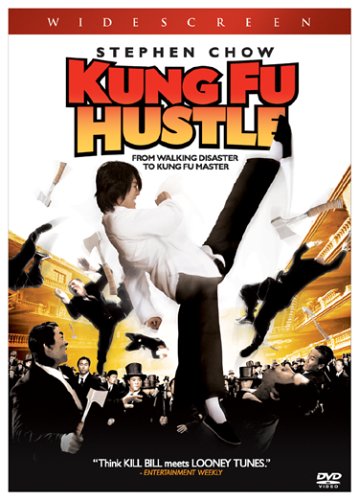
I am a big fan of Kung Fu on film, whether it be Bruce Lee’s Enter The Dragon or Jackie Chan’s Drunken Master I can't get enough. More specifically I love Asian Kung Fu cinema, the Sammo Hung's and the Sonny Chiba's. So I think it goes without saying that this isn’t the first time I’ve seen Kung Fu Hustle, and it certainty won’t be the last.

It’s the 1930’s in Shanghai and various gangs compete for territory, the most powerful being the deadly Axe Gang. The police are powerless and it seems the only people that can live without fears are the poor ones, who the gangs have no interest in. That is until things get shaken up by Sing (Stephen Chow, Shaolin Soccer) and his sidekick Bone (Lam Chi Chung, Shaolin Soccer). The two pose as Axe members in the tenement Pig Sty Alley, where they attract the attention of real gang members. Catastrophe is merely averted when three local tradesman the coolie, tailor, and baker showcase their kung fu talents and thwart an Axe gang attack.

Synopsis

Hot on the heels of the success of the Martin Scorsese film The Departed, I figured why not take a look back at the Hong Kong crime film that inspired it. Better yet, why not explore the trilogy that is the Infernal Affairs crime films, and how they hold up now. And I’ll try to minimize on the redundant stuff.

Synopsis

In the mid 90's, poachers are decimating the antelope population in the pristine lands of Kekexili. The locals have organized themselves to fight back, and now one of their patrolmen has been murdered by the poachers. Ga Yu, a journalist from Beijing, arrives to cover the story. Initially rejected by the leader of the mountain patrol, Ga Yu is taken in by the group when he suggests his coverage might help turn the area into a wilderness preserve. A long, grueling, dangerous manhunt ensues.>

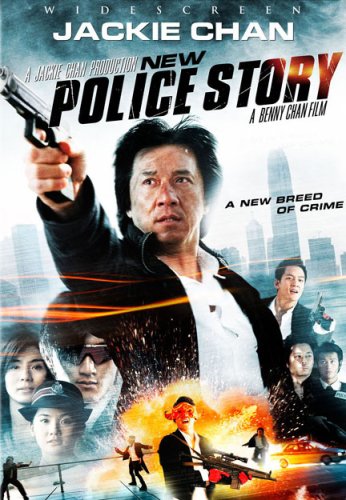
You might not know this, but there are two Jackie Chans. The original Chan was an intense martial artist. His films were quite serious and action packed. While humor was always an element to his style, these early films did not really capitalize on that element. The Asian productions were nearly a genre unto themselves. Still, international stardom was elusive to this talented actor.

The second Jackie Chan is the man most Americans are familiar with. Still a talented martial artist, these films show a lighter side to the actor. Chan has become a character of his own like any James Bond or Jack Ryan. Whatever the character he’s playing, what we’re paying to see is Jackie Chan. In these films, Chan allows his own disarming charm to be the creative force in the film. Humor is always served in generous proportions. At times he is almost the caricature of his former self.

Synopsis

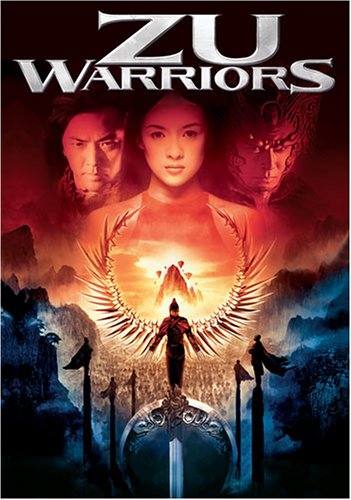
Above the Zu Mountain range, on floating peaks and the like, live various clans of immortals. They must unite to fight off the attack of a returning enemy: the dreaded demon Insomnia. The united efforts of the clans meet with plenty of problems, including star-crossed lovers, and humans from down below wind up being dragged into the battle, too.

Synopsis

In the 1930s, the dreaded Axe Gang is taking over all organized crime, terrorizing the city. One of the only places they don’t control is a slum complex ruled by a formidable landlady and her henpecked husband. Into this place come a couple of con artists, who pretend to be members of the Axe Gang. They set in motion an chain of events that leads to one apocalyptic battle after another, with ever more bizarre and powerful Grand Masters of Kung Fu turning to fight either for or against the Ax... Gang.

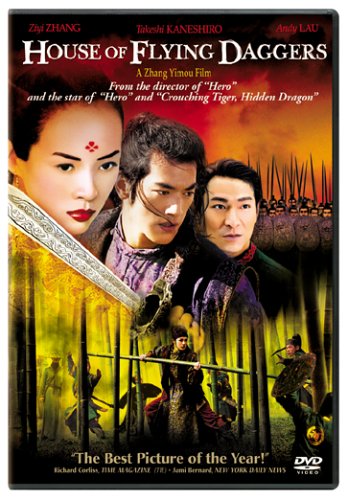
While House of Flying Daggers may be easy to pigeonhole as a movie similar to Zhang Yimou's own Hero or even Ang Lee's Crouching Tiger, Hidden Dragon, the only thing you could say about all three is that they have an impressive level of stuntwork that also, features the acting skills of Zhang Ziyi. But where Lee's work is more story based around three characters' feelings for one another, and Hero had some great stuntwork set against some breathtaking cinematography, House of Flying Dag...ers seems to trump them all.

Set in 9th century China, Mei (Ziyi) is a blind dancer in a brothel, who a policeman named Leo suspects can help find a rebel group called the House of Flying Daggers, who possess exceptional skills with small knives. Leo enlists the help of Jin to help free Mei from prison (after she attempted to kill Leo at the brothel) to help lure the government to the rebels. Along the way, he falls in love with Mei, and he does not want her to fulfill his mission, and will protect her at any cost. If you think any of these details divulge spoilers in any way, then you may not have seen the movie yet, as there are many twists and turns that keep you off-balance in the film, while enjoying the excellent fight sequences.

Synopsis

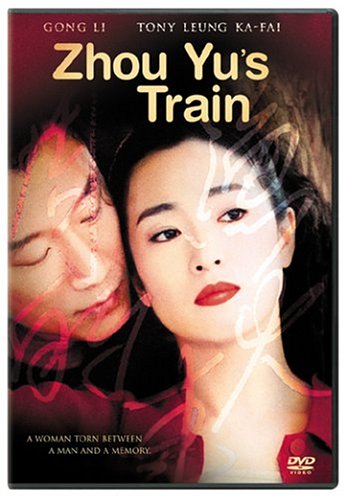
The storytelling is oblique in the extreme, but as near as I can discern it, the film tells the story of a young woman (Gong Li) who, after reading a collection of poems by Chen Ching (Tony Leung Ka-Fai) called Zhou Yu’s Train, attempts to imaginatively recover the experience of Zhou Yu (Gong Li again). Zhou Yu is an artisan who travels vast distances by train twice a week to keep up an increasingly troubled romance with Chen Ching. The other major figure is a veterinarian (Sun Hongle...), who also travels on that train, and wants to become more than a friend to Zhou Yu.