Posted in: Disc Reviews by Michael Durr on September 26th, 2007
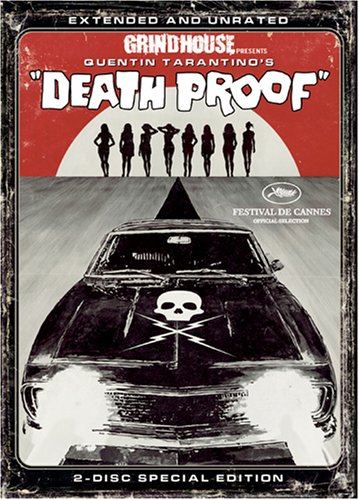
The style of "Grindhouse" films were something of a cult legend. More often than not, they were crazy over-the-top horror movies or action movies that had insane action that usually involved a body count that could rival an Arrrrrnold flic. These were referred to commonly as "B" flics due to the shoddy quality of the films. Video would be scratched up, missing reels were all over the place and audio would drop at the most inconvenient moment. More often than not they would be shown at some crusty drive-in for the change in your pocket. Fast forward to 2007 where Quentin Tarantino and Robert Rodriguez decided to resurrect the forgotten genre and brings us two movies (Death Proof and Planet Terror) to the screen.
The films unfortunately did not do so well at the box office. They were scrutinized for being too long (due to the Double Feature, the movie experience was roughly 4 hours) and many people just didn't get "it". When it came time for the two movies to be released on dvd, they decided to release them separately. Planet Terror would be released in mid-October and the focus of this review: Death Proof would be released in mid-September. I had the opportunity of picking it up at Best Buy with a special limited edition tin that included three discs rather than the standard two found in the other editions. Being the huge Kurt Russell fan, I leapt right in and paid at the counter.
Posted in: Disc Reviews by Archive Authors on March 17th, 2006
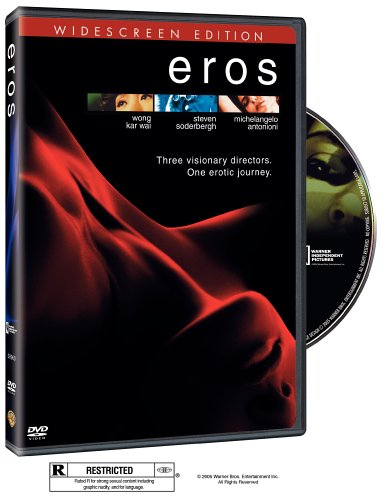
Anthology films are a good training ground for young filmmakers to flex their muscles and really get creative. However, with Eros, the three filmmakers have already been around the block a time or two, and on the surface, that could be considered a good thing. But when you consider what Michaelangelo Antonioni, Steven Soderbergh, and Kar-Wai Wong, are already capable of, these shorts seem a bit of a letdown. The best segment is Soderbergh’s “Equilibrium,” with its symbolic stylistic effects and wry sense of hu...or. It was the only one of these vignettes, which seemed neither cliché (“The Hand” – Kar-Wai) nor pointless (“The Dangerous Thread of Things” – Antonioni). In “Equilibrium,” Robert Downey Jr. plays a man caught up in an ambiguous dream world, who explains his situation to an eccentric psychiatrist (Alan Arkin). Arkin’s psychiatrist is a capable man, but he often uses his patients’ discussion time to do other less constructive things (i.e. stare out the window with binoculars, fly paper airplanes to the street below, etc.). The whole time, he is equally capable of dispensing advice and helping his patients get to the root of their issues. There are three color schemes in this segment (black-and-white; all blue, natural), all of which add artistic flare by making each portion a genre in and of itself. And in the blue portion (Downey’s recurring dream), the camera bobs slowly from side to side, giving an off-equilibrium effect, which is contrasted in the other two portions.
In “The Hand,” Kar-Wai proves himself a quality director, while the story of fading love and devotion rekindled for one final farewell lacks the intrigue of similar – and better executed – works. However, the performances by the two lead stars are solid. Unfortunately, even that perk is missing from the uninspired Antonioni contribution. “The Dangerous Thread of Things,” meanders about with all the importance of a porno (but without the excessive sex and nudity those, who might find such fare entertaining, are interested in seeing). It’s not a flattering introduction to the works of the great Italian director. As for storytelling, I’m not sure he even attempted to dabble in it here. Stick with Blow-Up, if you want a primer on Antonioni.
Posted in: Disc Reviews by David Annandale on December 9th, 2004
Synopsis
Posted in: Disc Reviews by David Annandale on April 12th, 2004
Synopsis
Posted in: Disc Reviews by David Annandale on February 17th, 2004
Synopsis
Posted in: Disc Reviews by Gino Sassani on April 8th, 2003
Synopsis
Posted in: Disc Reviews by Gino Sassani on April 8th, 2003
Synopsis