Dolby Digital 5.1 (Mandarin)

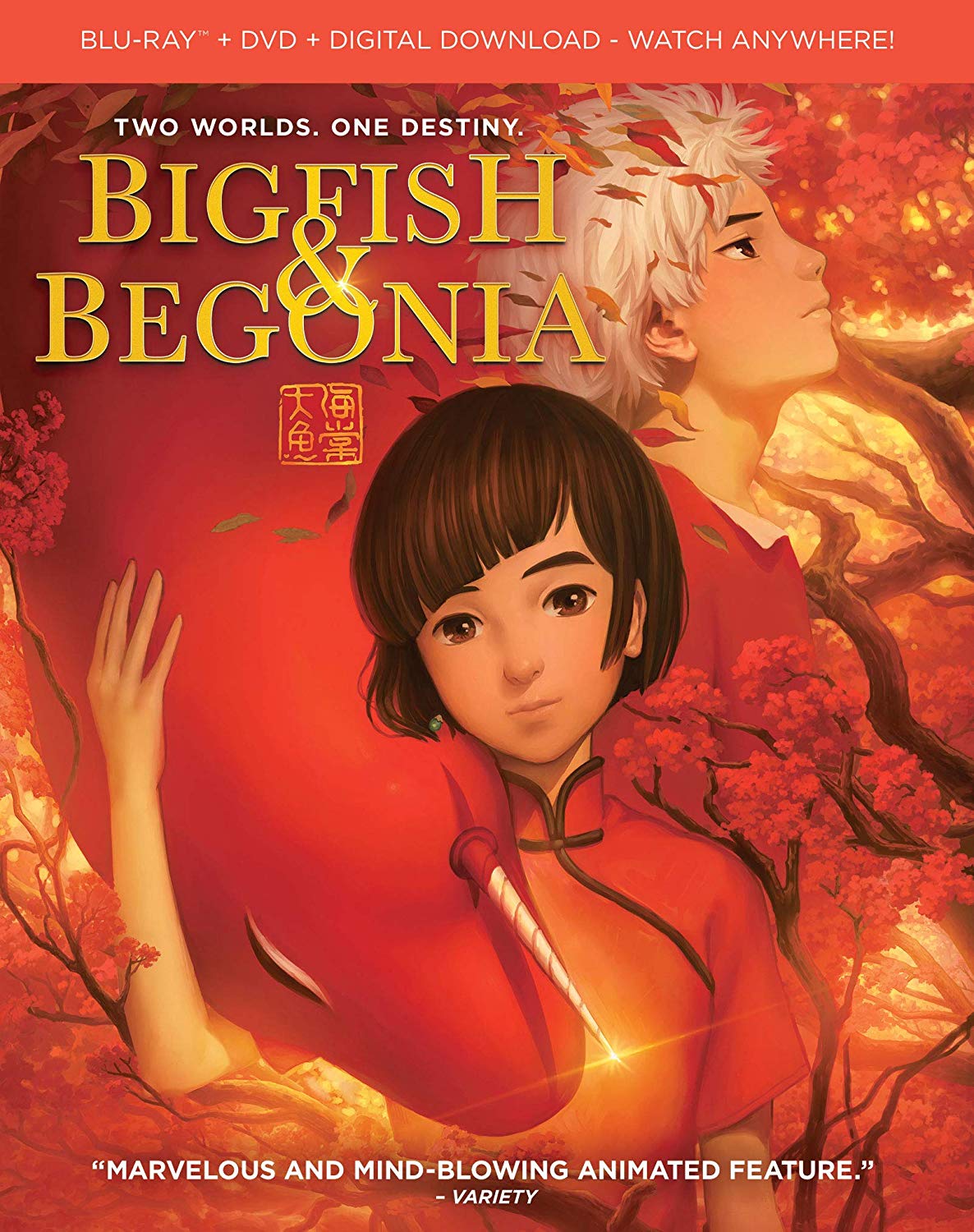
As some of you might know, I have a son, a three-year-old toddler. Since we live in the suburbs, we unfortunately don't get out as often as we like to places like the beach or any other places where we might be able to explore the animals and creatures that inhabit the wondrous ocean. As a result, we have a tendency to watch plenty of underwater nature documentaries or whichever Pixar animated Nemo or Dory show we can find. Today, we have for review an animated tale about creatures who can turn into beautiful red dolphins so they can be a part of the human world. Is the movie as beautiful as it seems, or much like the dolphins, is it something else in disguise?

"Some fish aren't meant to be caged. Because they belong to the sky." In the northern ocean, fish go by the name of Kun, because they are too large to measure. We listen to a narrator who is 117 years old explain the philosophy of life. We apparently are all just fish of the sea. Four and a half billion years ago, fish were the souls of human beings. At the end of the sea is a sky into the human world.

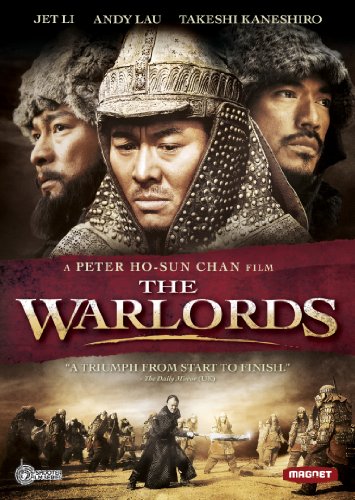
His troops defeated and massacred, General Pang (Jet Li) staggers away from the battlefield, more dead than alive. After a brief by intense overnight encounter with a mysterious Lian (Xu Jinglei), he falls in with bandits headed up by Er Hu (Andy Lau) and Wu Yang (Takeshi Kaneshiro). He finds a renewed purpose in life with this group, and forges the band into a formidable fighting force, one that will play an ever greater role in shaping the conflicts that are dividing China. But the fellowship he forms with his blood brothers has a fatal flaw: as fate would have it, Lian is promised to Er Hu. Betrayal and tragedy lurk in the wings.

First, the positives: this is a very handsome production, with a visual sweep that is appropriately epic. The battle scenes are expertly staged, whether these be small-scale skirmishes or grand campaigns. These are spectacular, exciting moments in the film. The characters and their story, however, are far less interesting. The love between Pang and Lian is difficult to empathize with – we don't really understand why these two are obsessed with each other, and must take it on faith that they are. All of which makes it difficult to care about the relationship, and thus its consequences are more irritating than tragic. And while Pang's internal conflicts are sometimes compelling, Lian's characterization is so perfunctory that she comes across as little more than venal, misogynist caricature. In the end, then, the film seems to drag on longer than its 113 minutes, as one finds one's eyes glazing over between the battle scenes. This is a beautiful movie, but an uninvolving one.

"The year is 208 AD. After 30 years of civil war, a deathly calm has fallen over northern China. One by one the rebel warlords have met their end under the sword of Prime Minister Cao Cao. Now even the Emperor bows before his power. Yet, from the south a challenge is heard. Two leaders rise against Cao Cao's tyranny. The aging Liu Bei and the inexperienced Sun Quam. So Cao Cao petitions the Emperor to brand these men as traitors and declare a new war against the peaceful southlands."

And so the stage is set for John Woo's enormous epic Red Cliff. The scale of this film is simply one that must been experienced to quite understand. It has the grandeur of any of the largest films in Hollywood's history. But this film is not a product of Hollywood. Woo filmed his massive triumph in his native China. You won't find a bigger story told with more elaborate sets or with such a legion of actors, required to bring these historic battles to life. Gladiator. Kingdom Of Heaven. The Ten Commandments. Red Cliff deserves to stand with the best of them, and it will.

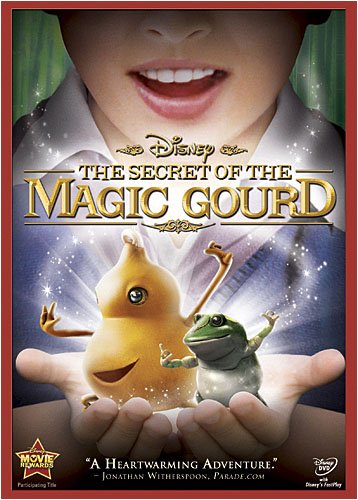
“The Magic Gourd has magical powers. He can carry you high up to the sky, right up to the clouds, where they feel just like cotton candy. Stick out your tongue and they taste like cotton candy. That’s the power of The Magic Gourd. If you become the Gourd’s master, he can grant you anything you wish for…”

Disney films have always had a world wide appeal. Children everywhere on the planet have grown up with the same classic images that we have in the United States. The language might not be the same, but the message and the magic has always been there to discover. So I guess it makes some sense that the studio might begin to do some international joint projects intended originally for children of another country and culture. Would the wide appeal translate in reverse? Could a film based on a Chinese story, made in China with Chinese actors, be able to bring the magic to American audiences as well? After watching The Secret Of The Magic Gourd, I don’t think I’ve found my answer, at least I hope not.

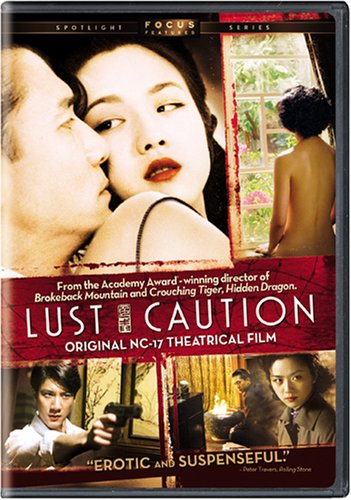
Tang Wei plays a student who is a member of a radical theatre troupe during the Sino-Japanese War. She and her cohorts determine to assassinate a prominent collaborator (Tony Leung). In order to get create the opportunity for the killing, our heroine must infiltrate Leung's household. She is on the threshold of becoming his mistress when he leaves Hong Kong for Shanghai. Three years later, now backed by the Resistance, she makes a new attempt. But she hasn't counted on the entanglements of passion in the affair she has embarked on.

Ang Lee's film was widely seen as both sumptuously beautiful but too leisurely for its own good, and there is something to that position. The story takes its sweet time, and the affair itself, along with its transgressive (by mainstream standards) sex scenes, doesn’t properly begin until over 90 minutes into the film. On the other hand, so much of the film is unspoken, left for the viewer to read between the lines (and Tony Leung is a master of conveying deeply repressed pain) that there is a lot going on, even when the images are still. And when the paroxysms of violence and sex do come, they are explosive.

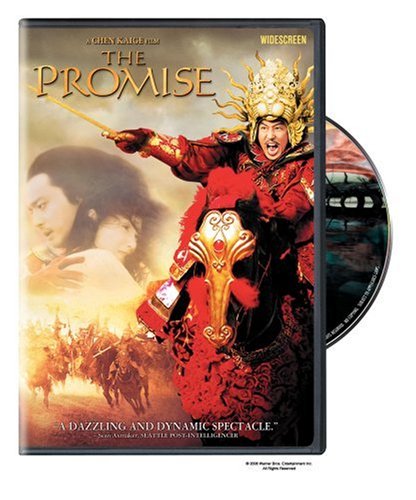
Retelling of classic tales has been a fodder for movie scripts for years. Take something that has worked for ages, spin it just so and you got a movie that might be gold. They have been doing this with Romeo & Juliet for years. The results can be great or sometimes they are one step of having the creator roll around in his grave with pain and anguish. Take Hamlet for example, the classic Shakespearian tale about a prince who takes revenge on his uncle Claudius who has murdered his father the King and taken the throne and the king's wife too. It has treachery, corruption and a little good ole fashioned incest to wet the palette. Now take that piece of journalistic tragedy and set it after the fall of the Tang Dynasty in China. Insert popular Asian actors like Ziyi Zhang & Daniel Wu and you might just have something.

Emperor Li (played by You Ge) has taken over the throne from his brother by murdering him. In the process, he has also taken the brother's wife Empress Wan (played by Ziyi Zhang) as his own for the good of the kingdom (and cause she's hot). An attack is also staged on the Prince, Wu Lan (played by Daniel Wu) who has devoted his life to the arts and is found at a nearby village of actors. After an elaborate fighting scene, he escapes with his life and makes his way to the castle to confront his step mother, the Empress (which we find out they shared romantic feelings toward each other) and expose his father's murderer, the Emperor.

On its surface, The Promise seems to have a good pedigree backing it up. You've got the guy who directed Farewell, My Concubine and the cinematographer of Crouching Tiger, Hidden Dragon, combining forces for a Chinese film that is epic in scope, similar to the Zhang Yimou films Hero and House of Flying Daggers.

The problem with The Promise is that the story rambles a bit, and the characters are ones that you don't care about. The stunts aren't even breathtaking either, as the visual effects are apparently done with wires and green screens, and can be made out so obviously, they lack the magic and wonder of the Yimou films, or even other films like Shaolin Soccer and Kung Fu Hustle.


Jet Li's Fearless is reportedly the star's final martial arts epic. Since we're talking about the guy who did Once Upon a Time in China, Twin Warriors and Hero, that fact alone makes this is a significant film for martial arts fans.

Fearless tells the story of Huo Yuanjia, who in 1910 helped found the Jin Wu Sports Federation (Chin Woo Athletic Association), the first civil Kung Fu organization in China. Li plays Yuanjia, who is a Chinese folk hero. The film follows Yuanjia's life from early childhood until his last days, showing his journey from a weak, little boy to a cocky, selfish bully, and finally to a respected martial arts master and Chinese patriot.

Synopsis

Hot on the heels of the success of the Martin Scorsese film The Departed, I figured why not take a look back at the Hong Kong crime film that inspired it. Better yet, why not explore the trilogy that is the Infernal Affairs crime films, and how they hold up now. And I’ll try to minimize on the redundant stuff.

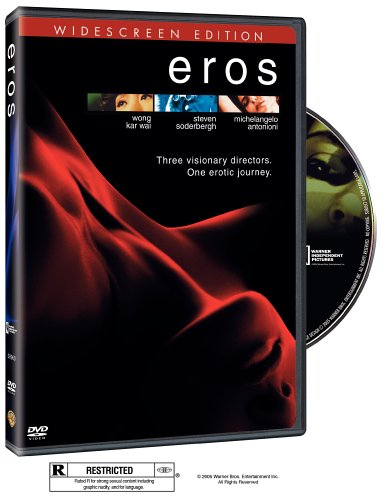
Anthology films are a good training ground for young filmmakers to flex their muscles and really get creative. However, with Eros, the three filmmakers have already been around the block a time or two, and on the surface, that could be considered a good thing. But when you consider what Michaelangelo Antonioni, Steven Soderbergh, and Kar-Wai Wong, are already capable of, these shorts seem a bit of a letdown. The best segment is Soderbergh’s “Equilibrium,” with its symbolic stylistic effects and wry sense of hu...or. It was the only one of these vignettes, which seemed neither cliché (“The Hand” – Kar-Wai) nor pointless (“The Dangerous Thread of Things” – Antonioni). In “Equilibrium,” Robert Downey Jr. plays a man caught up in an ambiguous dream world, who explains his situation to an eccentric psychiatrist (Alan Arkin). Arkin’s psychiatrist is a capable man, but he often uses his patients’ discussion time to do other less constructive things (i.e. stare out the window with binoculars, fly paper airplanes to the street below, etc.). The whole time, he is equally capable of dispensing advice and helping his patients get to the root of their issues. There are three color schemes in this segment (black-and-white; all blue, natural), all of which add artistic flare by making each portion a genre in and of itself. And in the blue portion (Downey’s recurring dream), the camera bobs slowly from side to side, giving an off-equilibrium effect, which is contrasted in the other two portions.

In “The Hand,” Kar-Wai proves himself a quality director, while the story of fading love and devotion rekindled for one final farewell lacks the intrigue of similar – and better executed – works. However, the performances by the two lead stars are solid. Unfortunately, even that perk is missing from the uninspired Antonioni contribution. “The Dangerous Thread of Things,” meanders about with all the importance of a porno (but without the excessive sex and nudity those, who might find such fare entertaining, are interested in seeing). It’s not a flattering introduction to the works of the great Italian director. As for storytelling, I’m not sure he even attempted to dabble in it here. Stick with Blow-Up, if you want a primer on Antonioni.