Posted in: Disc Reviews by David Annandale on March 10th, 2007
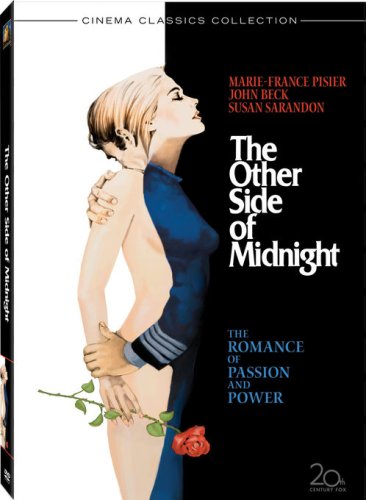
Terminally naive and beautiful Noelle Page (Marie-France Pisier) is abused and conned by every man she meets. In 1939 Paris, penniless and at the end of her tether, she meets American pilot Larry Douglas (John Beck, looking more like a 70s porn star than a 40s air force pilot). A great romance begins, but then duty calls him away. He promises to find her again in three weeks, but he never shows up. Noelle discovers that she is pregnant, and then finds out Larry is a terminal womanizer. She aborts herself with a wire hanger, and then, feeling she has nothing left to lose, slaughters all the young Jedi... I mean, she sleeps her way to movie stardom, hooks up with a Greek tycoon, obsessively tracks Larry’s life, including his marriage to PR executive Catherine Alexander (Susan Sarandon), and plots a dastardly revenge, a reigniting of the romance, and a murder. Busy girl!
As you might have inferred from the above, Noelle’s transformation from abused and abandoned waif to Queen of Darkness is no more convincing than a recent whiny brat’s transmogrification into the Lord of the Sith. In point of fact, NOTHING in this three-hour soap opera is the least bit convincing (right down to careless framing that permits a skyscraper completed in 1972 to be visible over Nazi-occupied Paris). But then, anyone expecting great art to be made from a Sidney Sheldon novel needs to see a therapist, and quickly. What we have here is trash of the absolutely highest order, and hence the four-star rating. Excessive, grotesque and unfailingly hilarious in a way only the 70s could produce, this is the cinematic equivalent of chowing down on a huge bowl of 100% deep fried, trans-fat munchies. Terrible for you, but delicious. And who can fail to love that title. What in the name of all that is holy does it MEAN?
Posted in: Disc Reviews by Archive Authors on March 7th, 2007
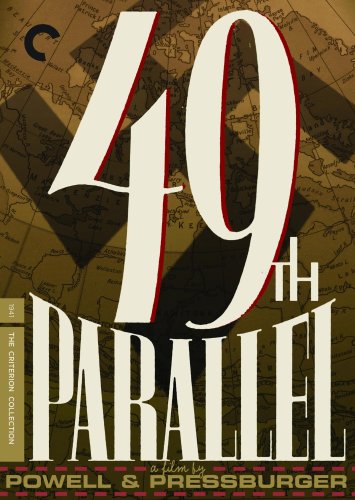
49th Parallel is a film that I had heard mentioned in passing on occasion, but never really had any practical knowledge of until now. Having now seen the film for myself, I find it to be one of those rare productions that only Criterion seems to be able to find. This is something that I would have never dreamed existed. While the idea of war films told from the Axis point of view are almost commonplace today, such a thing was practically unheard of in 1941, with the United States on the brink of entering World...War II themselves.
This is just part of what is notable about this film however. The truth is, the film stands on its own merit in any time frame. This is an epic feat of filmmaking that would qualify as a big budget project even today. The film follows the crew of a German U-boat as they make their way into Canadian waters. When they sink a Canadian tanker ship, the crew becomes the target of a massive manhunt. In an effort to evade capture, the crew take to land and move from hideout to hideout, eventually making their way to the United States.
Posted in: Disc Reviews by Gino Sassani on February 21st, 2007
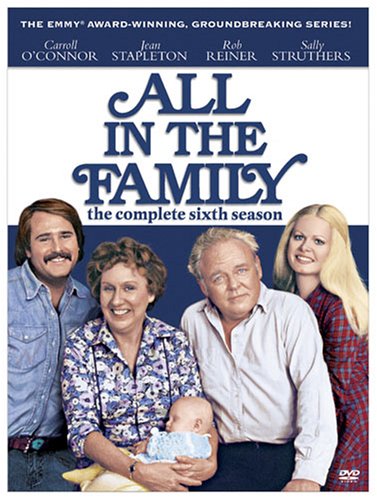
There were a lot of changes in store for the Bunkers in the sixth season. The Jeffersons, long a source of irritation for Archie and a ton of laughs for us, were moving on up to the East Side and that big de-lux apartment in the sky. Mike and Gloria finally move out of the house, but only as far as next door in the vacated Jefferson home. Most importantly, little baby Joey joins the family. For the 30 years since All In The Family, there is still speculation as to just how Carroll O' Connor was able to take such a bigoted, seemingly irredeemable character and make him loved by millions. We get perhaps the best insight into that mystery in year 6. In the now famous Joey's Baptism episode, we see just a glimpse of the Archie Bunker that O'Connor had been playing all along. Arguably the best episode of the series finds Archie worried about his grandson's soul when Mike and Gloria refuse to have the child baptized. Archie takes matters into his own hands, culminating in one of the most touching moments in television history. Archie Bunker is a complicated man, and nowhere has that been more evident. Season 6 is well worth your time. This was the peak of the show, and it would never again regain the ratings numbers enjoyed at this point.
Video
Posted in: Disc Reviews by David Annandale on February 16th, 2007
These are the other four films featuring Peter Lorre as the mysterious detective Mr. Moto. All but the first are from 1939.
1938's Mr. Moto’s Gamble began life as a Charlie Chan film, but difficulties with that franchise’s star (Warner Oland) led to Fox putting the Chan films on hiatus. Keye Luke, Chan’s Number One Son, is here anyway, as is plenty of footage shot for the Chan film. Luke and comic relief ex-boxer Slapsie Maxie Rosenbloom do their best to help Moto solve a case of murder in a boxing ring.
Posted in: Disc Reviews by Archive Authors on February 12th, 2007
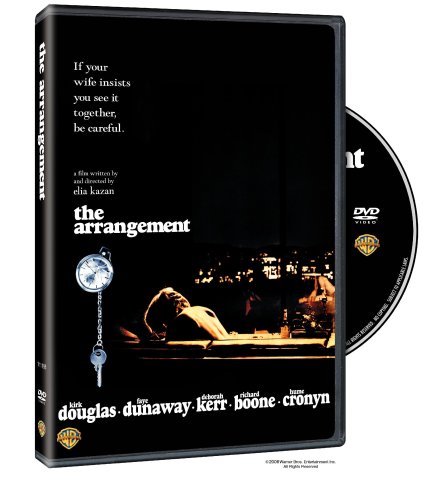
The Arrangement is a film that I had always heard the name of, but never really heard anything about. It's rare for a film to be directed by the author of the book that it is based on. In fact, I can't recall ever seeing that before. Upon watching the film, it is obvious to me how important it is for a director to have a clear understanding of the story he is trying to tell. Kazan knows this story inside and out, and even the slightest nuance of the least-important scene contributes to the story being told.
The arrangement tells the story of Eddie, a high-powered advertising executive who has a very unexpected midlife crisis within the first few minutes of the film. As viewers, we spend the rest of the movie examining his life, and slowly discovering what led him to this tumultuous point in his life. The film actually reminded me a lot of The Graduate, if Dustin Hoffman had been in this 40's. Here, Kirk Douglas plays the Benjamin Braddock role, with just a bit of Sybil thrown in for good measure.

Posted in: Disc Reviews by Archive Authors on February 12th, 2007
It's really hard for me to review films such as this one. On the one hand, I firmly believe in film preservation, and the importance of not shying away from history, no matter how painful it may be. On the other hand, it's difficult for me to enjoy a film that so casually deals with the trade of humans. Band of Angels tells the story of the daughter of a plantation owner who is sent away to school. Her father is a good and kind man, for he has never beaten his slaves. When he falls deathly ill, she rushes back...to the plantation to be by his side. Upon his arrival, she finds her father dead, and slave traders waiting for her. As it turns out, her mother, which she has never met, was a “negro”, which means that she is to be sold at market with the rest of the slaves.
Starting to see why I was so uncomfortable now? The thing is, I can see the noble intentions behind this film, originally released in 1957. Clearly, this is a film that means to convince audience members that slavery and racism are wrong. However, it's hard for me to hear that message when the dreaded “n” word is being thrown around so much. To be fair, the second half of the film is much more friendly for modern audiences, but I just can't say that I felt right about watching this thing. It's a shame too, because both Clark Gable and a very young Sidney Poitier have major roles which they handle quite well.
Posted in: Disc Reviews by Archive Authors on January 28th, 2007
The relationship between Richard Burton and Elizabeth Taylor appeared to blossom when they were both on the set of Cleopatra. The epic film was famous, not for the success of the film but more for the near bankruptcy of the studio and for the romance that blossomed between the two. Warner Brothers has recently been releasing groups of films surrounding various film icons, and this set of four titles focuses on the two acting giants.
The V.I.P.s was the first film after Cleopatra for both performers, and ironically enough they play a married couple on the downside of a marriage. Taylor plays Frances and Burton plays Paul, a wealthy businessman who treats Frances as more of a business chore than anything else, until one day Frances decides to leave Paul and for the waiting arms of Marc (Louis Jourdan, Octopussy). Marc is a gigolo but seems to have reformed for Frances. Frances and Marc are about to fly to New York until fog keeps them in, along with a few other notable individuals. Les (Rod Taylor, The Birds) is a rather convincing Australian businessman who is desperate to get to America to change a business deal that will save him financially, and his secretary Miss Mead (Maggie Smith, Clash of the Titans) will help him try to accomplish that. Max (Orson Welles, Touch of Evil) is trying to get out of England for tax purposes, and will even resort to marriage to try and do it. Margaret Rutherford (Blithe Spirit) won an Oscar in her role as the elderly Duchess.
Posted in: Disc Reviews by Archive Authors on January 21st, 2007
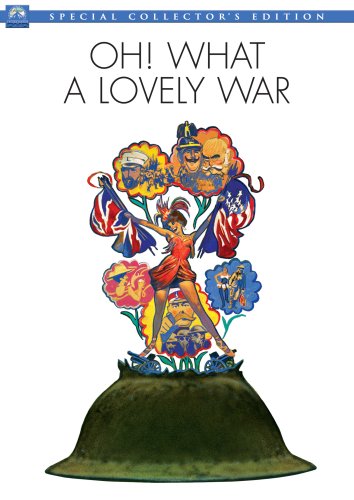
For all the talk about a film being "just as relevant now as when it was released", Oh! What a Lovely War seems to fit that bill more than a lot of movies I've seen recently. From a screenplay by Len Deighton and directed by a first-time director (but longtime actor) in Richard Attenborough (Jurassic Park), the film may be a daunting endeavor for some to see, probably because it's a film that's two and a half hours long and contains a lot of songs.
It also contains a lot of dialogue, and both the songs and dialogue were from the period. The world leaders that are involved during this time of crisis include President Poincaire (Ian Holm, Lord of the Rings), Count Leopold von Berchtold (Sir John Gielgud, Arthur), Emperor Franz Josef (Jack Hawkins, Bridge on the River Kwai), to name a few.
Posted in: Disc Reviews by David Annandale on January 18th, 2007
This is the second volume of Pluto cartoons, here going from 1947 to the end of the series in 1951. The neat thing about these themed collections in the Wald Disney Treasures series is that they highlight particular strengths in Disney’s animation. Thus, if the Silly Symphonies sets focus on the marriage of movement with music, the Pluto cartoons are wonders of pantomime, since the central character doesn’t speak. Pluto is not a jot less communicative for not using words, however, and the sight gags involved in some of his facial expressions (such as when wearing the unwanted “Pluto’s Sweater”) are priceless. Pluto’s frequent sidekick Figaro the cat has the spotlight to himself in three bonus cartoons.
Audio
Posted in: Disc Reviews by David Annandale on January 15th, 2007
Warner Bros. had the Looney Tunes and Merrie Melodies, Disney had the Silly Symphonies. This is the second volume collecting those shorts, covering the years 1929 to 1938. The shorts are selected on a menu that can be presented in alphabetical or chronological order, and it is the latter approach that is the most enlightening, as we can see the cartoons evolve. There is no dialogue in these shorts – the point was to fuse animation and music. And while that is an end in itself in the earlier cartoons (and quite the technological feat at that), more and more narrative content develops over the years. The culmination of this form of animation would, of course, be Fantasia, and in such early pieces as “Hell’s Bells,” one can see in embryonic form the ideas that would become, for instance, the “Night on Bald Mountain” segment.
Audio