Posted in: Disc Reviews by Archive Authors on July 4th, 2006
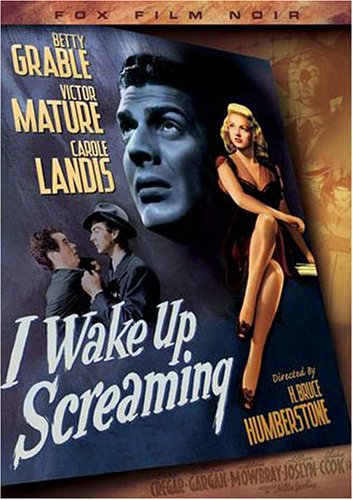
Fox has done a really great thing with their Fox Film Noir line. There are tons of great film noirs from the 40's and 50's, and Fox has done an excellent job of grabbing those classic films and presenting them in great new affordable editions for modern viewers to experience for the first time. I Wake Up Screaming is one of 18 films currently in the series, and I am sure that number will only continue to grow over time.
Betty Grable shows up here in a starring role that is a departure from her u...ual flirty faire. Here she plays a secretary, the sister of a murdered model. The film is told in flashbacks through the police interrogation process, as the investigation into who murdered this mysterious woman slowly unfolds. We discover that Grable's character has fallen in love with the prime suspect, and the more questions the police ask, the deeper the story goes. Plot twists, quick dialog and shady characters fill this film, and the whole sorted affair builds to a gutsy surprise ending.
Posted in: Disc Reviews by Archive Authors on July 1st, 2006
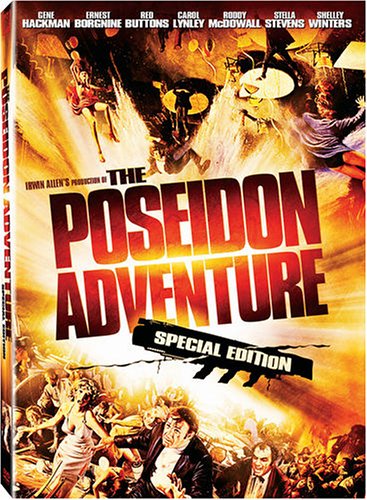
God bless producer Irwin Allen for aiming high in just about everything he did. He would make large scale productions, some focused on disasters (like his next film after this, The Towering Inferno), but he also produced Lost in Space for TV and made other contributions like Voyage to the Bottom of the Sea and an incarnation of The Lost World. He may not have had a DeMille-like grip on his project because the studios had so much control still in the early '70s, but he sure dreamt big, which is always a good thing.
In The Poseidon Adventure, based on the novel from Paul Gallico, the S.S. Poseidon has set sail and its cast and crew will be celebrating New Year's Eve on the water. When captain Leslie Nielsen (Airplane!) receives a notice about a tidal wave from an earthquake, he prepares for the worst. The wave hits the ship and turns it over, and it leaves a handful of passengers left to try and reach the water's surface before the ship sinks. Among those are Reverend Frank Scott (Gene Hackman, fresh off The French Connection), Mike and Linda Rongo (Ernest Borgnine (From Here to Eternity) and Stella Stevens (The Ballad of Cable Hogue), respectively), Belle and Manny Rosen (Shelly Winters, (Lolita) and Jack Albertson (Willy Wonka and the Chocolate Factory), respectively, Acres (Roddy MacDowall, Planet of the Apes) James Martin (Red Buttons, The Longest Day) and Susan Shelby (Pamela Sue Martin, Dynasty).
Posted in: Disc Reviews by Archive Authors on June 29th, 2006
Synopsis
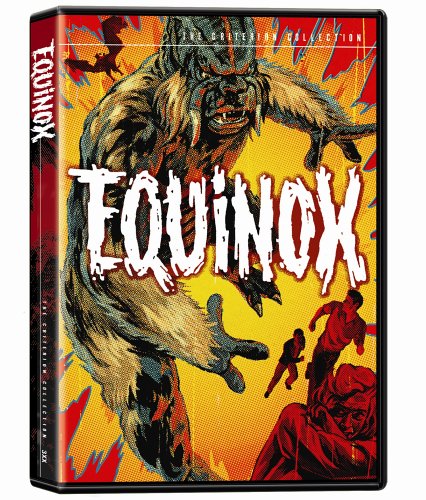
Four teens hit the wilderness, looking for a Professor Waterman (celebrated SF/fantasy/horror writer Fritz Leiber in a non-speaking role). The professor is missing, but they find an ancient time that turns out to provide the secrets of life, death, and the demons beyond. Said demons want the book back, and our heroes are attacked by one monster after another.
Posted in: Disc Reviews by Archive Authors on June 24th, 2006
War movies, in my opinion, are one of the rarities in film, where the most recent pics are usually the best ones. I need only cite films such as Full Metal Jacket, We Were Soldiers, and Saving Private Ryan to argue my cause effectively. But that doesn't mean all of the older ones were bad. Most were because they took more of a silly ra-ra viewpoint in relation to the reality of war. They didn't show the nasty details because, in many ways, they were recruiting tools. But Decision Before Dawn> was one earlier work, which took chances with its dramatization. This 1951 film refuses to jump on any bandwagons, instead telling a captivating, and sometimes tragic, story about a strange kind of hero... one that comes not from within our own ranks, but from those of our World War II enemies. In fact, the main character of Decision Before Dawn is a captured Nazi soldier, who makes the decision to spy for the U.S. army - not for freedom, but redemption.
It's no wonder a film such as this was nominated for the 1951 Best Picture - and it's also no surprise it didn't win. This type of subject matter has never been able to avoid controversy, and the Academy hates to honor controversy. However, director Anatole Litvak's handling of the George Howe novel Call It Treason makes for an exciting and tasteful motion picture that was sure to win over audiences - even in its time - with the tale of Lieutenant Rennick, a German POW, who has agreed to go back to his home country and betray his old side to the Allies. Tension builds as Litvak plays with the possibilities of trust. Neither the Allies nor the Nazis know what to think of Rennick, and for a time, neither do we. But as the film progresses, Rennick shows there may be more to his decision of assisting the Allies than simply the proverbial "get out of jail free" card. He's one well-drawn character at the center of an important motion picture, which dared to paint an uglier face on war, and call in to question the line between treason and heroism.
Posted in: Disc Reviews by Archive Authors on June 20th, 2006
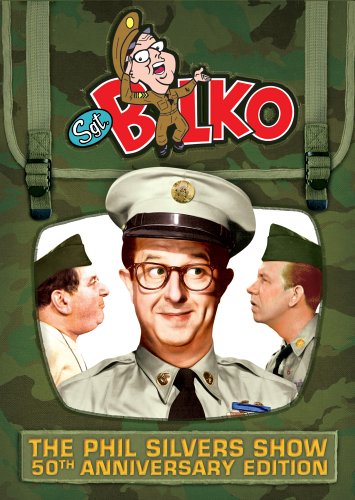
The Phil Silvers Show was groundbreaking for several reasons, but to look at the list of those who appeared on the show during its four season run is to look at a "Who's Who" of television ancestry and history. Allen Melvin played Sam the Butcher on The Brady Bunch, Harvey Lembeck previously appeared in Stalag 17 and his son Michael became an accomplished television director. Joe Ross played one half of the cop team in Car 54, Where Are You? next to a guest star of the show, a guy named Fred Gwynne, who also appeared in a show called The Munsters. Billy Sands went on to appear in McHale's Navy with a friend (and other Silvers show guest star named George Kennedy). Dick Van Dyke even showed up once in a blue moon.
Sometimes with projects like that, the stars in space seem to last longer than the television planet they orbit. But with The Phil Silvers Show and its star of the same name, there was an irreverent comic talent that not only was hilarious in his own right but helped to complement other members of the cast and giving them their chances to shine. Based around the fictional Ernie Bilko and the soldiers stationed on Fort Baxter, Bilko was sharp and a bit of a schemer, and his schemes involving other soldiers were the perfect vehicle to help Silvers offload some prime comedic moments to other actors. With Silvers and his co-creator Nat Hiken, the two managed to put together a show based on their sensibilities and wrote it the way they wanted to.
Posted in: Disc Reviews by Archive Authors on June 11th, 2006
OK, I hope I'm not diving into a review that may fall into the "film scholar" category, and thus rule me out of being taken seriously. When there's a lull in buying new releases, sometimes my wallet gets cabin fever, and so I went out and picked up the Hitchcock set from Criterion, entitled Wrong Men and Notorious Women: Five Hitchcock Thrillers 1935-1946, and includes the previous Criterion releases from Hitchcock, namely Rebecca, Notorious, Spellbound and The Lady Vanishes. I'm tackling the earliest release of the bunch, entitled The 39 Steps. The story very much resembles another of Hitchcock's later works, North by Northwest, in the aspect that the wrong man is thrown into a spy chase. While Cary Grant is taken through New York, a cornfield, and Mount Rushmore in the later film, in The 39 Steps, Richard Hannay, played by Robert Donat, attends a Music Hall production, meets and takes home a women (Annabella Smith, played by Lucie Mannheim), who he later finds out is a spy who is being chased by two men attempting to kill her. In the middle of the night, Annabella comes into Richard's room, and falls over him, dead of a knife in the back. As the police chase him, looking to detain him for the murder, the two men, assuming that Richard has found out about the secret she held, start to pursue him in order to kill him. And whatever he does, some of Anabella's last words to him are not to trust a man missing the tip of his right pinkie (It sounds strange to write the word "pinkie" in a review of Hitchcock, so I hope it looks out of place as you're reading it).

This was one of Hitchcock's last works before coming over to America to wow us with the movies that have become legend. For all of my DVD collecting, I'm still a bit green when it comes to the older stuff. And after seeing The 39 Steps, I now realize what I've been missing. For its time, it's a pretty suspenseful film, with a lot of shots that are still used in movies today, and even the story has been used in some fashion or another over the years, though clearly not to the same effectiveness that Hitchcock has done. Despite the "Born On" date for this film, it's a very good one, and to see many of the same devices used today, both within the story and within Hitchcock's technical realm, make it an easy recommendation to those who are even casual film fans.
Posted in: Disc Reviews by Archive Authors on June 9th, 2006
Limitations of budget and social conventions of the time prevent Murder, Inc. from being all it can be - still, the performances, and the captivating dynamic between hero (Stuart Whitman) and villain (Peter Falk) result in entertaining fare, so long as this film is allowed to be a movie and not a documentary. Whitman leads a fine cast as the mob lackey, who is constantly manipulated by a tough-talking contract killer. Part of the real life syndicate of hit-men "Murder, Inc.," Falk's baddie steals every ...cene he's in throughout this early career-making performance. He smacks of a young Brando, and comes across as just the type of ice-blooded villain, which gave the 1930's Brownsville mob its infamy. He'll lie, cheat, and steal, to get what he wants - whether it be conning Whitman's assistance to off a stale nightclub comedian (Morey Amsterdam), or brutally raping Whitman's wife (May Britt). And by "brutally," I mean "brutally for the times." The word "rape" is never used, and the explicit nature never goes beyond an aftermath scene, where a disheveled Britt anguishes, "Those filthy hands. Those dirty fingers."
A film like this could be revisited to great effect by a capable director like Scorcese. In fact, stylistically, Murder, Inc. shares many attributes with Scorcese's superior mob epics. It's the kind of film that influences better filmmakers to make better pictures - but I would only use the word "classic" to describe its age, and not its quality. For one, the narration is totally out of place, and - quite obviously - the result of a receding budget. The first bit of narration doesn't come into play until we're past the first act. And when it does finally appear, all we hear is a droll voice with zero personality. We only learn later the narrator is a character in the film - the heroic cop (Henry Morgan), who takes on the entire mob organization. Rather than give the film a documentary effect, the narration serves only to clumsily fill in cracks, where story should be. "Show, don't tell," this isn't. Another weak point is how the best element is often neglected - the Whitman-versus-Falk conflict with Britt caught in between. It seems like every time this story element gets rolling, we cut away to a less interesting sidebar. And when the angle is finally resolved, it happens with such anti-climax that we wonder why we even cared at all.
Posted in: Disc Reviews by Archive Authors on June 4th, 2006
Synopsis
Henry Fonda plays Colin Spence, a diffident, self-effacing Canadian (but of course!) corporal in the British infantry based in Tunisia. Led by the crusty but supremely competent Sergeant Kelly (Irish of course), Spence’s squad is sent out on a recon mission that goes badly awry, and the men are forced to engage in a terrible trek across the burning desert. Spence is forced to assume a leadership role, and along the way has flashbacks to his relationship with Maureen O’Hara, and how his unwil...ingness to take a risk or fight might have wrecked his chances with her.
Posted in: Disc Reviews by Gino Sassani on June 2nd, 2006
Monte Hellman filmed Back Door To Hell back to back with his better known Flight To Fury. This early Jack Nicholson film plays out very much like the throwaway it seems to have been. It’s certainly a brief affair, clocking in at just 69 minutes. Low budget films can often be impressive masterpieces. I have never seen a war film where that’s been true. After watching Back Door To Hell, nothing’s changed. The location and supporting cast make this at times feel more like Mexico than the Philippines. The settings are strictly back lot looking affairs, even when they are not. Cinematography is very limited and completely unimaginative. There is an odd, cold calmness to everything. Actors deliver their lines mostly in even soft tones. I found these portrayals more than a little unnerving. None of Nicholson’s future brilliance is on display here. I found my attention constantly straying during this film. One thing a war film should never be? Good or bad, it simply can’t afford to be boring.
Video
Posted in: Disc Reviews by Gino Sassani on May 31st, 2006
Yellow Sky is one of those near classic Westerns from 1949. For decades the film has flown under the mainstream radar, only to finally be rediscovered on DVD. Gregory Peck is an unlikely choice to play the lead role. Stretch heads a band of thieves that strike from town to town hitting usually banks. The film wastes very little time getting started. We see the gang set up, and soon pull off, one of these heists in the first five minutes. The gang is quickly chased out into the unforgiving desert sun of the Western badlands. It seems the band is done for in true western poetic justice until fortune once again smiles upon them. Fortune in this case is the ghost town of Yellow Sky. Here only an old prospector (Barton) and his young granddaughter (Baxter) reside. It seems the old man’s been hording some gold in the hopes of bringing Yellow Sky back to her glory days. Of course, Stretch’s gang has other plans. The remainder of the film slows down as the gang attempts to pry the gold from the old timer. Stretch has a change of heart, and this redeemed Stretch is less of a stretch for Peck. Here he begins to fit the part. Including the obligatory romance, the film becomes all too predictable. Harry Morgan, billed as Henry Morgan, makes a nice addition to the gang of outlaws. The film was remade in 1967 as The Jackals with the action moved to Africa.
Video